





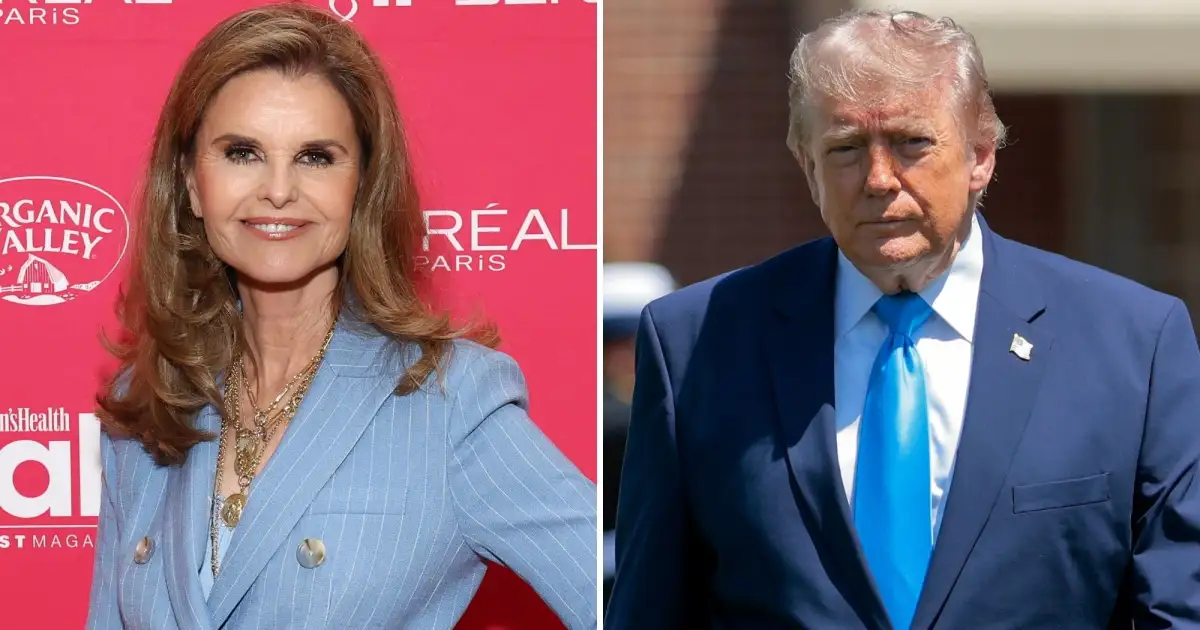
The intersection of personal family history and national legacy collided in a moment of profound emotional relief for Maria Shriver on a day already thick with ancestral memory. It was Friday, May 29, the date that would have marked the 109th birthday of her maternal uncle, President John F. Kennedy—a leader whose idealized legacy of hope, youthful vigor, and cultural patronship still casts a long, poetic shadow over the American consciousness. Shriver, now 70, took to the digital public square of Threads to share what she warmly characterized as an unexpected but deeply appropriate birthday present: a federal judge had officially blocked Donald Trump’s highly controversial attempt to rename the John F. Kennedy Center for the Performing Arts. The ruling represented far more than just a dry legal victory; to Shriver, whose mother, Eunice Kennedy Shriver, was one of JFK’s most fiercely devoted siblings, it was a defense of a sacred family altar. For months, the Kennedy clan had watched in quiet exasperation and public distress as the physical manifestation of JFK’s devotion to the arts was retrofitted with another man’s name. In her heartfelt celebratory post, Shriver detailed the mechanics of the ruling with a mixture of pragmatic realism and pure familial pride, explaining to her followers that a federal judge had declared President Trump and the Kennedy Center Board’s renaming actions completely unlawful. Though she acknowledged with seasoned political wisdom that an appeal was almost certainly on the horizon and that the ideological tug-of-war was far from over, she urged her audience to pause, breathe, and savor a rare, poetic triumph for her uncle’s enduring memory on the very day of his birth.
The judicial hammer that shattered the Trump administration’s rebranding efforts came from the gavel of U.S. District Judge Christopher Cooper, who delivered a sweeping, meticulously detailed 94-page order that served as a stern civics lesson on the limits of executive power and ego. The legal saga began in December 2025, when Trump, in a move that blindsided cultural historians and historic preservationists alike, officially superimposed his own name onto the front of the iconic Washington, D.C. landmark, rechristening it “The Donald J. Trump and the John F. Kennedy Memorial Center for the Performing Arts.” The jarring visual of the dual names instantly sparked intense public debate over whether an executive order or board action could unilaterally alter a monument established by an Act of Congress. Judge Cooper’s ruling cut through the political noise with surgical precision, reminding the nation that under the U.S. Constitution, the power to name, rename, or fundamentally alter national monuments rests solely within the halls of Congress. Cooper wrote with unambiguous clarity that the original statute passed by Congress to establish the performing arts center as a living memorial to the assassinated 35th president left absolutely no room for interpretation or executive encroachment. “Congress gave the Kennedy Center its name, and only Congress can change it,” the judge asserted, effectively declaring that no president, regardless of their bravado or administrative maneuverings, has the authority to overwrite legislative history or plaster their own moniker onto a monument birthed by the collective will of the American people’s representatives.
Beyond the linguistic battle over the building’s facade, a parallel conflict raged over the physical integrity of the center itself, which Trump had planned to shutter for a prolonged two-year period to facilitate a massive, highly disruptive architectural overhaul. The Trump-aligned Board of Trustees had planned a dramatic shutdown starting on the symbolic date of July 4, 2026, coinciding with the nation’s historic Semiquincentennial, to construct what Trump described on his social media platform, Truth Social, as a “new and spectacular Entertainment Complex.” In his characteristic rhetorical style, Trump had publicly denigrated the existing structure as a “tired, broken, and dilapidated Center” that had suffered from years of structural decay and financial mismanagement, promising to resurrect it as a “World Class Bastion” of cultural expression. However, Judge Cooper threw a massive wrench into these hyper-ambitious plans by issuing a temporary injunction to block the two-year closure, pointing out a critical, systemic failure in how the decision was made. The judge revealed that the Kennedy Center’s Board of Trustees had essentially acted as a rubber stamp, failing to conduct a balanced, independent evaluation of their ethical and operational obligations to the public venue. According to the court’s findings, none of the board members possessed adequate, objective information prior to their decisive March meeting to justify such a disruptive, long-term shutdown, meaning the decision was legally deficient and logistically reckless.
In the wake of this heavy judicial setback, the Trump camp quickly mounted a defensive public relations campaign, framing the court’s intervention as an unfortunate roadblock to necessary progress and national renewal. Roma Daravi, the vice president of public relations for the rebranded Trump Kennedy Center, issued a firm statement expressing absolute confidence that the judiciary would eventually vindicate the Board’s decision upon appeal. From the administration’s perspective, the renaming and the planned physical restructuring were not acts of ego, but rather a magnanimous effort to revitalize a struggling cultural institution using $257 million in federal funds that Trump had successfully secured and Congress had approved. Daravi argued passionately that despite the legal squabbles over nomenclature, the underlying physical reality remained unchanged: the iconic mid-century building desperately required urgent, deep structural restoration, a fact she noted even the plaintiffs in the lawsuit could not realistically deny. This defense highlights a deep, ongoing cultural clash in American public life: one side views national monuments as living, evolving spaces that can be modernized and branded by contemporary leaders to reflect current political realities, while the other side views them as sacred, unalterable historical trusts that must be fiercely protected from the commercialized vanity of any single era’s political actors.
The emotional heart of the opposition to Trump’s rebranding project found its loudest, most visceral expression not in the seasoned voices of the older Kennedy generation, but in the fiery rhetoric of Jack Schlossberg, JFK’s only grandson. Schlossberg, a 33-year-old political candidate running for a seat in Congress, viewed the renaming of the Kennedy Center not merely as an aesthetic insult to his family, but as a broader, existential assault on the democratic principles his grandfather championed. Taking to social media with a raw, unfiltered intensity that electrified his followers, Schlossberg declared that while Trump might have the temporary power to seize physical spaces, change names, and physically attempt to dismantle the monuments of the past, the true essence of JFK’s legacy remained entirely beyond his reach. “He can try to kill JFK,” Schlossberg wrote in a searing post, “but JFK is kept alive by us now rising up to remove Donald Trump, bring him to justice, and restore the freedoms generations fought for.” For Schlossberg, the fight over the performing arts center represents a vital training ground for his own budding political career, transforming a localized legal dispute over a building name into a grand civilizational struggle between two fundamentally different visions of the American experiment—one rooted in collective public service, and the other centered around personal branding and unilateral executive authority.
Ultimately, the dramatic legal intervention at the Kennedy Center forces a profound national reflection on what it truly means to honor a legacy and what a name inscribed on a stone wall actually represents. As Maria Shriver pointed out during the initial controversy in late 2025, true greatness is an intrinsic quality forged through service, sacrifice, and the enduring power of ideas, not something that can be artificially acquired by plastering one’s name over the monuments of giants who came before. Her poignant observation that putting one’s name on top of someone else’s memorial does not mean history will speak of both men in the same breath cuts to the very heart of the psychological tension surrounding Trump’s actions. The John F. Kennedy Center for the Performing Arts was never meant to be a transient billboard for the shifting winds of presidential ego; it was designed as a permanent, living testament to a president who believed that a nation’s soul is defined as much by its artists, poets, and musicians as by its military might or economic dominance. By legally stripping Trump’s name from the facade and halting the hasty demolition plans, the court has temporarily preserved a space where history can breathe undisturbed by contemporary political theater, ensuring that the legacy of a young president who dared to reach for the stars remains firmly anchored in the preservation of the arts for generations to come.