






The explosive series finale of the critically acclaimed drama series left audiences reeling, not just from the visceral violence of its final moments, but from the complex web of betrayal, unspoken grief, and moral ambiguity that defined its climax. At the absolute center of this dramatic storm was the shocking betrayal of the formidable gang leader Alamo by his enigmatic right-hand man, Bishop—a narrative twist that has sparked intense debate among fans and critics alike. The tension reached its fever pitch inside the dimly lit, smoke-hued sanctuary of the Silver Slipper, where Ali, consumed by a desperate and righteous grief, arrived seeking swift retribution for the tragic death of the young, troubled Rue. What was supposed to be a classic, nerve-shredding Western-style duel of quick draws and raw survival ended in a stunning anti-climax when Alamo’s weapon failed to fire, exposing a hidden act of sabotage from within his own inner circle. By secretly emptying the chambers of Alamo’s gun, Bishop did not merely save Ali from a violent end; he effectively dismantled his boss’s reign of terror in a single, quiet stroke of genius, leaving viewers thoroughly bewildered by his sudden shift in allegiance and desperate to understand the true humanity, or lack thereof, driving his actions.
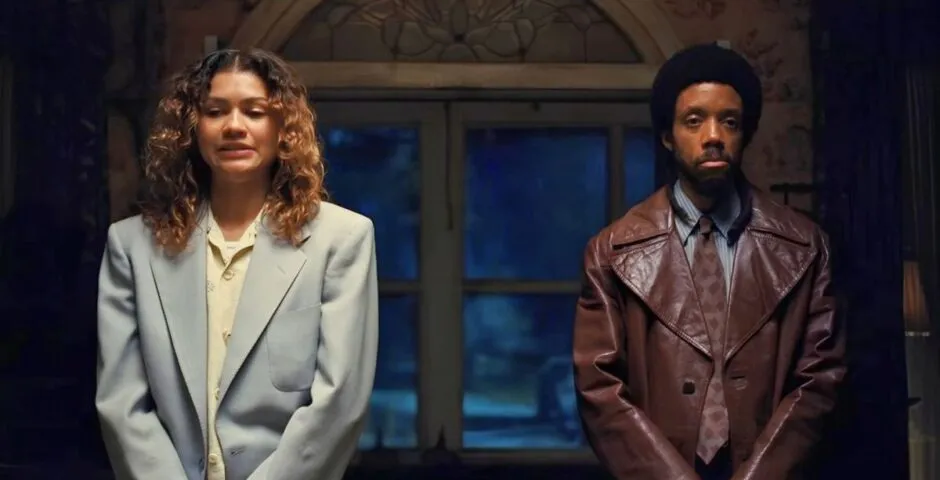
To make sense of this intricate act of defiance, actor Darrell Britt-Gibson offered a deeply humanized perspective on Bishop’s internal journey, painting a portrait of a man pushed to his absolute ethical limits by the sheer ruthlessness of his employer. According to Britt-Gibson, Bishop’s long-standing compliance with Alamo’s brutal operations was never a sign of genuine agreement, but rather a cold blueprint for a job he felt trapped within, a survival mechanism in a world where weakness is an immediate death sentence. The tragic and untimely demise of Rue served as the ultimate tipping point for Bishop, a horrific boundary that he simply refused to let Alamo cross without consequence. This emotional catalyst is beautifully illustrated in Bishop’s quiet, protective car conversation with Maddy, where he makes a solemn, unspoken vow to act as a barrier of safety between her and the dangerous world Alamo inhabited, showing a softer, albeit buried, side to his character. Britt-Gibson rejects the simplistic notion that his character was indifferent to Rue’s fate, arguing instead that Bishop functioned as a stern, tough-love elder brother figure who quietly tried to warn her away from the toxic elements of their environment. By choosing to leave the exact nature of their relationship open to interpretation, the narrative invites viewers to peer beneath Bishop’s icy exterior and find a deeply conflicted protector who was playing a high-stakes, long-term game of mental chess to bring down a tyrant.
In stark contrast to this somewhat redemptive, empathetic reading, Adewale Akinnuoye-Agbaje, who portrayed the fallen kingpin Alamo with a terrifying and commanding presence, offers a much more cynical, power-driven interpretation of the betrayal. From Akinnuoye-Agbaje’s perspective, Bishop’s actions were not born of a sudden awakening of conscience, but were instead a calculated, cold-blooded bid to seize the crown from a vulnerable leader whose empire was already beginning to crumble under its own weight. He points out that within any criminal hierarchy, there is a constant, predatory undercurrent of ambition where subordinates patiently bide their time, waiting for the kingpin to show a single moment of weakness before striking. Furthermore, Alamo’s historical treatment of Bishop was defined by a toxic, dismissive arrogance; he routinely belittled his associate’s monotone delivery, mocked his lack of social grace, and treated him like a useful idiot rather than a lethal peer. This constant underestimation and public degradation inevitably sowed the seeds of Alamo’s downfall, turning his most dangerous weapon into his eventual undoing. In this darker view of the narrative, Bishop’s sudden alignment with Maddy and his decision to spare Ali are not acts of genuine heroism, but strategic moves designed to consolidate his own power, clear his path to the top, and establish a new, perhaps even more terrifying, order.
This theme of a collapsing empire and a shifting dynamic of power is further highlighted by the quiet mutiny of the younger generation, represented by the character of Kidd, played by Asante Blackk. During the chaotic confrontation, Kidd possessed a clear opportunity to shoot Ali and save his boss, yet when Bishop gave the silent, authoritative command to stand down, the young man complied without hesitation, showing that Alamo had completely lost the respect and fear of his men. This collective refusal to protect their leader signals a profound “changing of the guards,” showing that a tyrant’s power is only as strong as the willingness of his subordinates to pull the trigger on his behalf. Akinnuoye-Agbaje emphasizes that this moment was a realization among the crew that Alamo’s dictatorial style of leadership had run its course, and that backing Bishop was the only viable path forward in a rapidly evolving landscape. The silent solidarity between Bishop and Kidd in that pivotal scene underlines how easily authority can disintegrate when a leader fails to cultivate genuine loyalty, transforming a once-feared boss into an isolated figure standing alone in the crosshairs of his own destiny. It illustrates a tragic truth about the cycle of violence: those who rule by fear are destined to be abandoned by the very people they rely on for protection.
The fascinating dichotomy between the two actors’ interpretations extends deeply into the psychological profile of Bishop himself, specifically regarding his capacity for violence and his mental state. While Akinnuoye-Agbaje firmly believes that Bishop is a genuine clinical psychopath who harbors a terrifying, secret pleasure in the act of taking human life, Britt-Gibson argues for a far more complex, emotionally detached character who is deeply traumatized by his own actions. To support his view, Britt-Gibson points to a chillingly nuanced scene where Bishop is preparing to brutally dismember a bouncer with a chainsaw, yet when casually asked how his day is going, he responds with a melancholic and highly specific, “I’ve been better.” This brief, dark glimmer of humanity suggests a man who is profoundly weary of his violent existence, showing that while he performs these horrific acts with clinical efficiency, he does not derive joy from them, but rather detaches his mind from his actions to preserve whatever fragments of his sanity remain. This internal struggle elevates Bishop from a one-dimensional villain into a highly compelling, tragic figure—a man who has been forced to become a monster to survive in a monstrous world, yet still retains a quiet, buried yearning for something better, even if he must commit unspeakable sins to achieve it.
Ultimately, the brilliance of the finale lies in its refusal to provide easy answers, choosing instead to embrace the rich, messy reality of human motivation where multiple contradictory truths can exist at once. Showrunner Sam Levinson’s open-ended writing provides a fertile ground of creative freedom, allowing the audience to project their own moral values, fears, and hopes onto these deeply flawed characters. Whether one views Bishop’s shocking betrayal as a heroic act of redemption fueled by a brotherly love for Rue and a desire to protect Maddy, or as a ruthless, narcissistic power grab by a calculating psychopath, there is no denying the profound emotional resonance of the performance. By leaving these motivations suspended in a state of perpetual ambiguity, the show mirrors the complex, gray nature of our own world, reminding us that people are rarely purely good or purely evil, but are instead defined by the desperate choices they make in their darkest hours. Long after the credits roll and the screen fades to black, the haunting, silent showdown at the Silver Slipper remains etched in our minds, serving as a powerful testament to the beauty of complex storytelling, the thin line between survival and damnation, and the enduring mystery of the human heart.