






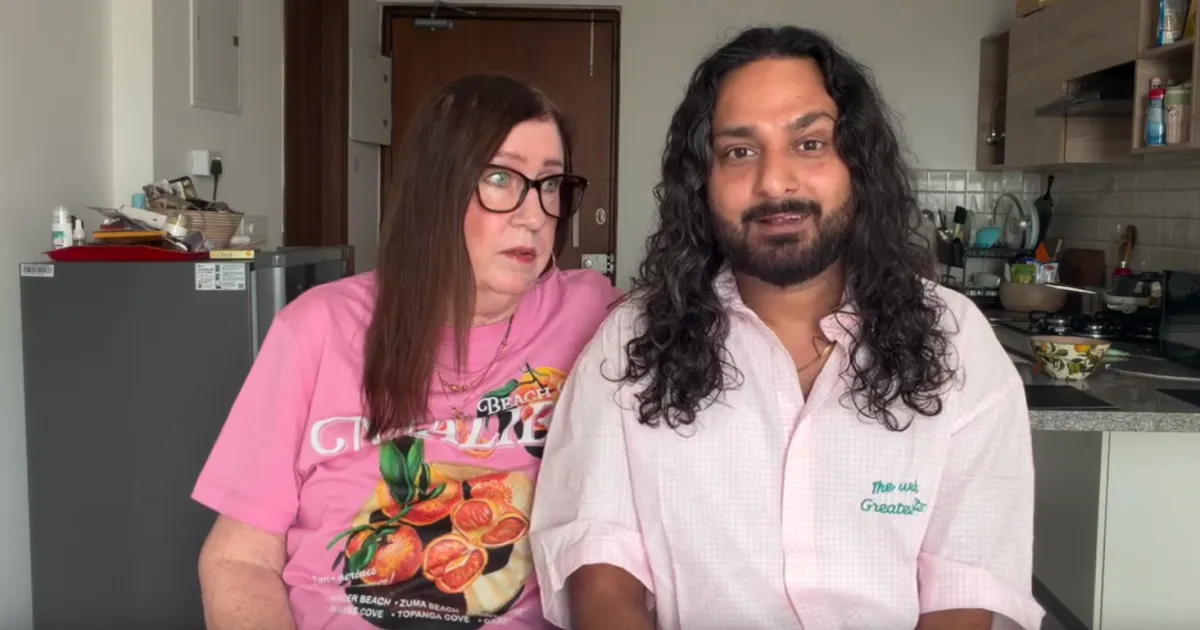
Every love story has moments no one prepares for. For Jenny Slatten and Sumit Singh, whose romance played out in front of millions of viewers on 90 Day Fiancé: The Other Way, those moments are now unfolding in real time, and with heartbreaking speed. In a recent Instagram video, Sumit, 37, gave an unfiltered update about his 68-year-old wife’s health, revealing that her battle with ALS is progressing. Not long after the couple shared the news that Jenny had been diagnosed with amyotrophic lateral sclerosis—a degenerative nervous system disease that affects nerve cells in the brain and spinal cord, eventually taking away a person’s ability to speak, move, feed themselves, and even breathe, and for which no cure is currently known—the effects have become harder to hide. Jenny herself acknowledged that she “can’t talk” much anymore. Sumit explained that the disease is now showing more in her talking; it is hard for her to get words out, and her balance and ability to walk have also been affected. He remembered a time not long ago when she was doing well, but the disease has continued its cruel march. These are the same two people who said “I do” on the 2021 season 3 finale of 90 Day Fiancé: The Other Way, after years of uncertainty over whether they would ever truly be together. For a couple who once seemed to overcome every obstacle in their path—distance, culture, scandal, and family opposition—this latest battle is different. It is quiet, unpredictable, and profoundly isolating. The update was not slick or rehearsed; it was two people trying to make sense of something that makes no sense. Yet their bond remains visible in the way Sumit speaks for her, with tenderness and desperation, and in the way Jenny tries to smile through her tears. Their love story, built before cameras and carried into real life, has entered a far more serious and deeply human chapter.
Jenny’s health crisis did not appear on anyone’s radar until recently. In May, the couple announced that she had been diagnosed with ALS, revealing that the official diagnosis had come in December 2025. The news landed like a thunderbolt for their fans, but for Jenny and Sumit it was only the beginning of a long and bewildering journey. Since marrying, Jenny had made her home in India, Sumit’s native country, embracing a life far from the United States. But ALS, in many ways, has no respect for geography, love, or hope. According to Jenny, local Indian doctors and hospitals do not have comparable studies, research, or hands-on experience with the disease as their American counterparts. That realization sent the couple into planning mode. Sumit said they began thinking about coming to America, believing that the United States might offer something better—if not a cure, then at least a more robust support system. “I always keep my hopes high,” he said, expressing a conviction that there could be a treatment protocol in the U.S. that is simply unavailable where they currently live. Their hope was not to escape India; it was to give Jenny every possible chance. They wanted a medical team that had seen more cases, a system equipped to manage the complexities of ALS, and perhaps a network of specialists who could slow the progression or improve her daily quality of life. Sumit acknowledged that her condition is getting weaker, and they both knew they could not wait indefinitely. The phrase “at least a better support system” appears over and over in their public statements, and it reveals how much their hopes have had to bend around reality. They are no longer bargaining for a miracle; they are asking for something to hold onto. For a woman who once spent so much energy navigating the enormous distances of a cross-continental love affair, this fight feels both entirely new and painfully familiar. And yet, even the most hopeful plans can hit a wall. In their case, the wall is neither medical nor scientific. It is much more bureaucratic: a visa.
Perhaps the cruelest part of this ordeal is that the treatment Jenny needs most is hours away by plane, yet also impossibly far. Sumit says he has not yet been approved for a visa to enter the United States, and without that approval, the couple is effectively trapped. Every day the visa remains pending, the disease is not waiting. Jenny’s symptoms are not static; they are advancing. Sumit watches her struggle to form sentences, then comes online to try to convince a bureaucratic system that his presence is necessary. Jenny could, in theory, travel to America on her own, since she is an American citizen, but she has made it clear that she will not leave without him. In her view, India is her home now. She married Sumit there, built a life there, and cannot imagine facing the most terrifying battle of her life surrounded by strangers in a country that would suddenly feel empty without him. Sumit understands this, and he is terrified of the alternative. “If I don’t get the visa,” he speculated, “it means that we will be apart forever.” That is not melodrama; it is the reality of a progressive illness. If he cannot accompany his wife to the United States, she would either have to forgo the treatment she hopes to receive or go alone and watch their marriage turn into a long-distance relationship during what could be the most critical months of her health. He explained that their plan was to get the visa so that he could travel with Jenny and start the treatment together. He also wondered, with an anguish that is impossible to fake, that if their relationship and medical plans are not enough for the embassy to approve his visa, then he does not know what situation or condition would ever be enough. For a couple who already spent years separated by oceans, strict immigration rules, and family opposition, the thought of yet another separation is unbearable. This is not about convenience or preference. It is about being present for the woman he loves while she faces a disease that takes away one thing after another, day by day.
Through it all, Sumit has tried to center his wife’s needs rather than his own fears. “We love each other,” he said, as if that simple fact should be enough to unlock every door. He wants Jenny to start receiving treatment, to feel better, or at least to have a support system that makes every day less of a struggle. He has watched his wife fight to speak, fight to walk, fight to maintain routines that once felt ordinary. The idea of watching her do that alone, without family and familiar voices around her, is unbearable. That is why Sumit and Jenny have decided to ask for help. They are not just sharing a sad update; they are spelling out an appeal, explaining what they need and how supporters can assist them. This is a hard thing for proud people to do, but ALS has a way of stripping away pretense and forcing everyone involved to admit their limitations. Jenny, for her part, has not lost her spirit. She still speaks of India as home. She still insists on remaining beside her husband no matter what. Those decisions may seem impractical to outsiders, but they are also deeply human. Love is not logical, especially when it is tested by illness. The couple drew inspiration from a familiar story: fellow 90 Day Fiancé alum Armando Neidermeier-Rubio, whose efforts to secure a medical visa after his 13-year-old daughter’s health scare were ultimately helped along when an immigration lawyer arranged the proper documents. Armando got help, and now Jenny and Sumit are hoping that the same kind of assistance might find them. “We’re sharing our appeal, what we’re asking for, and how you can help us during this difficult time,” Sumit wrote in his caption. It is a strange position for a couple who spent years sharing their private lives on television, but this is not about attention. It is not about ratings or fame. It is about survival, and about refusing to let paperwork decide the fate of their marriage.
ALS is a disease that does not announce its next move. It takes muscles, words, and eventually independence, often while the mind remains sharp enough to understand exactly what is being lost. For Jenny, the diagnosis means confronting a future she never imagined. For Sumit, it means becoming a caregiver in a country where resources for ALS are limited, and where the emotional toll is all too real. Caregivers often disappear into the background of such stories, but Sumit’s role is essential. He helps Jenny with daily tasks, listens for the words she can no longer easily form, and holds onto hope when hope feels thin. His love language has shifted from romantic gestures to quiet acts of endurance. But neither of them should have to manage this alone. The term “support system” appears repeatedly in their recent posts, and it is telling. They are not asking for magic. They are asking for people to show up—to understand that ALS is not just a physical disease but a social one, isolating both patient and partner in ways that can be devastating. There is no roadmap for a couple facing a serious illness in a foreign country, especially when the two people involved hold different citizenships and the bureaucratic systems they must navigate were not designed with love in mind. They are inventing this journey as they go, and they need people who know how to navigate it. The outpouring of love from fans, fellow cast members, and advocates has undoubtedly helped, but what Jenny and Sumit need now is practical, tangible help: legal help to navigate the visa process, perhaps financial help to cover medical expenses, and above all, the feeling that they are not forgotten, not invisible, not left behind by the world that once watched their every move. In many ways, the fear of being forgotten is almost as heavy as the disease itself, because ALS can make a person feel like they are disappearing before everyone’s eyes. Sumit refuses to let that happen to his wife. He is making sure the world sees her, hears her, and knows that she is still here.
This is not how Jenny and Sumit envisioned their life together. They imagined growing old in India, sharing meals, laughing at inside jokes, maybe helping each other with the small, unglamorous routines of marriage. Instead, they are fighting for time, for treatment, and for the right to face the future as a couple. And yet, in the middle of all that pain, something beautiful remains: their refusal to give up on each other. Sumit still speaks about his wife with the same devotion that made viewers fall in love with their story. Jenny still refers to India as her home, not because of a passport, but because Sumit is there. Their love has always survived by breaking expectations, and this moment is no different. They are asking for a chance, not a guarantee. They are asking for the opportunity to walk into a hospital together, to hold hands in an exam room, to hear a doctor explain options that may or may not work. They are asking for the simple dignity of being allowed to face a crisis side by side. Supporters who wish to help can listen to their message, share their story, and contribute what they can. They can send words of encouragement and practical resources. The most important thing anyone can do is refuse to look away. In a world that often moves too fast to notice the quiet struggles of others, Jenny and Sumit remind us that love is not just about the easy days. It is about who stays when everything is hard. It is about who still reaches for your hand when your voice is fading. This is their hardest chapter, and they are still holding on, still hoping, still fighting for the chance to face tomorrow together.