





A High-Stakes Autumn Showdown: Senate Leadership Positions CLARITY Act for Critical September Vote
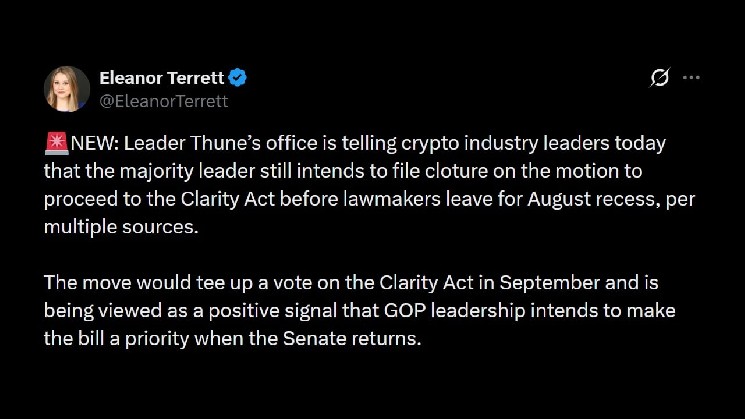
In a calculated political maneuver designed to signal unwavering legislative intent before Washington empties for the late-summer doldrums, Senate Majority Leader John Thune is preparing to orchestrate a crucial procedural showdown on the future of digital asset regulation in the United States. According to high-profile reporting from Eleanor Terrett, the host of Crypto in America, Senate Republican leadership intends to formally file for a cloture vote on the motion to proceed to the Digital Asset Market Clarity Act—frequently referred to as the CLARITY Act—just before the chamber adjourns for its traditional August recess. By initiating this formal process now, leadership is not merely managing the congressional calendar; they are strategically setting the stage for a high-intensity legislative push immediately upon their return in September, forcing both allies and opponents to clarify their positions during a high-stakes campaign season. The decision to file for cloture on the motion to proceed serves as an assertive legislative catalyst, designed to bypass potential filibusters and establish the groundwork for a binding vote on the chamber floor, thereby compelling lawmakers to confront the rapidly evolving regulatory landscape of the multi-trillion-dollar digital asset sector. This procedural gambit underscores a broader, highly coordinated effort by the Republican leadership to position the establishment of a robust, predictable federal framework for digital currencies as an urgent, top-tier economic priority that cannot be indefinitely sidelined by partisan gridlock or executive-branch hesitation. As the Senate prepares to disperse to their respective home states, the impending filing of this cloture motion ensures that the complex debate over financial innovation, national security, and regulatory jurisdiction will remain at the absolute forefront of the national political discourse throughout the summer, setting up a dramatic, time-sensitive legislative confrontation in the early autumn.
Deciphering the Digital Asset Blueprint: Regulatory Urgency Meets Midterm Election Politics
At its core, the push to advance the Digital Asset Market Clarity Act represents a watershed moment in the ongoing struggle to define the boundaries of federal oversight over the domestic cryptocurrency ecosystem. Eleanor Terrett’s insider assessment that this move is widely viewed within Capitol Hill circles as a highly positive signal of the GOP’s legislative agenda highlights a calculated effort to contrast their proactive legislative approach with what industry advocates describe as the regulatory-by-enforcement strategy currently favored by independent executive agencies. With the pivotal midterm elections rapidly approaching, the timing of this push carries profound political implications, as lawmakers on both sides of the aisle seek to appeal to an increasingly vocal, well-funded constituency of digital asset developers, institutional investors, and retail participants who have long clamored for explicit legal frameworks. By advancing the CLARITY Act to the Senate floor, Republican leaders are attempting to seize the narrative on financial modernization, branding their party as the champions of cutting-edge technological innovation and economic competitiveness while simultaneously addressing long-standing consumer protection concerns. This strategic posture is designed to force vulnerable incumbent Democrats in tightly contested states to make difficult, highly public choices between supporting a comprehensive regulatory framework favored by the broader tech sector or aligning themselves with more progressive elements of their party who remain deeply skeptical of the cryptocurrency industry’s systemic risk profile. Consequently, the debate surrounding the CLARITY Act is no longer confined to the technical minutiae of commodity definitions and cryptographic protocols; it has evolved into a vital macroeconomic and political battleground that could significantly influence campaign fundraising, voter sentiment, and the ultimate balance of power in the next Congress.
The Industry Rally: Coinbase Championing Clear Rules of the Road for American Innovation
This aggressive legislative push has garnered enthusiastic, high-profile support from the vanguard of the American digital asset industry, most notably from Coinbase Chief Executive Officer Brian Armstrong, who has repeatedly vocalized the urgent necessity of establishing a cohesive federal market structure. Armstrong’s public commendation of Senator Thune’s steadfast commitment to the initiative underscores a growing consensus among domestic technology executives that the current lack of regulatory predictability represents the single greatest barrier to long-term capital deployment and job creation within the United States. In his advocacy, Armstrong has forcefully argued that a clear, comprehensive federal statute would not only unlock unprecedented levels of institutional investment and catalyze domestic technological breakthroughs but would also implement robust, standardized consumer safeguards that are sorely lacking under the current fractured oversight regime. For years, major domestic platforms have warned that the absence of a unified, statutory framework has actively incentivized innovative startups and capital to migrate offshore to jurisdictions like the European Union, Singapore, and the United Kingdom, where regulators have already established clear, predictable rules of the road. By formalizing clear definitions of asset classes and delineating regulatory jurisdictions, proponents argue the CLARITY Act would finally provide the legal certainty required for traditional financial institutions to safely integrate blockchain technology into their operations, thereby securing America’s historic position as the undisputed global capital of financial technology and capital markets innovation.
The Battle Over Yield: Traditional Banking and the Looming Threat to Community Financial Institutions
Despite the palpable momentum generated by industry endorsements and strategic leadership maneuvers, the path to securing the sixty votes necessary to clear a Senate filibuster remains fraught with formidable, deeply entrenched obstacles, none more contentious than the simmering dispute over stablecoin yields. A powerful coalition of traditional financial institutions, represented by the highly influential banking lobby, has raised urgent alarms regarding provisions within the bill that would allow stablecoin issuers to offer yield-bearing products directly to retail consumers without being subject to the same stringent capital reserves and regulatory compliance requirements imposed on traditional commercial banks. This issue has created significant friction within the Republican conference itself, with at least two prominent GOP senators explicitly declaring their intention to vote against the legislation unless comprehensive amendments are introduced to safeguard community banks from a potential mass migration of retail deposits into high-yield digital alternatives. These dissenting lawmakers argue that if non-bank stablecoin issuers are permitted to offer yields backed by high-quality, short-term government securities without the costly overhead of traditional banking regulations, local financial institutions—which serve as the economic lifeblood of rural and suburban America—could face devastating liquidity strains. This brewing regional banking crisis in miniature highlights the profound structural challenges of integrating decentralized, yield-bearing cryptographic protocols into a legacy fractional-reserve banking system, illustrating how traditional economic interests can quickly disrupt party unity and derail even the most carefully coordinated legislative strategies.
Ethics, Divestment, and the White House: Negotiating the Boundaries of Executive Integrity
Simultaneously, the prospects for the CLARITY Act’s ultimate passage are heavily complicated by delicate, ongoing negotiations with the White House regarding rigorous new conflict-of-interest and ethics provisions aimed at high-ranking federal officials. The core of this diplomatic impasse involves a robust legislative proposal that would mandate strict divestment protocols for the President, Vice President, and senior regulatory officials who hold personal, direct financial stakes in private cryptocurrency enterprises or public digital asset platforms. Proponents of these strict ethics mandates argue that because the executive branch wields immense discretionary power over the enforcement of financial regulations and the appointment of key regulatory chiefs, absolute transparency and complete financial decoupling are essential to maintaining public trust in the integrity of the market. Thus far, the White House has maintained a conspicuous silence regarding the latest compromise proposal put forward by Senate negotiators, raising concerns among Capitol Hill insiders that the executive branch may seek to utilize these ethical provisions as a convenient pretext to stall the bill’s momentum or extract major policy concessions on other fronts. This diplomatic stalemate underscores the broader philosophical divide between a cautious administration wary of legitimizing the digital asset sector and a legislative branch eager to establish a permanent regulatory baseline, leaving the ultimate fate of the bill’s governance standards hanging in a delicate, unresolved political equilibrium.
The Fourteen-Day Countdown: Navigating a Razor-Thin Legislative Window
As senators prepare to return to Washington in September, they will confront a punishing, highly compressed legislative calendar that leaves virtually no room for error, delay, or protracted partisan bickering. With only fourteen scheduled legislative working days in session before Congress adjourns once again in October for the final, frantic stretch of the midterm campaigns, the window of opportunity to debate, amend, and pass a complex, highly technical piece of financial legislation like the CLARITY Act is extraordinarily narrow. During this brief two-week period, the Senate must also tackle a host of other critical, must-pass legislative items, including emergency government funding resolutions to prevent a federal shutdown, defense authorization bills, and essential farm policy updates, all of which will fiercely compete for valuable floor time. Financial analysts and legislative experts remain deeply divided on whether GOP leadership can successfully navigate these formidable temporal and political obstacles to secure a historic, bipartisan breakthrough before the pre-election recess. However, even if the relentless ticking of the legislative clock ultimately prevents the CLARITY Act from crossing the finish line in this session, the high-profile push orchestrated by Senator Thune and his colleagues will have accomplished a vital strategic objective: establishing the definitive, baseline framework for the future of digital asset policy in the United States, ensuring that stablecoin regulation and market structure reform will remain the absolute centerpiece of the financial regulatory debate for years to come.