







The High-Octane Promise of Sui Meets a Harsh Infrastructure Reality
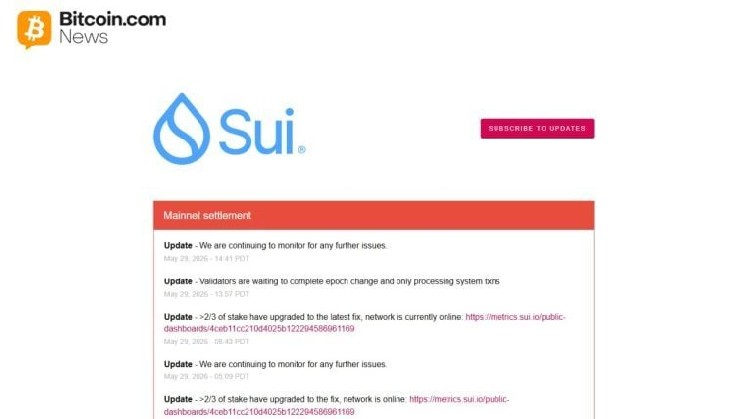
The decentralized finance landscape was thrown into disarray this week as the Sui network, a highly touted Layer 1 blockchain celebrated for its ultra-fast throughput and high-performance consensus, suffered three distinct network outages within a staggering 48-hour window. The series of critical disruptions culminated in a major system-wide halt at approximately 4:30 PM EDT, leaving validators, traders, and decentralized application developers locked out of the network as transaction processing ground to a complete standstill. According to the network’s official status page, the consecutive stalls completely paralyzed network operability, forcing the core engineering teams into an emergency diagnostic posture. For a blockchain platform that has positioned itself as the primary enterprise-grade alternative to established giants like Solana and Ethereum, this sequential cascade of failures represents a severe operational crisis. The sudden operational freeze quickly sent shockwaves through the broader Web3 ecosystem, sparking intense volatility for the native SUI token and exposing critical architectural vulnerabilities in the network’s underlying consensus and transaction processing layers.
Inside the Architecture: How Zero-Fee Incentives Triggered a Systemic Code Failure
To understand the genesis of this multi-day technological paralysis, we must look at a recent governance and protocol-level decision aimed at boosting on-chain liquidity and stablecoin adoption: the introduction of zero-fee transaction mechanisms. In an effort to lower the barrier of entry for mainstream users, the Sui Core Team deployed updates to its gas charging logic, explicitly designed to eliminate gas costs for specific stablecoin transactions. While this zero-fee design was publicly celebrated as a breakthrough for user experience, it fundamentally altered the economic feedback loop of the network’s transaction execution engine. In practice, the zero-fee logic contained inherent design defects that failed to account for complex smart contract execution pathways, creating a vulnerability where abnormal transactions could consume validator resources without providing the corresponding gas fees to regulate execution. This technical mismatch in the consensus layer meant that instead of executing smoothly, the network’s transaction pipeline suffered from severe resource contention, ultimately resulting in the first major system stall as validators reached an unresolvable state mismatch while trying to process free transactions.
The Cost of Speed: Accusations of AI-Driven Coding and Market Manipulation
The drama intensified following the first recovery effort, as the Sui Core Team rushed to implement an interim patch to restore the mainnet to functional status. However, this temporary resolution was admittedly fragile, possessing a known, albeit low-probability, vulnerability that made the system highly susceptible to secondary crashes. According to public post-mortems and social media disclosures, the network hit a variation of this known issue early the following morning, triggering a second complete halt at 7:58 AM EDT. As the network ground to an abrupt halt for the second time, industry analysts and on-chain investigators began pointing fingers at both the development pipeline and potential external bad actors. Prominent ecosystem voice 0xarthur.sui publicly suggested that the second stall’s timing was far from coincidental, suggesting that a malicious actor may have intentionally exploited the network’s known vulnerability after accumulating substantial short positions in SUI derivatives to profit off the ensuing panic. Furthermore, critics leveled sharp accusations against the developer pipeline, alleging that the initial patches were “vibe-coded” using generative artificial intelligence tools without undergoing rigorous, multi-layered manual auditing and security validation processes—a risky shortcut for a multi-billion-dollar network that relies heavily on absolute consensus consistency.
The Epoch Transition Failure: Why Validators Ignored User Transactions
Just as the community began to breathe a sigh of relief following the deployment of secondary patches, the network was struck by a third, highly unusual failure at approximately 4:30 PM EDT. This third disruption was structurally distinct from the gas charging issues, presenting as a failure tied directly to the epoch change—a critical, periodic transition on the Sui network where validator sets, staking distributions, and reward allocations are synchronized. During this specific epoch boundary, the consensus mechanism faltered in a bizarre fashion: validator nodes continued to successfully generate and commit system-level transactions to the ledger, yet they completely ignored and bypassed user-submitted transactions. This breakdown created an eerie scenario where the blockchain appeared outwardly active to automated monitors, but was practically useless to real-world users who found their pending transactions perpetually stuck in the mempool. The Sui Core Team quickly launched an intensive investigation to determine why the validator network lost its ability to transition user states during the epoch shift, highlighting a deeper, systemic issue within the blockchain’s state transition controls that apparently surfaced during the rapid-fire patch deployments of the preceding hours.
Rebuilding Trust in a Hyper-Competitive Layer 1 Landscape
This series of rapid-fire technical failures has struck a massive blow to Sui’s primary competitive marketing angle: its unyielding performance and absolute reliability under pressure. Built on the highly secure Move programming language—originally designed by Meta engineers specifically to address the memory-safety vulnerabilities of Solidity—Sui had positioned itself as the direct, enterprise-oriented successor to legacy Layer 1 platforms like Solana, which has historically suffered from its own highly publicized network outages. For institutional capital, high-frequency traders, and enterprise partners, an unstable ledger is a non-starter, as a couple of hours of downtime can translate into millions of dollars in liquidated positions, missed arbitrage opportunities, and ruined user experiences. The optics of three consecutive halts in a mere two days threaten to undo months of aggressive business development and marketing campaigns, raising uncomfortable questions among the Web3 community about whether high-throughput networks are inherently prone to sacrifice stability in their desperate pursuit of sub-second block times and near-zero fees.
System Recovery and the Blueprint for Next-Generation Security Standards
Looking forward, the road to recovery for the Sui network will require far more than rapid hotfixes; it demands a fundamental reassessment of how zero-fee mechanisms are integrated into high-throughput ecosystems. The Sui Core Team is currently working on a comprehensive, permanent software upgrade that seeks to resolve the gas charging logic defects without exposing validator nodes to memory overflows or consensus halts. To win back the trust of both the developer community and institutional stakeholders, the foundation behind Sui must institute more transparent testing protocols, including rigorous testnet stress-testing phase-ins for fee-structure changes and multi-layered manual auditing pipelines to eliminate any suspicion of reliance on unverified, AI-generated code. As the mainnet stabilized after a grueling series of system restarts, the crisis served as a stark reminder to the entire blockchain industry that security, scalability, and decentralization remain an exceptionally fragile balancing act, where over-optimizing for user incentives can easily compromise the very operational integrity that makes a decentralized ledger valuable in the first place.