



Dormant Bitcoin Stirred in August: 6,427 BTC on the Move as Wallet Security Worries Deepen
A Month of Security Scares Shakes Loose Bitcoin’s Sleeping Giants
The story of August’s dormant bitcoin movement does not begin on the blockchain. It begins in the anxious aftermath of a string of hardware wallet security scares that rattled the cryptocurrency community to its core. It started on July 30, when Bitcoin.com News first reported on the initial accounts of losses connected to the Coldcard firmware exploit — an incident that eventually tallied roughly 2,000 bitcoin. Then, over the next few weeks, two prominent hardware wallet manufacturers, Safepal and Trezor, disclosed separate data breaches that exposed customer information, including names, email addresses, phone numbers and shipping addresses. These disclosures raised uncomfortable questions about self-custody, the very principle that draws many investors to Bitcoin in the first place. While no direct connection can be established between those security events and the sudden movement of long-idle coins, the timing is hard to ignore. In the wake of these scares, a measurable wave of early adopters began moving vintage bitcoin, prompting analysts to consider whether a broader reassessment of storage arrangements is underway. The pattern suggests that even the most seasoned holders — those who watched Bitcoin grow from an obscure digital experiment into a trillion-dollar asset class — are no longer content to leave decade-old keys untouched. Whether driven by caution, fear or simple housekeeping, these dormant wallets began to wake up, and the resulting on-chain activity tells a compelling story about trust, custody and the changing relationship between Bitcoin’s oldest investors and their digital fortunes.
August’s Sleeping Bitcoin Activity Leaves July in the Dust
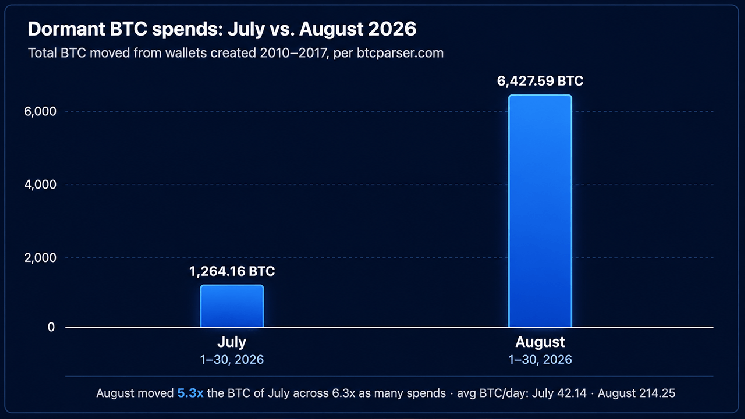
The numbers for August paint a striking picture. According to data logged by btcparser.com, the last 30 days of August recorded a significant daily average of 214.25 bitcoin moved from dormant wallets — a figure that stands in stark contrast to July’s 40.78 bitcoin per day. In percentage terms, that represents a 5.3-fold increase in the pace of sleeping bitcoin movement, a jump significant enough to catch the attention of blockchain analysts and market observers alike. Over the course of the month, the platform logged 188 distinct spends involving dormant addresses, with a total of 6,427.59 bitcoin changing hands from wallets that had remained silent for years. Perhaps most striking, eight of those transfers came from truly ancient wallets, addresses first created in either 2010 or 2011. The two transfers from 2010 wallets moved a combined 50 bitcoin, while the six movements tied to 2011 wallets shifted approximately 155.57 bitcoin. This kind of activity from wallets that predate the modern crypto infrastructure is remarkable precisely because it is so rare. Coins held since the early days of Bitcoin are often viewed as digital artifacts — untouched, unmoved and, in many cases, forgotten. Yet August saw those artifacts re-enter circulation with unusual urgency. The surge in dormant wallet activity suggests that something fundamental has changed in how longtime holders perceive their assets, or at the very least, how they manage them. At the very least, Bitcoin’s sleeping giants no longer seem to be sleeping.
Wallets From 2014 Dominated the Movement, With an Unexpected Focus
While the ancient 2010 and 2011 transfers grabbed headlines, the bulk of August’s activity came from wallets created between 2012 and 2017, with the 2014 cohort dominating the movement. The data reveals that 94 transfers from bitcoin addresses created in 2014 moved approximately 3,286.26 bitcoin between Aug. 1 and Aug. 30. That single-year cohort accounted for more than half of the total dormant bitcoin transferred during the month. Wallets from 2016 ranked second, with 985.38 bitcoin moved across 29 transactions, while 2013-era wallets took third place, recording 16 distinct transfers totaling 845.48 bitcoin. Wallets from 2012 shifted 233.41 bitcoin, addresses created in 2015 moved roughly 415 bitcoin, and the 2017 cohort saw 456.47 bitcoin spent across 26 movements. On its own, this year-by-year breakdown demonstrates that the wave of dormant spending was not limited to one particular era of Bitcoin history. It spanned the early institutional experiments, the first retail wave, the exchange boom and the speculative frenzy of late 2017. Yet the 2014 total is especially notable, not only because of its size but because a closer examination reveals it was not one broad, uniform movement. Instead, it breaks into two distinct clusters with markedly different behavior. That divergence makes the 2014 activity by far the most intriguing pattern in the dataset — and it raises questions about whether the moves were coordinated, automated or driven by entirely separate groups of holders acting independently for reasons that remain opaque.
Two 2014 Clusters Reveal Strikingly Different Behavioral Signatures
The first cluster consists of 64 addresses created between Jan. 27 and Feb. 4, 2014. Those addresses moved a combined 1,672 bitcoin, but the coins were not spent in a rush. Instead, they trickled out across 11 separate days between Aug. 3 and Aug. 13, with a handful of later stragglers adding to the total. Individual transfers in this cluster ranged from as little as 0.31 bitcoin to 33 bitcoin, suggesting a series of distinct decisions rather than a single automated sweep. This gradual pattern is consistent with individual holders rethinking their storage choices, moving funds in batches as they set up new wallets, update security protocols or prepare to transfer assets to more modern custody solutions. The second cluster tells a very different story. Twenty-five addresses created between Nov. 30 and Dec. 26, 2014, moved a combined 1,514 bitcoin in nearly uniform lots of roughly 50 bitcoin each. The most striking detail is the timing: 22 of the 25 addresses were swept on Aug. 19 within approximately one hour. That degree of coordination makes it highly unlikely that unrelated holders independently decided to move decade-old coins on the same afternoon. Instead, the data strongly points toward a single custodian or key holder executing a scripted batch sweep of multiple addresses in a short window. The wallets appear to have been funded together in late 2014, which could reflect any number of historical scenarios, including an exchange cold-storage reorganization, an escrow release, or even a bulk paper-wallet distribution organized years ago. The uniformity, the timing and the shared origin all suggest that this was not a decision made by a panicked individual but a controlled, deliberate operational move.
A Coordinated Batch Sweep Points to Institutional-Level Housekeeping
What makes the second cluster so compelling is not just the amount of bitcoin involved but the level of organization required to move it. A transfer of 1,514 bitcoin, distributed across 25 wallets and executed within a single hour, speaks to an entity with both technical capability and a clear operational plan. The near-uniform lot sizes — roughly 50 bitcoin per address — further suggest that the original wallets were created as part of a structured allocation process, potentially tied to an exchange’s internal accounting system, a lending platform’s reserve management, or a large-scale distribution to early customers. In the context of August’s broader security concerns, this kind of batch movement could represent a major holder consolidating legacy holdings into a smaller number of modern, more secure addresses. It could also indicate a custodian upgrading its storage architecture in response to heightened concerns about firmware vulnerabilities and data breaches. The fact that these wallets sat dormant for nearly a decade before suddenly being swept with surgical precision suggests that the keys were never lost — they were simply waiting for the right moment, or the right reason, to be moved. And in the current climate, where hardware wallet exploits and customer data leaks have made headlines, the rationale for moving long-dormant coins into freshly secured infrastructure becomes easier to understand. Even if the specific trigger remains unknown, the behavior fits the broader narrative of an industry engaged in a quiet but significant reassessment of how digital assets are safeguarded.
Bitcoin’s Sleeping Giants Don’t Leave Their Motives on the Blockchain
Of course, the blockchain does not record intention. It records transactions, timestamps and addresses. The deeper story behind August’s dormant bitcoin movement may extend far beyond technical vulnerabilities to an erosion of confidence powerful enough to push even the earliest adopters to reconsider passive custody. For years, holding bitcoin in cold storage was seen as the gold standard of security — a way to remove coins from the reach of hackers, rogue employees and unstable exchanges. But the recent disclosures have exposed cracks in that armor, revealing that the supply chain between hardware manufacturers and end users is not as impenetrable as many assumed. When a firmware exploit can compromise a device before it ever reaches the customer, and when shipping databases can be breached to expose the names and addresses of wallet owners, the calculus begins to change. The coordinated batch movements observed in August suggest that larger holders, in particular, may be proactively consolidating legacy holdings, increasingly treating aging keys as operational liabilities rather than digital trophies. Whether these coins are being sold, moved to institutional custody or simply reorganized into newer storage solutions, the effect is the same: Bitcoin’s oldest and quietest addresses are becoming active again. The true motivations may never be fully known, and the dormant coins themselves are not telling. But the pattern has been recorded, the data has been analyzed, and the message is clear. In a month defined by security fears, even the most patient holders decided it was time to move.