


Here is the content rewritten as a comprehensive, SEO-optimized feature article in a professional journalism style.
The Great Hedge: Record $7 Billion Flows into Gold and Bitcoin ETFs Signal a Paradigm Shift
By [Staff Correspondent]
In a striking display of investor conviction, the financial markets have witnessed a seismic shift in capital allocation, with Gold and Bitcoin exchange-traded funds (ETFs) absorbing a historic $7 billion in combined inflows over just five trading sessions. This unprecedented surge of capital, which positions both asset classes at the epicenter of a defensive investment strategy, underscores a growing institutional appetite for assets perceived as immune to the erosive forces of inflation and fiscal mismanagement. As central banks navigate a precarious landscape of mounting sovereign debt and shifting monetary policy, the convergence of these two distinct asset classes—one a millennia-old store of value, the other a nascent digital commodity—is painting a compelling picture of a market bracing for a prolonged period of currency depreciation.
A Historic Convergence of Capital
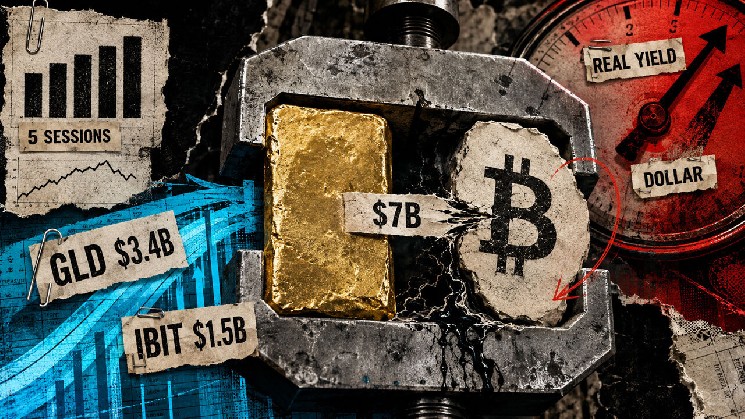
The magnitude of this recent capital influx is nothing short of staggering, breaking previous records for the two asset classes when considered together. Leading the charge, the SPDR Gold Shares (GLD) exchange-traded fund absorbed approximately $3.4 billion of this total, solidifying its position as the premier vehicle for traditional gold exposure. Not far behind, BlackRock’s iShares Bitcoin Trust (IBIT) attracted a hefty $1.5 billion, demonstrating the rapid mainstream acceptance of digital gold. According to data from Bloomberg Intelligence, these two heavyweights alone accounted for roughly 70% of the combined inflow into the broader “debasement trade” universe, a testament to their dominant liquidity and institutional trust.
The significance of this synchronized move extends beyond the raw numbers. Bloomberg Intelligence senior ETF analyst Eric Balchunas highlighted that this five-day period marked a record for the pairing, with both GLD and IBIT ranking among the top ten US ETFs by weekly inflows. This places them in the same echelon as the S&P 500 and Nasdaq tracking behemoths, a feat that would have been unthinkable just a few years ago. The fact that investors are routing billions into both a traditional safe-haven metal and a volatile digital asset simultaneously suggests not a mere hedge against a single risk event, but rather a structural re-evaluation of portfolio construction in an era of unprecedented fiscal expansion.
The Debasement Trade: Why Now?
The catalyst for this massive accumulation is the resurgence of what market strategists have dubbed the “debasement trade.” This macroeconomic strategy involves acquiring assets with a fixed or limited supply—such as gold and Bitcoin—as a protective measure against the depreciation of fiat currencies. The current environment provides a fertile ground for this thesis. With the US national debt having eclipsed $40 trillion, concerns over the long-term sustainability of government spending and the potential for future money printing to service that debt are at an all-time high. This anxiety is further compounded by the recent volatility in the US Treasury market, which has prompted the central bank to intervene in an effort to ensure liquidity and stability.
The recent decision to double the maximum size of liquidity-support buybacks for longer-dated securities from $2 billion to $4 billion per operation sent a clear signal to the markets: the fiscal tail is wagging the monetary dog. This intervention, while designed to calm the fixed-income market, inadvertently reinforced the narrative that the central bank will prioritize the funding of government deficits over the preservation of the dollar’s purchasing power. Consequently, investors are increasingly looking to gold and Bitcoin as alternative reserve assets, bulking up their holdings to insulate their portfolios from the potential fallout of a continued decline in the dollar’s value and the risks of stagflation.
Voices from the Vanguard of Digital Assets
The intellectual rationale behind this pivot is being articulated by some of the most prominent figures in the investment world. Matt Hougan, Chief Investment Officer at Bitwise Asset Management, a leading crypto fund manager, frames the shift as a modernization of the classic portfolio hedge. “A 60/40 portfolio is 100% exposed to fiat currency,” Hougan recently noted, arguing that the traditional allocation of stocks and bonds is entirely at the mercy of the purchasing power of the dollar. As fiscal uncertainty rises, he posits that investors are recognizing the need for a “modest source of diversification” that exists entirely outside the traditional fiat system, which is precisely what a small allocation to Bitcoin provides.
Similarly, Matt Cole, CEO of Strive Asset Management, views the phenomenon through the lens of scarcity. He argues that the expansion of the global money supply is driving a “search for yield” and, more importantly, a “search for scarcity.” Gold, with its finite terrestrial supply, and Bitcoin, with its mathematically capped supply of 21 million coins, both fit this bill perfectly. Cole observes that Bitcoin is currently undergoing a period of “monetization,” where its utility as a store of value is being validated by increasingly wider adoption. This, he suggests, allows Bitcoin to capture a growing share of the “debasement trade” demand, as a new generation of investors, who may find gold cumbersome or outdated, flock to a native digital asset for the same protective qualities.
A Shift in Market Structure and Momentum
Beyond the philosophical arguments, the technical and structural landscape is also aligning in favor of these hard assets. Charlie Morris, founder of the independent research firm ByteTree, points to a compelling data point: both Bitcoin and gold are currently exhibiting strong positive trend momentum, as indicated by their respective 200-day moving averages. Both assets currently carry ByteTree’s highest bullish reading, a score of 5, while the US Dollar Index, in a stark contrast, is languishing with a score of zero. This divergence is a powerful technical indicator that the macro momentum has decisively turned away from fiat and towards store-of-value assets.
This alignment suggests that the current rally is not simply a short-covering event but is backed by sustained, long-term buying pressure. The multi-year high in gold prices and Bitcoin’s breach of the psychologically significant $80,000 level provide a strong technical foundation. Analysts view this as a positive feedback loop: as prices rise, more institutional players are forced to initiate positions to avoid underperforming, which in turn pushes prices higher. The availability of highly liquid and regulated ETF products has made this process easier than ever, providing the infrastructure necessary for large-scale capital deployment.
Long-Term Pressures vs. Short-Term Risks
While the immediate catalyst may be the recent uptick in Treasury market stress, many analysts believe the structural forces driving the “debasement trade” are of a longer-term nature and are unlikely to dissipate quickly. Bernstein, a global asset management firm, argues that the four-decade-long decline in interest rates has come to an end, leaving the global economy in uncharted territory. As interest rates remain elevated, the cost of servicing enormous sovereign debt burdens increases, requiring governments to issue even more debt or resort to monetary financing, thereby perpetuating the cycle of currency debasement. This dynamic creates a persistent, tailwind for gold and Bitcoin that will likely remain in place for the foreseeable future.
However, it is crucial to distinguish between the long-term investment thesis and the potential for short-term volatility. The market is still fraught with risk, and a sudden shift in monetary policy—such as an aggressive interest rate hike to combat inflation—could temporarily strengthen the dollar and put downward pressure on both gold and Bitcoin. Furthermore, Bitcoin retains a significantly higher volatility profile than gold, making it a more turbulent holding. As one market veteran put it, “Bitcoin has a much shorter history as a defensive asset.” While it is currently attracting inflows for the same reasons as gold, it has not yet been tested through a full global recession in the same way that gold has.
The Verdict: A Durable Shift in Portfolio Construction
The record-breaking $7 billion flow into gold and Bitcoin ETFs is a clear signal that a fundamental change is underway in institutional portfolio management. The era of unquestioning faith in the fiscal and monetary authorities appears to be fading, replaced by a pragmatic recognition that a truly diversified portfolio must include assets that operate outside the purview of government policy. While the current burst of buying is driven by specific Treasury market interventions, the underlying drivers—soaring debt levels, expansive fiscal policy, and the end of the bond bull market—are unlikely to reverse anytime soon.
Looking ahead, the initial verdict suggests that this is more than just a short-term trade. The “debasement trade” is morphing into a core portfolio holding, with strategic allocation sizes increasing significantly. The test for these assets will come not during a bull market, but during a period of renewed dollar strength or a liquidity crisis. If gold and Bitcoin continue to demonstrate their resilience and effectiveness as hedges during those turbulent times, their status as permanent fixtures in the modern investment landscape will be indelibly etched. For now, the market has spoken, and it is placing its bets on the enduring value of scarcity.