





The Great Schism: How BIP-110 Sparked an Abrupt Fork in the Bitcoin Network
On August 8, the Bitcoin blockchain experienced a quiet yet highly consequential ideological split at block 961632, triggering a chain fork that laid bare the deep philosophical divisions within the world’s premier cryptocurrency network. This split was the direct result of the activation of BIP-110—the controversial “Reduced Data Temporary Softfork”—which mandated that node operators reject any newly mined blocks that failed to signal support for the protocol upgrade. While the dominant, mainstream Bitcoin blockchain continued to produce blocks without interruption under its established, legacy consensus rules, a small faction of nodes enforcing the BIP-110 rules branched off into a minority chain, determined to purge the ledger of what they deemed non-financial data bloat. This minority chain initially showed signs of life when Roughnecks, a mining group operating via Ocean Mining’s decentralized DATUM template system, successfully discovered and broadcast blocks 961632 and 961633, fueling hope among proponents that a viable, independent network could be sustained. However, the initial momentum quickly evaporated, and the newly formed BIP-110 minority chain ground to a sudden and dramatic halt at block 961634, leaving its supporters stranded on a silent ledger while the rest of the global Bitcoin network marched forward, producing blocks at its typical ten-minute intervals and ignoring the rebellious offshoot entirely. This sudden halt underscored the immense practical difficulty of executing a minority fork in the modern era of industrial-scale cryptocurrency mining, demonstrating that ideological purity alone cannot sustain a blockchain if it lacks the raw computational power required to validate its transactions and secure its history against the mathematical inertia of the legacy system.
The Gravity of Consensus: How Bitcoin’s 127 Trillion Difficulty Stranded the Minority Chain
The rapid stagnation of the BIP-110 fork highlights a fundamental, unyielding reality of decentralized consensus: the sheer mathematics of Bitcoin’s network security. When the BIP-110 minority chain severed its ties with the main network, it inherited the identical, monumental mining difficulty of approximately 127.48 trillion, a metric calibrated to match the astronomical computing power of the entire global Bitcoin mining infrastructure. This mining difficulty determines the mathematical complexity required to find a valid block hash, a mechanism designed to ensure block times remain consistent regardless of how many machines are actively securing the network. However, while the main Bitcoin chain retained nearly 100% of the world’s SHA-256d hashpower—consisting of millions of highly specialized Application-Specific Integrated Circuit (ASIC) machines—the BIP-110 fork split off with only an infinitesimally small fraction of this computational support. Because Bitcoin’s consensus rules do not dynamically or instantly adjust the difficulty downward when a sudden drop in hashpower occurs, the remaining handful of miners on the BIP-110 chain were left attempting to scale an ideological Everest with shovels, facing a mathematical hurdle that would realistically take months, if not years, of continuous computation to resolve under normal circumstances. Consequently, without a massive, near-impossible influx of industrial-scale miners or a radical, hard-forking rewrite of the chain’s core consensus rules, the minority blockchain remains effectively frozen in time, serving as a digital monument to the uncompromising laws of cryptographic proof-of-work.
Reclaiming the Ledger: The Ideological Crusade Against ‘Blockchain Spam’ and the Failed Signaling Campaign
At the heart of this technical standoff lies BIP-110, an ambitious and highly polarizing proposal authored by pseudonymous developer Dathon Ohm with significant structural guidance from veteran Bitcoin Knots maintainer Luke Dashjr. Designed as a temporary measure, the proposal seeks to restrict the methods through which arbitrary, non-financial data can be permanently embedded into the Bitcoin blockchain—specifically targeting protocols like Ordinals, BRC-20 tokens, and other metadata-heavy transactions that have exploded in popularity over the past year. Supporters of the initiative argue that such protocols constitute an existential threat, transforming a sovereign monetary settlement network into a cluttered, expensive, and bloated “toxic data dumping ground” that drives up transaction fees and increases the cost of running a sovereign node. To achieve activation, BIP-110 was structured to require a 55% miner-signaling threshold, a benchmark designed to ensure broad industry consensus before nodes began actively enforcing the new constraints; yet, the actual mining community showed virtually no interest in the proposal, with voluntary signaling hovering at a negligible 2% to 2.6% in the weeks leading up to the split. This lack of support culminated in a public war of words on social media, where figures like the founder of F2Pool openly mocked the effort, challenging Dashjr and his cohort to abandon the SHA-256d mining ecosystem altogether if they were unhappy with the market’s preference for transaction fees generated by Ordinals. When the mandatory signaling deadline finally arrived, the vast majority of industrial miners simply ignored the BIP-110 rules, leaving the enforcing nodes isolated on a separate, economically unviable ledger that proved incapable of attracting the hashpower needed to survive.
‘Fire the Miners’: The Radical Proposal to Rewrite the Proof-of-Work Consensus
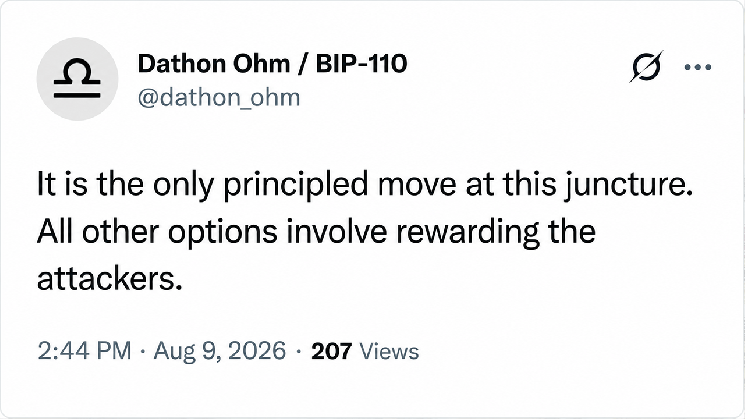
Confronted with the reality of an inactive blockchain and the indifference of the global mining industry, BIP-110 proponents quickly shifted their strategy from peaceful consensus building to radical institutional rebellion, popularizing the rallying cry to “fire the miners.” On August 9, just a day after the split occurred, Dathon Ohm published a scathing critique on social media, accusing the world’s major mining pools of operating as a cartel that colluded to prioritize short-term transaction fees over the long-term decentralization and health of the network. To break free from this perceived corporate capture, Ohm and other key supporters began actively drafting a proposal to alter the minority chain’s proof-of-work algorithm, an architectural shift that would render the existing global fleet of SHA-256d mining hardware completely useless on the BIP-110 network. This proposed change represents an existential divergence from the traditional Bitcoin security model, as ASICs engineered specifically for the SHA-256d algorithm cannot be reprogrammed or adapted to mine on a network utilizing a different cryptographic puzzle. By replacing the mining algorithm, the BIP-110 community hopes to neutralize the influence of the established industrial mining complexes, thereby preventing dominant pools from either attacking the minority chain or starving it of the computational validation needed to process transactions and adjust its difficulty to functional levels. While such a change would have absolutely no impact on the dominant, primary Bitcoin blockchain, it would formally codify a new branch of digital asset development, one where node operators assert supreme authority over the physical infrastructure providers who secure the ledger.
Inside the Knots War Room: Discord Debates, Algorithmic Roulette, and the Search for a New Consensus Engine
This theoretical battle for governance has rapidly transitioned into concrete technical planning within the private channels of the Bitcoin Knots Discord server, particularly inside the #strategic channel, where Luke Dashjr and an active cohort of developers are exploring alternative proof-of-work mechanisms. When one participant noted that the primary motivation for abandoning SHA-256d was to systematically strip power from the centralized mining industry rather than to fix a broken cryptographic standard, Dashjr pushed back, asserting that SHA-256d is indeed technically compromised and pointing specifically to the controversial efficiency optimization known as ASICBoost as evidence of its vulnerability. The developer group has been leveraging generative artificial intelligence tools to analyze and compare a wide array of alternative algorithms—including CPU- and GPU-friendly options like RandomX, Scrypt, BLAKE3, and Autolykos v2—in an effort to identify a system that could quickly bootstrap the stalled BIP-110 chain without immediately falling prey to centralized control. However, every option analyzed presents a unique set of trade-offs; for instance, while adopting the Scrypt algorithm would allow the BIP-110 chain to leverage the existing mining hardware currently used by Litecoin and Dogecoin networks, it would also expose the young fork to immediate domination or hostile reorganization attacks by those same established mining interests. To bypass this vulnerability, Dashjr floated a highly unorthodox proposal to compile a short list of viable cryptographic candidates and use a deterministic, random process to select the final algorithm only at the moment of activation, a strategy designed to prevent hardware manufacturers from secretly developing specialized ASIC units ahead of the public release.
An Uncertain Horizon: Experimental Codebases and the Looming Exile of Luke Dashjr
As the debate over cryptographic algorithms continues to divide the community, the BIP-110 fork remains frozen in place, its fate tied to an unactivated codebase and a mounting political crisis that threatens to reshape the social dynamics of Bitcoin’s development core. While developer Chris Guida has successfully rebased experimental consensus-changing code—originally written by Dashjr during the contentious 2017 block-size wars—onto the modern Bitcoin Knots client, no activation parameters have been finalized, and many prominent BIP-110 advocates have kept their distance from the active Discord discussions or chosen to operate under pseudonyms. This technical gridlock has been accompanied by a dramatic escalation in developer politics, as prominent Bitcoin software engineer and researcher Mark Erhardt, widely known as “Murch,” publicly recommended to the Bitcoin developer mailing list that Luke Dashjr be removed from his long-standing position as a BIP editor. Dashjr responded with characteristic defiance, using social media to accuse his critics of capturing and corrupting the official mailing list, while dismissing their technical objections as novice opinions that fail to grasp the historical processes of the network. This public fracture highlights a deeper philosophical conflict: whether the true governance of Bitcoin resides with the physical infrastructure of the miners, the ideological enforcement of the node operators, or the collaborative, consensus-driven processes of its core developers. For now, the BIP-110 chain stands as a quiet, inactive testament to the unresolved tensions of this struggle, a dormant fork waiting to see if its creators can successfully execute a paradigm shift or if it will simply fade into the crowded graveyard of alternative consensus experiments.