






Donald Trump’s financial portfolio has long been a source of intense fascination, speculation, and scrutiny, but a newly released federal ethics filing has introduced a profound new mystery to his balance sheet. At the center of this financial riddle is a massive, freshly secured loan from Charles Schwab Bank, a premier financial institution catering to high-net-worth individuals. According to the disclosure, the principal on this new liability is listed in the vague, top-tier category of “over $50,000,000,” carrying an incredibly competitive interest rate of just 3.9%. While multi-million-dollar loans are nothing new for a billionaire real estate mogul who has spent decades leveraging debt to build an empire, this particular transaction stands out for its striking lack of transparency. Unlike his previous liabilities, which are anchored to famous physical properties with extensive public paper trails, this fresh infusion of capital from Charles Schwab Bank exists almost entirely in the shadows. For decades, the public could trace the exact contours of Trump’s primary debts because they were structured as traditional mortgages. Highly publicized loans, such as the $125 million mortgage against his sprawling Trump National Doral golf resort in Miami and the $100 million loan secured against his crown jewel, Trump Tower in New York City—both of which are locked in to mature in the year 2032—are recorded in local municipal registries for anyone to inspect. Yet, this new liability completely disrupts that standard pattern of transparency, leaving the broader public, financial analysts, and ethics watchdogs entirely in the dark about how much money America’s most famous businessman-turned-politician actually owes today.
To understand why this financial arrangement is causing such a stir among ethicists and financial experts, one has to look closely at the specific mechanics of the loan itself and how it was reported on the official disclosure forms. In the precise section of the ethics filing where Donald Trump is legally obligated to list the specific properties or real estate assets against which his loans are pledged, the description contains no physical addresses, towering skyscrapers, or manicured golf courses. Instead, it simply reads “pledged asset line.” Furthermore, in the column reserved for specifying the maturity date of the loan—which tells the public and regulators when the borrowed capital must be repaid in full—the filing simply notes “N/A,” or not applicable. A pledged asset line of credit is a highly sophisticated wealth-management tool typically reserved for the ultra-wealthy, allowing clients to borrow immense sums of liquidity by leveraging their existing portfolios of stocks, bonds, mutual funds, or other liquid securities without having to sell those assets and trigger massive capital gains tax liabilities. Because these credit lines are backed by liquid financial portfolios rather than physical real estate, they do not require public county recording deeds or mortgage filings. Consequently, by choosing a pledged asset line over a traditional property mortgage, Trump has successfully bypassed the local registry systems that historically illuminated his capital structures. Coupled with federal disclosure laws that allow public officials to report massive liabilities in broad, open-ended brackets like “over $50 million,” this financial maneuvering means the actual size of the debt could comfortably be $60 million, $100 million, or even hundreds of millions of dollars, with no public mechanism available to verify the true scope of the obligation.
This pivot toward ultra-discreet, liquid debt instruments represents a significant evolution in Donald Trump’s historic relationship with leverage and lending institutions. Throughout the 1980s and 1990s, Trump proudly styled himself as the “King of Debt,” a title he wore as a badge of honor even as high-profile corporate restructurings in Atlantic City pressured his empire. During those turbulent decades, and well into his pre-presidential career, his financial survival depended on massive, highly publicized syndications of real estate mortgages, famously relying on major international institutions like Deutsche Bank when mainstream Wall Street firms became hesitant to back his projects. Today, however, his financial identity is undergoing a dramatic paradigm shift, moving away from heavy, illiquid, brick-and-mortar mortgages and toward highly flexible, immediate capital lines. By securing a 3.9% interest rate on a loan worth more than $50 million, Trump has locked in a borrowing cost that is remarkably low, especially when compared to the broader commercial and consumer lending rates of recent years. This favorable rate suggests that the underlying collateral backing the pledged asset line is incredibly robust and highly valued by Charles Schwab Bank, signaling that the former president’s wider financial health is perceived by premier institutions as exceptionally stable, even as the lack of public detail keeps the exact nature of his financial bedrock shrouded in mystery.
The mystery deepens when examining the massive influx of newfound wealth that Trump has accumulated in recent years, much of which could easily serve as the very liquid collateral backing this secret line of credit. Specifically, his political and cultural brand has captured an entirely new, highly lucrative frontier: the wild, unregulated world of cryptocurrency and decentralized digital finance. According to the very same ethics filing, Donald Trump’s venture into digital assets has yielded staggering, almost surreal sums of money that dwarf his traditional licensing operations. The company responsible for launching his official memecoin disclosed a breathtaking $635 million in royalties, while another parallel cryptocurrency venture detailed nearly $800 million in financial proceeds. This sudden, massive windfall of digital cash represents an unprecedented convergence of modern internet culture, speculative finance, and political influence. For an old-school real estate developer who once built his reputation on the tangible power of poured concrete and polished brass, the transition to generating over a billion dollars in digital tokens is a dizzying transformation. These massive digital cash reserves give Trump an unprecedented level of personal liquidity, providing him with a mountain of highly valuable assets that could easily be pledged to a bank like Charles Schwab in exchange for a massive, low-interest, tax-free stream of ready cash to fund cash-intensive business ventures, legal expenses, or lifestyle maintenance.
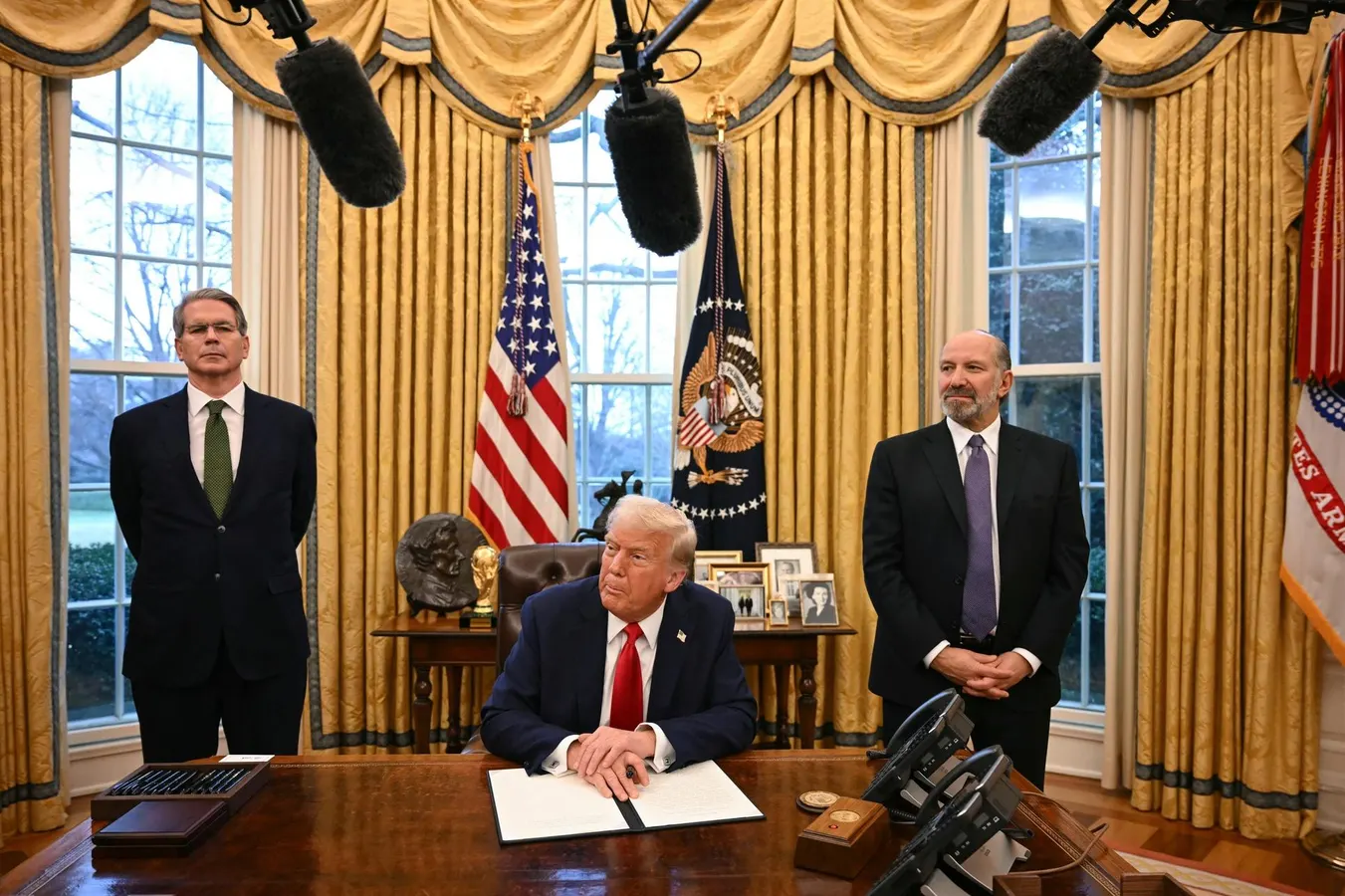
However, the intersection of Trump’s private financial dealings with Charles Schwab Bank and his public role as a dominant political figure raises inevitable questions about ethics, influence, and the optics of presidential power. In April 2025, during a period of high-stakes global trade negotiations and sweeping domestic economic policy overhauls, the legendary founder of the bank, Charles Schwab himself, paid a high-profile visit to the White House. The billionaire financier was photographed hanging out in the iconic Oval Office alongside Donald Trump, newly appointed Treasury Secretary Scott Bessent, and Commerce Secretary Howard Lutnick. Following the meeting, Trump publicly lauded the banking icon, calling him “one of the great financial people” and fondly recalling that Schwab had privately told him he had been waiting forty years for a leader to implement the exact economic policies Trump had put forward in the preceding month. While there is no direct evidence to suggest that the founder’s warm Oval Office reception or his enthusiastic endorsement of the administration’s economic policies were linked to the highly lucrative, low-interest pledged asset line extended to Trump by his namesake bank, the timing of these events creates a complex web of overlapping personal and political interests. In a landscape where the Trump Organization, the White House, and representatives for Charles Schwab Bank have all declined to comment on the matter, the public is left to ponder the delicate boundaries between private wealth management and public trade statecraft.
Ultimately, this opaque financial arrangement highlights the growing limitations of decades-old government ethics and disclosure frameworks in an era dominated by hyper-wealthy, modern political figures. The federal ethics disclosures designed in the wake of the Watergate scandal were built for a simpler financial era, intended to monitor traditional stock portfolios, straightforward savings accounts, and physical property deeds. They were never fully envisioned to police the complex, modern financial machinery of a global brand empire that moves effortlessly between commercial real estate, high-stakes international trade policies, massive institutional credit lines, and hundreds of millions of dollars in highly volatile, decentralized cryptocurrency royalties. When a public figure can secure an undisclosed amount of debt exceeding $50 million from a major domestic bank under an “N/A” maturity timeline, the traditional mechanisms of public oversight and accountability are stretched to their absolute limits. As the boundaries between corporate influence, decentralized digital fortunes, and executive governance continue to blur, the true nature of Donald Trump’s modern debt profile remains an intriguing dark spot on his balance sheet. This ongoing financial opacity leaves voters and analysts alike searching for clarity in a world where the ultimate cost of unchecked institutional leverage is often paid in the delicate currency of public trust.