





Tom Mueller navigates his custom, candy-green Porsche Taycan Turbo S with the exact kind of raw, uncompromising intensity that he once used to revolutionize modern rocket propulsion: with a breathtaking burst of instantaneous torque and a complete disregard for the mundane speed limits of El Segundo. As the electric sports car cuts a sharp path westward down Marine Avenue, slicing through the heavy, smog-filtered afternoon sunlight of Southern California’s South Bay aerospace corridor, Mueller is focused on a far grander bottleneck: the physical limitations of planet Earth. At sixty-five years old, having spent his entire adult life building technologies to escape our atmosphere, he is increasingly preoccupied with the sheer mathematics of resource exhaustion, citing the exponential, ravenous energy grid demands of modern artificial intelligence data centers as an immediate threat. He warns that if human enterprise continues its current pattern of unchecked growth, the world will eventually deplete its metals, minerals, and practical energy reserves, with AI compute alone requiring the entirety of Earth’s current electrical output by the year 2045. For Mueller, peeking out from behind a pair of reflective wrap-around sunglasses, the solution is not to scale back our ambitions, but to expand our industrial footprint into the cosmos, where the moon and near-Earth asteroids harbor billions of tons of pristine iron, silicon, water-ice, and rare metals waiting to be harvested. Spotting a brief gap in the congested South Bay traffic, he stomps on the accelerator pedal, sending the Porsche rocketing from zero to sixty miles per hour in a neck-snapping 2.3 seconds, unleashing a wild, youthful cackle as the brutal physical force pins his passengers deep into their leather seats.
This uncompromising, high-speed vision of the future is the driving force behind Impulse Space, the Redondo Beach-headquartered startup that Mueller founded in 2021, just months after walking away from his historic run at SpaceX. While his former employer has successfully established an ironclad monopoly on launching payloads from the Earth’s surface, Impulse is aiming to colonize the next critical frontier: “in-space mobility,” the complex art of moving satellites, equipment, and eventually human crew members once they are delivered into orbit. Rather than building massive, ground-shaking booster rockets, Impulse designs highly agile spacecraft that hitchhike to space inside the cargo bays of larger launch providers, waiting to detach so they can act as orbital tugboats and ferry sensitive payloads between wildly different altitudes. The startup’s primary competitive advantage lies in its sheer speed, a crucial element in an industry historically plagued by agonizing delays. While the vast majority of modern satellites rely on ultra-efficient but painfully sluggish electric thrusters that take up to a year to slowly crawl from low-Earth orbit to high geostationary orbits over twenty-two thousand miles up, Impulse utilizes self-developed chemical engines fueled by highly energetic liquid methane and liquid oxygen. This cosmic choice of propellants essentially converts a grueling, six-month orbital trek into a brisk, twenty-four-hour journey, effectively swapping the slow, steady progress of a terrestrial cargo freighter for the rapid, on-demand speed of an overnight delivery aircraft.
Mueller’s bold logistical bet comes at a time of unprecedented financial enthusiasm for the extraterrestrial, with global space sector spending forecasted to skyrocket from $600 billion to an astronomical $1.8 trillion by the middle of the next decade. Venture capitalists, eager to find the next generation of aerospace giants, poured a record $55.3 billion into space startups last year alone, fueling an investment environment where Impulse Space has swiftly raised over $1 billion and secured a pressure-tested private valuation of $4.3 billion. This soaring tide of capital, combined with his valuable early equity in both SpaceX and his new venture, officially vaulted Mueller into the ranks of the global tech billionaires this past spring, with an estimated net worth sitting at a comfortable $1.7 billion. However, underneath the glittering valuations and the personal fortunes lies a profound, high-stakes gamble against market timing, as Impulse is actively pouring hundreds of millions of dollars into developing sophisticated, high-speed transportation infrastructure for a marketplace that is still largely theoretical. Industry analysts point out that while the capabilities Mueller is building are incredibly impressive, they are designed to support a mature, hyper-active space economy—including asteroid mining, lunar bases, and commercial space stations—whose commercial viability is still years, if not decades, away from actual realization.
Mueller’s innate passion for building things from scratch was forged in the modest, hard-working environment of Saint Maries, Idaho, an isolated logging town of just twenty-five hundred residents nestled deep in the Pacific Northwest. The son of a local logger, he grew up far removed from the pristine laboratories of defense contractors, spending his youth riding dirt bikes through the pine forests and working at a local grocery store to save up for his first car, a rusty 1977 Triumph Spitfire whose engine he constantly disassembled and rebuilt. Guided by a supportive high school mathematics teacher who recognized his raw spatial intelligence, he pursued mechanical engineering at the University of Idaho, developing a reputation as a gritty, hands-on maker who understood the tactile, messy reality of machinery far better than academic theorists. By 1985, he had migrated to Southern California to work as a propulsion engineer for TRW, cutting his teeth during the golden era of President Ronald Reagan’s multi-billion-dollar “Star Wars” missile defense push, where he was given free rein to construct and test bizarre, highly volatile rocket engines. Yet, as the defense sector became increasingly bureaucratic, Mueller grew profoundly frustrated with corporate committees and slow-moving regulatory red tape, leading him to seek creative refuge in the Mojave Desert on weekends with the Reaction Research Society, where he built a massive, thirteen-thousand-pound-thrust amateur engine that caught the attention of an ambitious internet entrepreneur named Elon Musk in 2002, who promptly hired Mueller as SpaceX’s first official employee.
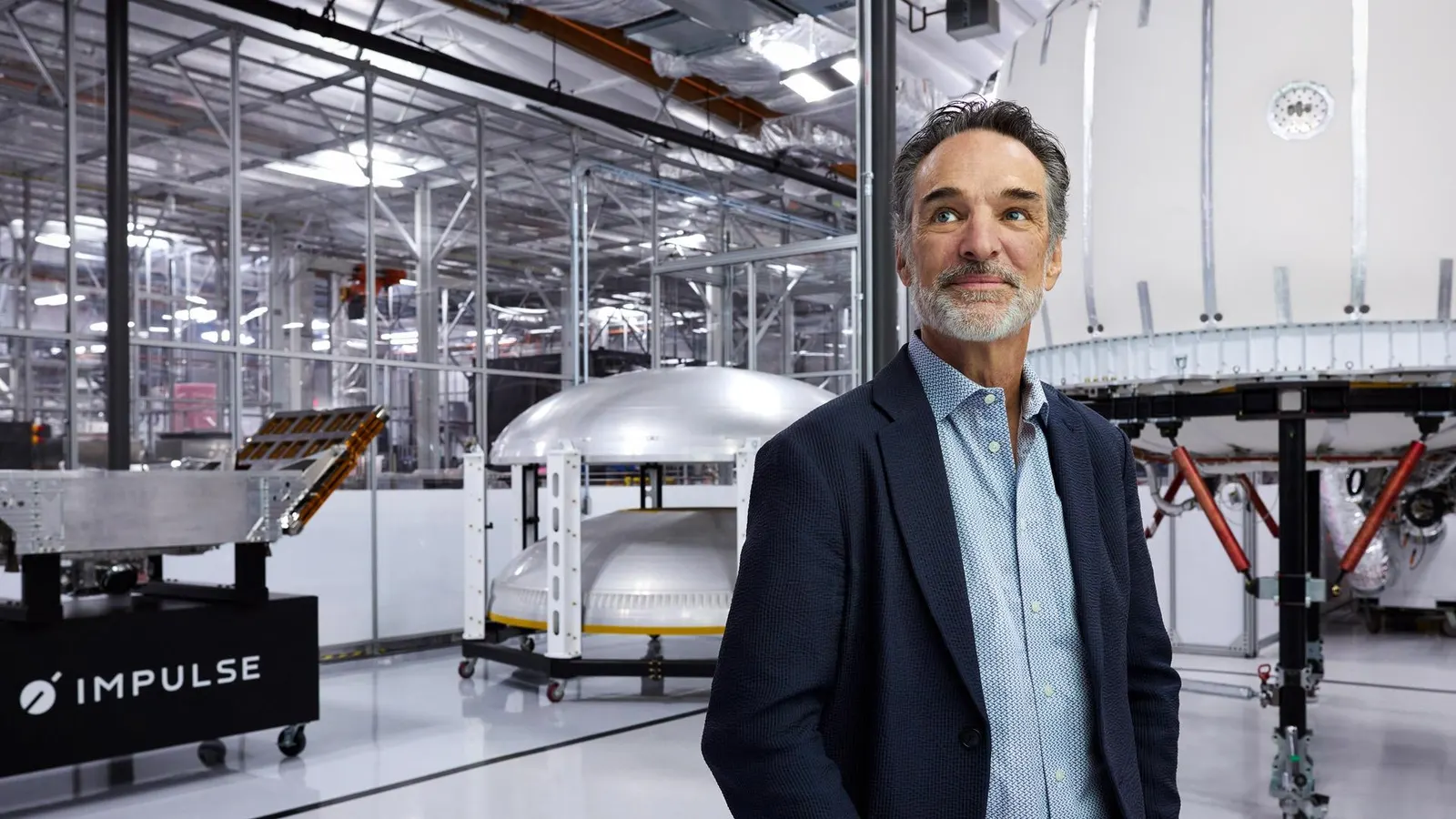
At SpaceX, Mueller served as the quiet, engineering engine room behind Musk’s grandest ambitions, leading the development of the iconic Merlin engine that powers the Falcon 9—a rocket that now handles over eighty percent of all global satellite launches—before he shifted his focus to the vertical operations of Impulse Space inside their sprawling, sixty-thousand-square-foot facility in Redondo Beach. Within this high-tech manufacturing hub, hundreds of young engineers supervise high-precision 3D printers that melt exotic metal alloys in glass chambers, striving for the same total vertical integration that made SpaceX a global powerhouse by keeping the production of avionics, propellant tanks, and thrusters strictly in-house. Mueller remains a deeply hands-on executive, keeping a simple graph-paper notebook on his desk filled with intricate, hand-drawn engine parts that he often refines in computer-aided design software before personally fabricating early prototypes in his private, car-filled home garage. This rigorous design culture has already yielded two core vehicles: Mira, a compact orbital bus that has successfully completed multiple missions of satellite deployment, and Helios, a massive, water-tank-sized heavy-hauler scheduled for its maiden flight in 2027 to carry four-ton payloads directly to high orbit. Even when a recent software glitch during Mira’s third flight caused its sensors to over-correct and prematurely exhaust its fuel supply, the industry remained fiercely confident in Impulse’s engineering department, knowing that such teething issues are merely par for the course under Mueller’s experienced oversight.
While the commercial market for orbital shipping slowly matures, Impulse’s immediate financial survival is securely anchored by Uncle Sam, with the United States Space Force aggressively requesting $71 billion for fiscal year 2027 to bolster cosmic defense networks, and NASA funding ambitious permanent bases on the moon. This surging tide of national security spending has already secured Impulse nearly $400 million in government contracts, providing a crucial operational cushion as the company awaits the deployment of SpaceX’s massive Starship rocket, a vehicle whose massive payload capacity could dramatically accelerate the need for in-space orbital transfer tugs. Though some industry insiders wonder if SpaceX might eventually leverage its capital to build its own fleet of orbital transfer vehicles and crush the startup, Mueller remains characteristically unbothered, chuckling at the unpredictable, shifting focuses of his former boss while focusing entirely on his own operational lane. Driving his Porsche past the retired Falcon 9 booster standing like an industrial monument outside the SpaceX campus in Hawthorne, Mueller feels no distracting nostalgia, keeping his eyes on the road ahead and methodically planning a route featuring only right turns to avoid the friction of rush-hour traffic. For the legendary engine builder, the endless space between the stars is just another highly complex routing system waiting to be streamlined, mastered, and ultimately opened for business.