





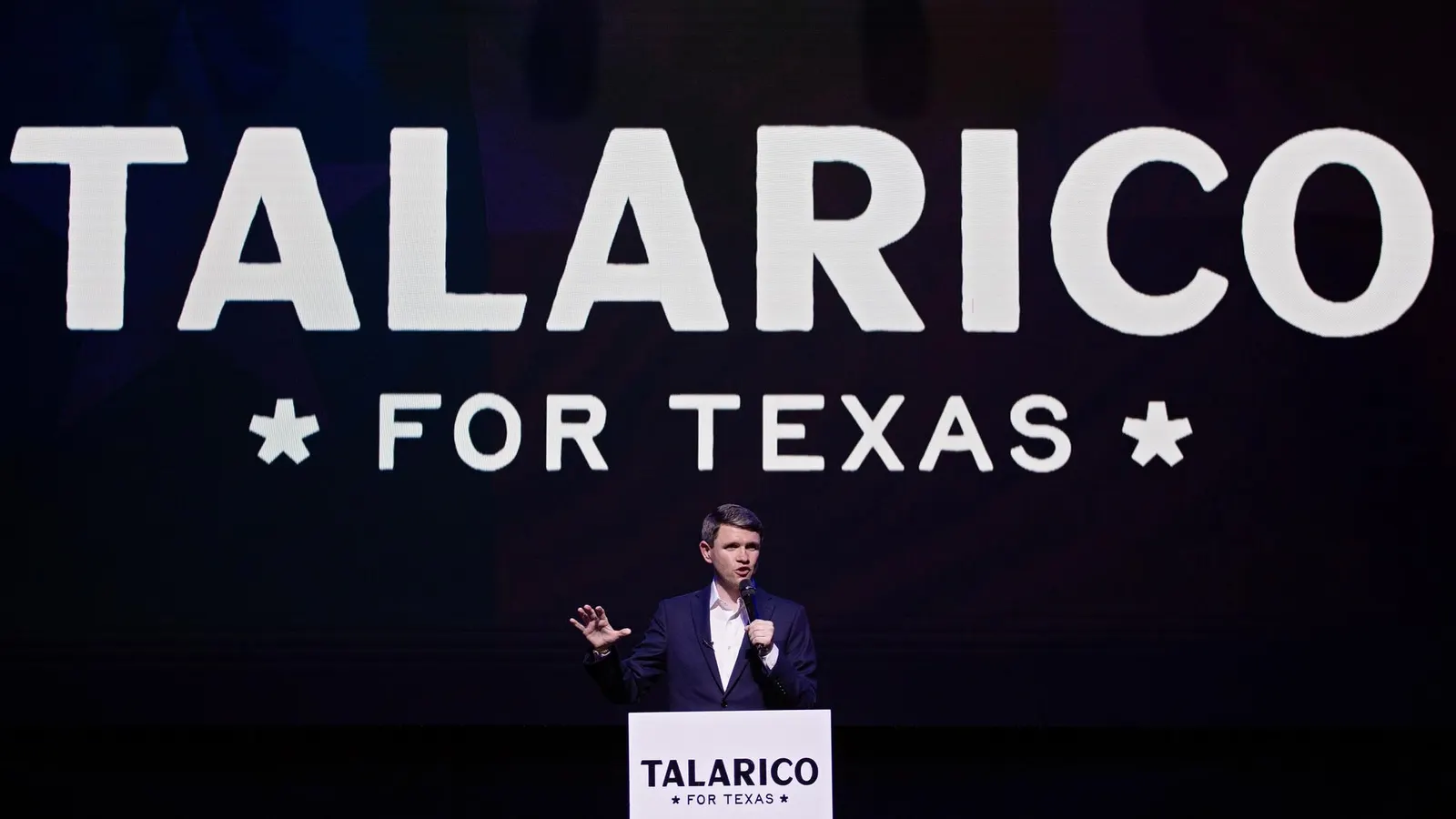
Not long ago, James Talarico was a figure known mostly to the local communities he served within the state of Texas—a former middle-school English teacher, a dedicated state representative, and a thoughtful seminarian seeking to marry deep spiritual faith with the muddy realities of public service. An eighth-generation Texan who possesses an abiding love for his home state, his sudden rise to national political prominence was nothing short of spectacular, catalyzed by a high-profile media tour that saw him articulate a powerful message of economic populism on major nationwide platforms, most notably during an appearance on Joe Rogan’s widely-listened-to podcast. During these broad-reaching discussions, Talarico carved out a distinct identity by launching ferocious, direct, and uncompromising attacks on the highly corrupting power of money in American politics, famously telling Rogan that the personal values, moral character, or policy positions of elected officials are ultimately irrelevant if billionaires are able to simply buy whoever winds up winning office. He did not mince his words or hide behind polite euphemisms, going so far as to publicly label billionaires as “the only minority destroying America” and passionately arguing that the extreme consolidation of wealth in the hands of a select few constitutes an existential and active threat to the very foundations of democratic self-governance. For a political landscape often dominated by highly polished, carefully focus-grouped talking points designed to avoid offending wealthy donors, Talarico’s fiery and direct rhetoric offered a refreshing, albeit highly provocative, voice that deeply resonated with working-class voters who felt increasingly alienated by a political system that seemed to cater exclusively to the desires of the ultra-wealthy. His unique background as an educator who worked with children and a student of theology lent a powerful sense of moral authority to his populist crusade, making his critique of systemic inequality feel less like standard partisan bickering and more like a deeply held ethical conviction that transcended typical political gamesmanship.
However, the messy, highly demanding reality of running a major modern political campaign in a massive, geographically diverse, and incredibly expensive state like Texas has forced an intriguing and highly visible paradox to the center of Talarico’s ambitious bid for the United States Senate. Despite his unrelenting public broadsides against the billionaire class and his frequent assertions that hyper-wealthy donors are subverting the will of the people, a thorough and detailed analysis of federal campaign finance filings reveals that Talarico’s official campaign and the super PACs dedicated to securing his election have quietly accepted at least $2.5 million in total financial support from at least seven prominent billionaire households. This stark and undeniable contradiction between fiery populist rhetoric and the hard numbers on his campaign ledger sheets has not gone unnoticed, drawing intense scrutiny from political opponents who question the authenticity of his anti-wealth crusade, while presenting observers with a fascinating study in the inevitable compromises required for contemporary political survival. When pressed by journalists on this apparent discrepancy, Talarico’s campaign has responded with a highly pragmatic, almost defensive realism that highlights the sheer difficulty of competing in high-stakes statewide races without leveraging every financial tool and resource legally available. Campaign spokesperson JT Ennis defended the arrangement by arguing that if any billionaire genuinely desires to support progressive policies, tax their own massive wealth more heavily, and voluntarily limit their own disproportionate political influence, they should be warmly welcomed into the collective, urgent effort to defeat far-right politicians like Republican Attorney General Ken Paxton. Simultaneously, the campaign has worked tirelessly to protect Talarico’s grassroots credentials, pointing out that an impressive ninety-seven percent of the individual donations received directly by his official campaign during the first quarter of 2026 were in small-dollar increments of $100 or less, attempting to maintain a narrative of a campaign fueled by ordinary working people even as it is heavily fortified by elite finance.
This financial dualism is unfolding against the backdrop of an intensely competitive, high-stakes political environment in Texas, where Talarico successfully secured his party’s nomination in the Democratic primary on March 3. The true scale of the money flowing into this specific race is difficult to overstate, particularly as national Democratic strategists identify Texas as a premier, logical battleground where they can potentially flip a crucial Senate seat, a monumental task that will inevitably require hundreds of millions of dollars from nationwide donors before the final ballots are cast in the November general election. This overwhelming reality explains why Talarico, regardless of his public disavowal of the billionaire class and his theoretical opposition to high-dollar political access, has been spotted attending exclusive, closed-door fundraisers with wealthy, progressive power brokers in the San Francisco Bay Area, demonstrating that the immense gravitational pull of coastal venture capital is nearly impossible for a modern statewide candidate to resist if they hope to remain competitive. Meanwhile, the Republican side of the political spectrum has experienced its own dramatic, money-drenched transformation that has reshaped the state’s conservative establishment. Incumbent Senator John Cornyn, a long-standing fixture of traditional Texas politics, was unexpectedly ousted in a fiercely contested primary by Ken Paxton, the state’s controversial and highly resilient Attorney General, who successfully marshaled his own substantial army of billionaire backers to fuel his insurgent campaign. As the general election approaches, the race is rapidly transforming into an unprecedented financial arms race of historic proportions, establishing a scenario where both candidates, despite their radically different public platforms and ideological identities, find themselves profoundly dependent on the financial decisions of a tiny, hyper-wealthy global elite to broadcast their competing messages to the millions of voters across the Lone Star State.
To understand the mechanical foundations of Talarico’s campaign apparatus and super PAC support, one must look closely at the specific billionaires who have chosen to cross his palm with silver, starting with the technology and finance sector giants who form the absolute vanguard of his financial backing. Chief among these powerful patrons is Silicon Valley legend Reid Hoffman, the co-founder of LinkedIn and an early PayPal executive, whose net worth hovers around $2.7 billion and who has emerged in recent years as one of the most prolific and influential donors to the Democratic Party. Hoffman, who publicly describes himself as a political centrist who rejects ideological extremes on both sides, donated an eye-popping $1.5 million to Lone Star Rising, the primary super PAC working alongside Talarico’s campaign, while simultaneously engaging in highly publicized, high-stakes legal and political warfare with Donald Trump over his financial support for E. Jean Carroll’s civil lawsuit. Joining Hoffman in this major financial venture is Stephen Mandel Jr., the billionaire founder of the prominent hedge fund Lone Pine Capital, who carries a net worth of $5 billion and boasts a decades-long history of supporting progressive candidates dating back to Bill Clinton’s 1992 presidential campaign. Mandel, alongside his wife, contributed a substantial $500,000 to the pro-Talarico super PAC, a massive move that aligns with his broader philanthropic and political efforts, which include multi-million dollar donations to Kamala Harris’s presidential bids and active, long-term involvement in the charter school expansion movement and Teach for America. Rounding out this top echelon of tech and finance backers are venture capitalist Tench Coxe, a major individual shareholder in the semiconductor behemoth Nvidia, and his wife Simone Coxe, a highly successful former public relations executive. Together, the Coxes contributed approximately $500,000 to support Talarico, establishing a fascinating bipartisan bridge given Tench Coxe’s historical support for high-profile conservative figures like Mitt Romney, thus proving that Talarico’s political appeal extends even to those deep within the traditional structures of corporate venture capital and global market investment.
Beyond these massive, multi-million dollar contributions to independent super PACs, Talarico’s official campaign committee has attracted direct, maximum-allowable individual donations from several other highly noteworthy members of the global billionaire club, illustrating how his network of elite support seamlessly spans both local Texas dynasties and national financial cartels. Among his home-state backers are John and Laura Arnold, a highly influential Houston-based couple who amassed a $2.8 billion fortune through John’s highly successful career as an energy trader at Enron before pivoting to full-time, systemic philanthropy. Over the past fourteen years, the Arnolds have donated more than $2 billion of their personal wealth to advocate for criminal justice reform, community college funding, and public education, and they chose to provide $3,500 each to Talarico’s campaign, despite also keeping a foot in the conservative camp by donating to the now-defeated incumbent Senator John Cornyn prior to his primary loss. This highly strategic, bipartisan giving pattern is contrasted by the deeply ideologically driven support of Henry and Marsha Laufer, who contributed a combined $7,000 to Talarico’s official committee. Henry Laufer, a former mathematics professor who accumulated his $3.2 billion fortune by developing quantitative trading algorithms for Jim Simons’ legendary hedge fund Renaissance Technologies, has long been a highly reliable and massive financial pillar for major Democratic candidates and progressive causes nationwide. Joining the Laufers are Dirk and Natasha Ziff, heirs to a historic publishing fortune who have constructed a massive, highly successful investment empire through Ziff Capital Partners. The Ziffs, who possess an estimated net worth of $7.2 billion and have a long history of investing millions into progressive political organizations since 2020, also contributed the maximum individual amount of $7,000 to Talarico, further demonstrating how seamlessly the candidate’s staff has integrated coastal investment capital into their fundraising operations.
Rounding out this impressive roster of high-net-worth supporters is Laurie Tisch, an heir to the multibillion-dollar Loews Corporation conglomerate and a prominent co-owner of the New York Giants, who donated $5,000 directly to Talarico’s official campaign committee. Tisch, whose personal wealth is estimated at $2.2 billion, has spent hundreds of thousands of dollars supporting Democratic candidates across the nation, though her political interventions are often highly calculated and deeply localized, as evidenced by her significant financial backing of efforts to stall left-wing progressive challengers in her home state of New York, including a substantial contribution to super PACs aligned with Andrew Cuomo to block candidates like Zohran Mamdani. Ultimately, the story of James Talarico’s Senate run is a profoundly human narrative about the inescapable tensions, moral gray areas, and systemic compromises that define modern democratic politics in the twenty-first century. It forces us to confront a highly uncomfortable truth: in an era where running a successful statewide political campaign requires astronomical sums of capital, even the most passionate, well-intentioned reformers find themselves forced to play by the rules of the very system they seek to dismantle. As Talarico continues to campaign across the vast state of Texas, speaking passionately to everyday citizens about the urgent need to strip billionaires of their disproportionate political power, he does so while carrying a campaign chest heavily fortified by those very same elite fortunes, leaving voters to decide whether this represents a hypocritical betrayal of core principles or a necessary, pragmatic strategy to weaponize the resources of the wealthy to achieve lasting, systemic change for the common good of all Americans.