





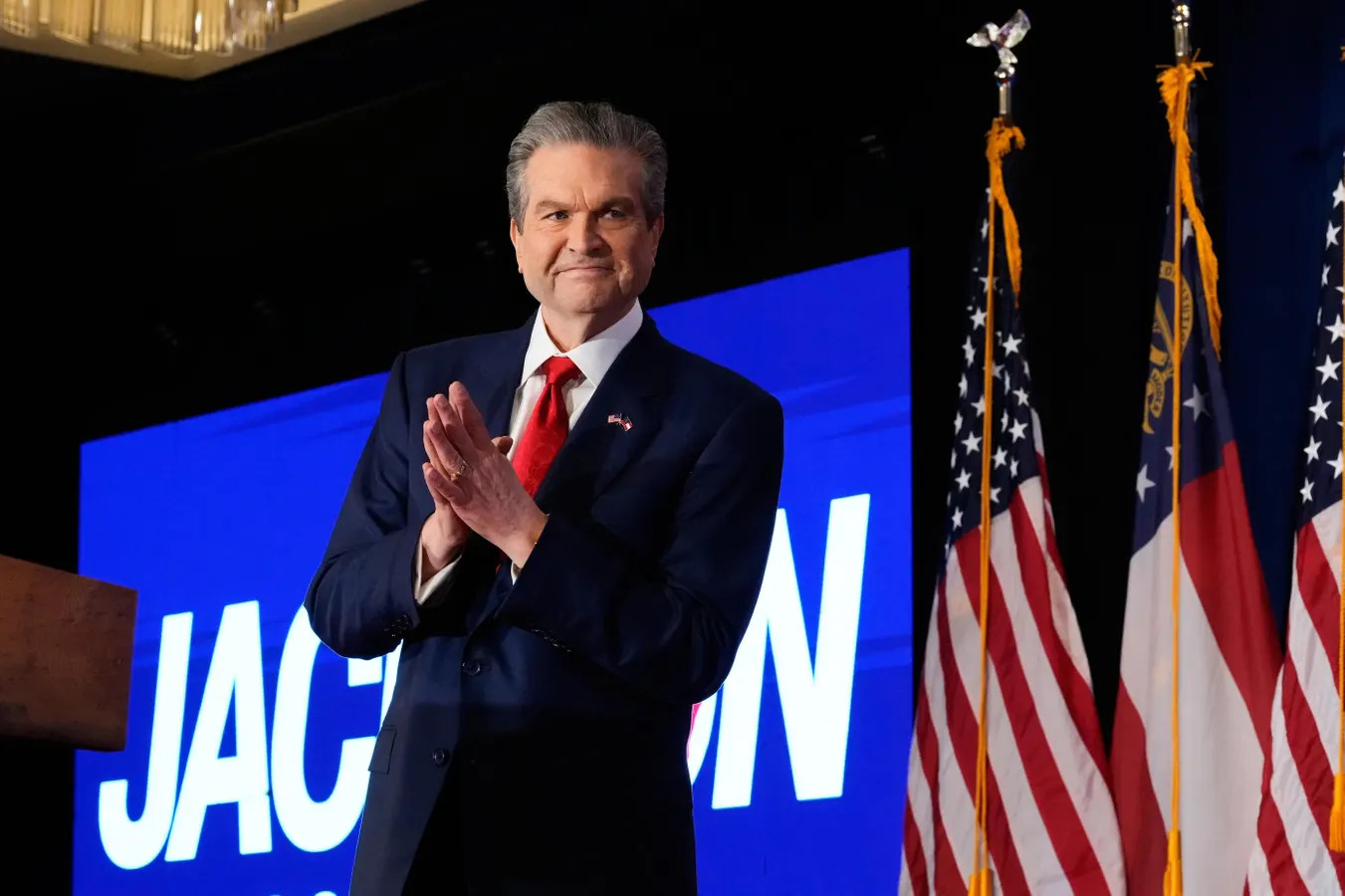
On June 16, the political landscape of Georgia was permanently reshaped when billionaire healthcare entrepreneur Rick Jackson achieved a stunning upset victory over the Trump-backed candidate, Lieutenant Governor Burt Jones, in the Republican gubernatorial runoff. The election results defied the predictions of political insiders and major polls, which had consistently shown Jones maintaining a comfortable lead. Jackson’s improbable rise to the top of the ticket began earlier that year, on chilly February 3, when he stood before a crowd at his company’s head-turning, Roman Colosseum-inspired headquarters in Alpharetta to declare his outsider candidacy. Running on a platform of severe tax cuts, hardline crackdowns on illegal immigration, and deep systemic reforms to a broken healthcare system, the seventy-two-year-old launched his campaign with zero political experience, relying instead on his raw survival instincts and a staggering war chest. Forbes estimates Jackson’s net worth at over $1 billion—a fortune reflected in his gargantuan 35,000-square-foot, twenty-bathroom estate spanning seventy-two pristine acres in Cumming, Georgia. To finance his political ambitions, Jackson has reportedly poured more than $100 million of his own money into the campaign, blanketing television and digital airwaves with commercials detailing his childhood journey from foster care to corporate triumph. While analysts initially dismissed Jackson’s chances, his shocking performance in the May 19 primary secured him a spot in the runoff, prompting political scientists like Dr. Charles S. Bullock III of the University of Georgia to note that Jackson had successfully proven that unlimited money could buy a decisive share of the electorate. With his runoff victory now secured, Jackson is poised to face former Atlanta Mayor Keisha Lance Bottoms in a highly anticipated, high-stakes general election in November, demonstrating that those who count him out do so at their own peril.
To fully comprehend the tenacity driving Rick Jackson’s political and professional ambitions, one must look past his current billionaire status and examine the extreme poverty of his early years. Born into a broken home, Jackson’s father abandoned the family when he was just nine months old, leaving his upbringing entirely in the hands of his mother, an alcoholic cocktail waitress who had only achieved a sixth-grade education. Growing up in Techwood Homes, a notoriously rough public housing project situated near the campus of Georgia Tech, young Rick learned the rules of survival on the streets, hustling to make a buck by selling newspapers, peddling peanuts, and scalping tickets to college football matches. Recognizing the stagnation and danger of his domestic life, the resourceful thirteen-year-old made a desperate, life-altering decision, convincing his uncle to spend $66 of scarce welfare funds to place him in a taxi and send him to the Methodist Children’s Home in Decatur to enter foster care. Despite the upheaval, Jackson managed to graduate from the Greater Atlanta Christian School, though his financial reality prevented him from remaining at Nashville’s Lipscomb University for more than two quarters. Undeterred, he worked grueling hours at UPS, JCPenney, and a collections agency to pay off his debts, ultimately landing his first staffing job back in Atlanta in 1974 at a tiny two-person secretarial agency called Perimeter Placement. When his manager unexpectedly quit, the ambitious young Jackson saw an opportunity, leveraging what little he had to convince the owner to hand him the keys and transfer the firm’s total liabilities directly into his name, marking his official entry into the world of business ownership.
Recognizing early on that the demand for medical care is immune to economic downturns, Jackson pivoted toward the healthcare sector by taking a position in 1977 with a physician recruiter named Jackson C. Coker. Within a year, Jackson acquired that business through a five-year payout agreement, renaming it Jackson & Coker and hiring a Georgia State University business professor for $2,000 a month to guide him through the complex mathematics of scaling a company. Though he split with the firm’s original founder in 1987, Jackson kept the valuable brand name and expanded aggressively into surgery centers, allergy clinics, and specialized staffing operations. His path, however, was paved with significant setbacks; in 1996, his non-clinical medical management company, Allegiant Physician Services, collapsed into bankruptcy, requiring Jackson to spend four long, grueling years of personal effort to pay back every single one of his creditors in full. This traumatic business failure left a permanent mark on his executive philosophy, sparking a lifelong vow never to accept outside venture capital or corporate investors again. By the turn of the millennium, Jackson consolidated his decentralized network of businesses under the banner of Jackson Healthcare, a conglomerate that has since grown into a $3 billion revenue giant and the nation’s second-biggest medical staffing enterprise, outmatched only by publicly traded rivals like AMN Healthcare. Following a corporate philosophy directly inspired by legendary investor Warren Buffett’s principle of the “long-term hold,” Jackson Healthcare now operates twenty-two distinct medical staffing companies, placing thousands of physicians, nurses, and anesthesiologists across the country.
Jackson’s appetite for high-risk, purpose-driven ventures was highlighted during the height of the COVID-19 pandemic when he purchased a bankrupt, shuttered pharmaceutical factory in Bristol, Tennessee. By his own admission, the acquisition of the 400,000-square-foot plant was an incredibly poor business move on paper, but Jackson felt a deep, personal obligation to step forward, viewing the factory’s survival as a critical matter of American national security. Until 2008, the facility had served as the sole domestic producer of the active ingredients needed for Amoxicillin, a fundamental antibiotic, before losing its entire market share to heavily subsidized, cheap generic manufacturers in India who obtained their chemicals from China. Incensed by the realization that USA healthcare facilities were completely dependent on potentially hostile foreign supply lines for essential medicines, Jackson poured $50 million of his own capital into reviving the facility under the patriotic moniker USAntibiotics. Although the massive plant has yet to turn a profit, Jackson’s gamble succeeded in achieving a designation from the Department of Homeland Security as a Critical Manufacturing Infrastructure Facility, currently producing about eight percent of the nation’s total supply of Amoxicillin. This venture captured the public’s imagination, strengthening Jackson’s corporate image as a nationalistic savior willing to burn personal capital for the public good, while introducing voters to an executive who claimed he could apply the same decisive, mission-first principles to the state government of Georgia.
Despite the inspiring nature of his self-made billionaire narrative, Jackson’s entry into public life has illuminated severe hypocrisies and major conflicts of interest. Chief among these issues is the astronomical sum of money Jackson Healthcare has systematically raked in from taxpayers, particularly during the pandemic when Georgia Governor Brian Kemp bypassed normal competitive bidding processes to award Jackson’s firm a series of lucrative, single-source emergency staffing contracts. These lucrative, state-level arrangements have routed more than $1 billion in state payments directly to Jackson Healthcare, a massive flow of public cash that Jackson has promised to “unwind” and refrain from bidding on should he win the governor’s mansion in November. Furthermore, his hardline, conservative campaign rhetoric advocating for harsh crackdowns on undocumented workers has run headfirst into embarrassing reports that he employed undocumented immigrants to landscape his own private Cumming estate. Critics have also pointed out that his corporate staffing network has derived immense profits by importing foreign medical professionals under EB-3 visas, a practice that has landed some of his subsidiaries in legal trouble. Specifically, Avant Healthcare Professionals, a subsidiary of Jackson Healthcare, is currently battling a high-profile class-action lawsuit in a Florida federal court where international nurses have accused the company of violating federal labor laws and engaging in racketeering (RICO) by promising them the American Dream, only to trap them in predatory, high-penalty “stay-or-pay” employment contracts.
As the race moves into the general election phase against Keisha Lance Bottoms, Jackson’s bid to run Georgia like one of his private corporations faces steep cultural and structural hurdles. Historically, Georgia’s electorate has shown a deep-seated resistance to self-funded, ultra-wealthy political outsiders, famously rejecting candidates like Kelly Loeffler, who lost her 2020 Senate bid despite spending $34 million of her husband’s stock-exchange fortune. The state’s history shows that Georgia’s governors have almost exclusively been career political insiders, with very few exceptions over the past century. Political scientists point out that Jackson’s experience as an absolute CEO, where his corporate directives are met with immediate compliance, will not prepare him for the tedious, frustrating gridlock of the state legislature, where a governor must negotiate, compromise, and build consensus. If he wins, the fast-talking healthcare tycoon will find himself in an arena where money alone cannot buy consensus, and his corporate authority will be heavily checked by entrenched political factions. Yet, as his life has repeatedly proved—from the rough Techwood public housing complex to his sprawling Alpharetta headquarters—Jackson is a man who thrives when the odds are stacked against him. Whether his raw survival instincts and formidable business acumen can translate into effective democratic governance remains an open question, but his journey has already redefined what is possible in the modern era of Georgia politics.