

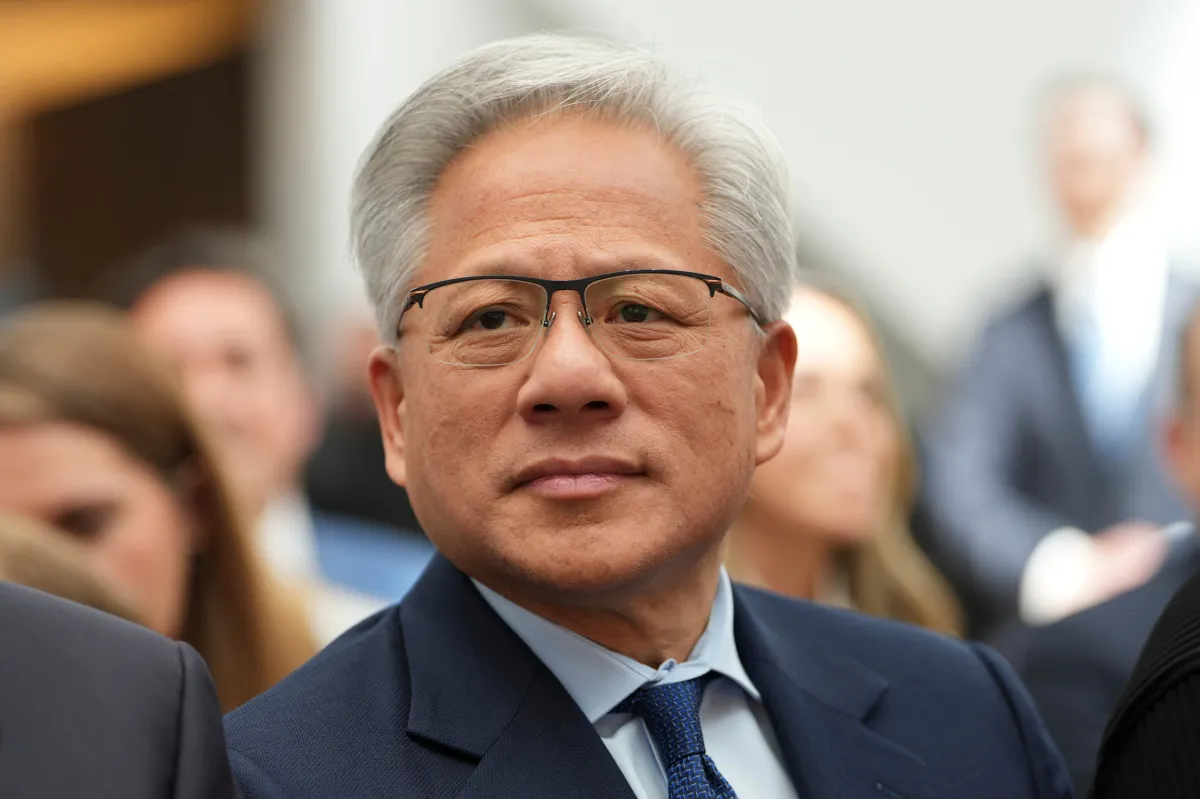
There is a kind of story that only makes sense when power, money, and suspicion collide. Jensen Huang, the leather-jacket-wearing, rock-star chief executive of Nvidia, has spent the past few years as the face of the artificial intelligence boom, a man courted by presidents, CEOs, and governments alike. Now he is at the center of a scandal that has all the ingredients of a political thriller: a beautiful former television host, a Singapore-based company with murky ties, billions of dollars in banned chip sales, and the intelligence services of the world’s two most powerful nations. The allegation, at least as it has been framed in certain American media reports, is that Huang’s alleged mistress, a woman known only as Alice, was more than a romantic partner—that she may have been a Chinese spy. But in Washington and Beijing alike, many are asking a different question: why is this story coming out right now? For skeptics, the timing is too convenient. The story exploded just after the Republican Party suffered a major defeat in the midterm elections, and it lands at a moment when Donald Trump, newly weakened, is trying to navigate a fragile thaw in U.S.-China relations. Huang, a rare figure who has managed to remain popular in the United States, China, and Taiwan, may have been caught with his pants down, but the people pointing at him may be less interested in national security than in settling political scores.
Chinese state media has been unusually quick and aggressive in coming to Huang’s defense. The Communist Party’s propaganda machine did not merely dismiss the espionage claims; it flipped the narrative entirely. China’s Foreign Ministry said that anyone looking for links to espionage was “chasing shadows,” while the state-owned Global Times published an editorial demanding to know why the “Chinese spy” rumor had suddenly surfaced at the very moment when China and the United States were finally starting to rebuild trust. The implication was clear: this was not a leak born of genuine concern, but a deliberate smear campaign, timed to explode and sabotage the fragile detente between the two countries. The former longtime editor of the nationalist tabloid, Hu Xijin, went even further, calling Huang “a political sacrificial lamb in the bitter infighting between America’s two major parties.” In his telling, the scandal has absolutely nothing to do with China. It is, he said, “entirely an American stunt.” That framing has found resonance even in Washington, where the debate has split into two very different theories. One camp sees a tawdry but essentially human story: a powerful man, a beautiful woman, and a serious lapse in judgment that violated business ethics but not national security. The other camp sees something far darker: a foreign intelligence operation designed to infiltrate the highest levels of American tech power. The truth may lie somewhere in between, but the ambiguity itself is part of the problem. Huang’s relationship with Alice, a former executive at Megaspeed, Nvidia’s biggest client in Southeast Asia, was apparently known or suspected for at least a year. Huang is, by all accounts, one of the most photographed men in the tech world, and wherever he goes, people notice. It seems almost impossible that no one in the intelligence community or the corporate world flagged this relationship before now.
The political context only deepens the mystery. Huang has long been seen as a rare voice of reason in Trump’s ear on technology policy. He reportedly convinced the president to lower barriers to exporting Nvidia’s powerful H200 chips to Chinese AI labs, arguing that the Chinese AI industry would remain a generation behind if it relied on American hardware. It was a clever strategy, and for a while it worked. Chinese companies bought tens of thousands of the chips, and Huang positioned himself as the indispensable bridge between the two tech superpowers. But in doing so, he made enemies. Marko Jukic, a senior analyst at the consulting firm Bismarck Analysis, put it bluntly: Huang was caught in “a vicious business battle” because Nvidia’s strategy for the future of AI is fundamentally at odds with the strategies of the frontier AI labs. Nvidia wants to control the hardware layer, while the labs want to control the models and applications. Both sides are trying to maintain a monopoly over their respective layers as leverage over the entire industry. In that kind of fight, a scandal like this is a weapon. The front pages that appeared amid the GOP’s midterm defeat may have been a calculated move by hawks in the U.S. government—people who wanted to weaken Trump at a moment of vulnerability and, at the same time, push for stricter restrictions on China’s access to American technology. Huang, in this reading, was not the target of a Chinese operation but the victim of an American political hit job. The fact that the story broke at such a sensitive diplomatic moment only adds fuel to that theory.
Beijing, for its part, has made it clear that it will not simply play the role of the eager buyer in Huang’s grand vision. In the ten months since the H200 chips were cleared for sale to China, Chinese companies have purchased tens of thousands of them. But the Chinese government has not been so enthusiastic. According to reports, more than half a billion units are sitting idle in Hong Kong, waiting for approval from Chinese authorities to enter the mainland. This is not a logistical hiccup; it is a deliberate decision. President Xi Jinping sees strategic vulnerabilities in relying on foreign technology, especially in a sector he considers vital to China’s long-term economic prosperity. The Chinese leadership understands that buying American chips is easy, but building an independent AI ecosystem is hard. If China simply opens its wallet and buys everything Nvidia wants to sell, it will remain permanently dependent on the United States. That is exactly the outcome Huang and Washington have in mind, and Beijing is not interested. A Global Times op-ed last week pushed back directly on the idea that China would accept a U.S. chip business plan designed to “preserve a stable technological gap between the two countries.” The paper scoffed at the notion that a slight loosening of export restrictions would trigger a buying spree in China, insisting that the Chinese market today is no longer at a stage where it must buy whatever the U.S. decides to make available. It warned that any attempt to use export controls to lock other countries out of technological progress would ultimately “come back to haunt those imposing the restrictions.” In other words, Huang’s charm offensive may have worked on American policymakers, but it has not convinced the Chinese leadership to abandon their strategic autonomy.
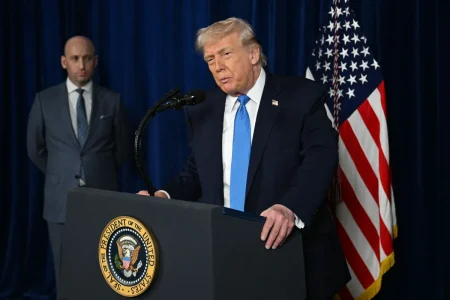
As for the espionage question itself, even the U.S. intelligence community does not seem to know what to believe. Alice, the woman at the center of the scandal, had a previous career in Chinese television and investment banking. That background, on its own, is not unusual. But China’s Ministry of State Security has a long history of recruiting or coercing well-placed Chinese nationals to do its bidding overseas. There is even a spy school in Beijing, known as the University of International Relations, that has produced generations of intelligence officers. Whether Alice was trained there, or whether she was simply a businesswoman who happened to have a relationship with the most powerful man in the AI industry, is still unclear. The lack of clarity has not stopped people from drawing conclusions. Trump, for his part, told reporters at the White House that he was “amazed” at the allegations against Huang, describing him as “a very high-quality person.” Trump said he had called Huang earlier that day and that Huang had “absolutely no idea that the person in question was a spy.” He also said the FBI was now looking into the case, though he offered no details. That leaves Huang in an extraordinarily difficult position. He cannot easily escape the circumstances he put himself in. His relationship with Alice, and his company’s business ties to Megaspeed, are now under a microscope. Megaspeed, a Singapore-based cloud computing company, purchased $4.6 billion worth of Nvidia equipment from 2022 to 2025, according to the Center for Advanced Defense Studies. A C4ADS report published in September linked Megaspeed to a web of shell companies that were transshipping blacklisted Nvidia chips to China in violation of U.S. law. Nvidia and Megaspeed have both declined to comment on the allegations. But the evidence, at least as it currently stands, is damning enough that even Huang’s defenders are not sure what to say.
The consequences of this scandal could ripple far beyond one man’s career. James Lewis, a senior adviser at the Center for Strategic and International Studies, has argued that the incident is probably fatal to Huang’s position at Nvidia, but that the damage to chip technology itself is probably minimal. The real issue, he says, is why the United States continues to tolerate aggressive espionage by a hostile foreign power. In this case, there has not even been a public rebuke of China. Lewis wrote on his Substack newsletter that China is a “hostile, aggressive power” and that while the U.S. needs to find a modus vivendi with it, that accommodation should not include “untrammeled economic espionage.” His words capture the frustration of many in Washington who believe that the U.S. has been too soft on China for too long. But they also capture the deeper irony of the situation. If Huang is truly the victim of a smear campaign, then the perpetrator is still at large. If he is guilty of recklessness or worse, then he has no one to blame but himself. Either way, the story has exposed the uncomfortable truth that the AI industry is no longer just a business. It is a battlefield, and the people who run it are not just CEOs and engineers. They are players in a global game of power, where a single scandal can shift the balance of technology, politics, and national security. Jensen Huang may have dreamed of building the future, but now he is fighting for his legacy. And the world is watching to see whether he falls, or whether he somehow manages to rise again from the wreckage of his own making.