


There’s something deeply comforting about a buffet. It’s not just the food — it’s the feeling of being in a place where you’re invited to eat as much as you want, where the options keep coming, and where the price didn’t climb with every extra spoonful. In a time when grocery bills and restaurant tabs keep creeping higher, that kind of abundance feels almost like a luxury. And Americans have clearly taken notice. According to a recent report from The Wall Street Journal, Yelp searches for all-you-can-eat buffets have jumped a staggering 252%. That surge makes sense when you consider how expensive eating out has become. People are looking for ways to feel like they’re getting more than they paid for, and a buffet is one of the last places where that can genuinely happen. For a family, it’s a way to feed everyone without running up a shocking bill. For older diners, it’s a familiar ritual that brings back memories of Sunday afternoons. For young food lovers, it’s a chance to explore flavors from around the world in a single sitting. The old image of a buffet — a sad line of colorless food under heat lamps — no longer tells the whole story. Yes, mega-chains like Golden Corral still dominate the landscape. But the five spots highlighted here show just how far the buffet concept has expanded. From a Manhattan spot serving Southern comfort food to a New York supermarket celebrating Uzbek cuisine, from a Korean barbecue chain that lets you cook at your table to a heartland favorite that feels like a trip to your grandmother’s farmhouse, and from there to a Brazilian steakhouse loved by Gen Z, the buffet has been reborn. It now means many different things: all-you-can-eat, pay-by-weight, grill-at-your-table, or roast-carved-in-front-of-you. What hasn’t changed is the underlying promise: you won’t leave hungry, and you won’t feel shortchanged.
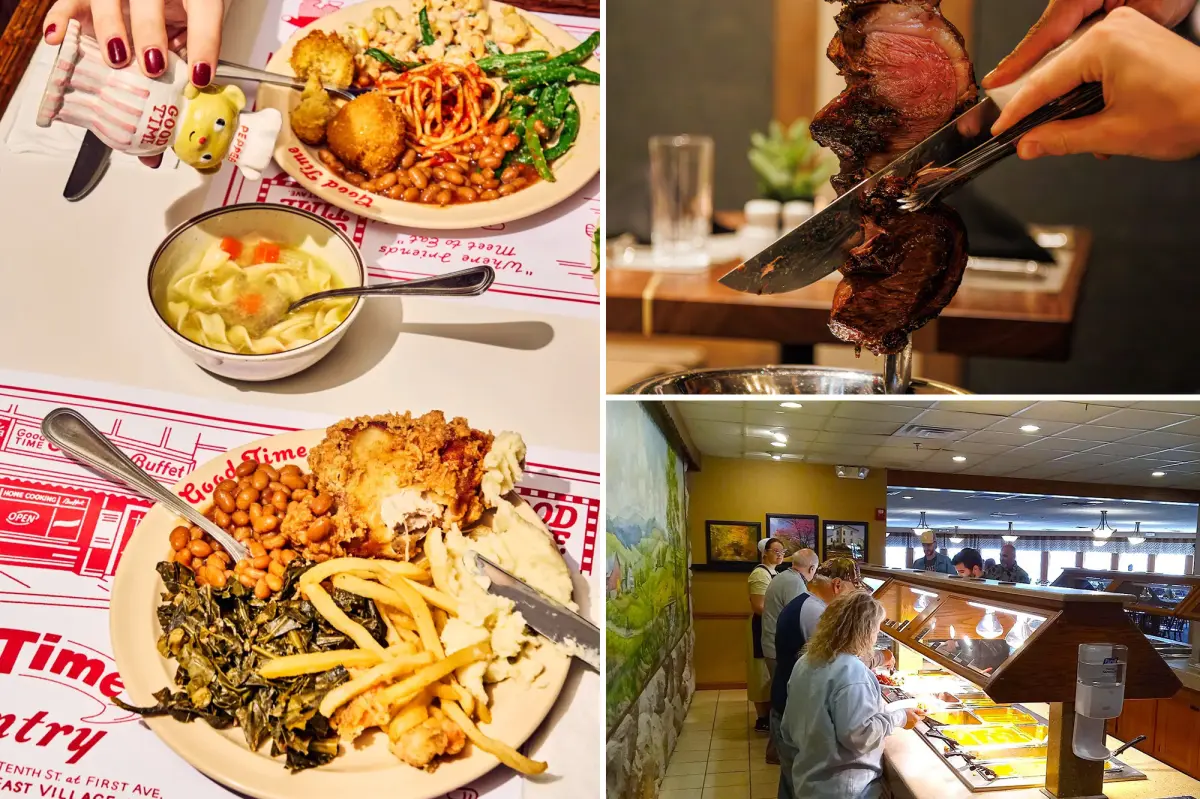
In Manhattan, that promise comes with a side of nostalgia and Southern cooking. Good Time Country Buffet opened in September with the kind of spread that feels familiar in all the right ways. Salisbury steak, collard greens, dinner rolls, peach cobbler — these are dishes that don’t try to be fancy. They’re meant to be comforting, filling, and loaded with flavor. For $26.99, you can go back as many times as you like, which in New York City feels almost like a bargain. Co-founder David Yun said the goal was to offer “something affordable” and to evoke “the humble buffet that really brings you back to that memory.” And that’s the key to its appeal. In a neighborhood where rent is high and restaurant prices are often higher, Good Time offers something remarkably rare: a meal that feels timeless. The room itself is unpretentious — the kind of place where you can take your time, pile your plate high, and not feel rushed. You might come in tired from the city and leave feeling like you just had dinner at a relative’s house a few decades ago. The servers are friendly, the steam trays are full, and the dessert table probably has something warm waiting for you at the end. For anyone who grew up eating at small-town buffets, walking into Good Time feels a little like coming home. For everyone else, it’s a chance to understand what that experience is all about — generous portions, simple flavors, and the quiet joy of knowing that seconds are always on the table.
A little further south in New York, there’s another kind of buffet experience entirely, one that most Americans might not have encountered before. Tashkent Supermarket, in the West Village, has become an unlikely destination for people curious about Central Asian cuisine. The store has a hot bar featuring dozens of prepared dishes — plov, which is the fragrant rice dish beloved across the region, stuffed cabbage, manti dumplings, and an assortment of pastries that are both savory and sweet. Unlike traditional all-you-can-eat buffets, you pay by weight here. According to The Wall Street Journal, a takeout container full of goodies typically costs anywhere from $10.99 to $11.99 per pound. That means you could grab a little bit of everything and get a delicious meal for a lot less than you’d spend at a standard sit-down restaurant nearby. Since the supermarket opened last year, it has put a spotlight on Uzbek food in a part of the city known for its adventurous dining scene. Food bloggers have helped spread the word, filming the colorful trays, the warm breads, and the satisfying scoop of plov. But what makes Tashkent so special isn’t just the food — it’s the feeling of discovery. You walk in expecting to grab a quick bite, and suddenly you’re drawn to the smells of heated spices, the sight of dough being baked in the back, and the unfamiliar but welcoming names of dishes you’ve never tried. The hot bar is both a supermarket convenience and a cultural introduction. It lets you taste someone’s home cooking without a formal menu, without a waiter, without the pricey atmosphere. You can stand at the counter, point at what looks good, and walk out with a warm bag of food that turns lunch into an adventure. In a city filled with culinary trends, Tashkent is proof that buffets don’t have to be about excess. Sometimes they’re about expanding your palate, one pound at a time.
For those who want a more hands-on buffet, there’s KPot Korean BBQ and Hot Pot. This isn’t the kind of place where you wait for food to appear in a steam tray. Instead, you sit at a table with a built-in grill, pick your ingredients, and cook them yourself. You can do Korean barbecue — thin slices of meat, vegetables, and noodles sizzling over flames — or you can go the hot pot route, dropping those same ingredients into a bubbling broth that simmers at the center of the table. The best part? You don’t have to choose. For an extra $5, diners can do both, which is exactly the kind of option that makes a buffet so appealing. Prices vary depending on where you are. The Wall Street Journal reports that the all-you-can-eat deal runs about $36.99 in New York and $31.99 in Oklahoma City, and the menu can adjust to local tastes. But the experience is consistently interactive, social, and loud in the best way. There’s smoke rising from the grill, steam rolling off the broth, and laughter from friends trying to figure out who gets the last piece of bulgogi. KPot has grown into one of the largest Korean restaurant chains in the country, with locations in nearly forty states. That’s impressive for any restaurant, but especially for one that requires diners to do some of the cooking themselves. The beauty of KPot is that it turns a meal into an event. You’re not just consuming food; you’re participating in it. Every table is different because every table cooks differently — some people like their meat charred and crispy, others prefer it tender and barely kissed by the grill. The buffet is no longer just about abundance; it’s about control. You decide what goes into the pot, how long it stays on the fire, and how many sauces you want to mix together. It’s the kind of place where time disappears. You sit down, and two hours later you’re still nibbling on something, dipping it into another sauce, wondering if you have room for one more slice of brisket.
If KPot is the loud, energetic version of a buffet, Der Dutchman is the opposite. It’s the kind of place that makes you want to slow down, sit on a rocking chair, and watch the world go by. Located in the heartland, surrounded by rolling farmland and Amish country, Der Dutchman serves hearty, home-style food inspired by Amish and Mennonite cooking. The menu includes all the classics: creamed chicken, meatloaf, baked ham, and noodles with mashed potatoes. It’s food that doesn’t try to impress you with novelty or exotic ingredients. Instead, it comforts you with familiarity, salt, butter, and the kind of warmth you associate with a family dinner. One diner told The Wall Street Journal that the restaurant has “a good rocking-chair-on-a-big-front-porch type of vibe,” and that description couldn’t be more accurate. The dining room feels like a farmhouse kitchen expanded to feed the whole county. There’s no rush, no pretense, no food trends. Just honest cooking and a sense of welcome that starts the moment you walk in. All-you-can-eat dinners are about $20 for adults, which is remarkably reasonable for the amount of food you get. Breakfast is even more affordable at around $14, with pancakes, biscuits, and regional specialties that you don’t see on every menu — tomato gravy, fried cornmeal mush, and other dishes rooted in local tradition. For people who grew up in the Midwest, Der Dutchman probably tastes like childhood. For visitors, it’s a glimpse into a way of eating that feels increasingly rare. There’s gravy that’s actually rich, bread that’s actually warm, and portions that make you understand why the phrase “hearty” exists. The buffet doesn’t need to be global to be great. Sometimes it just needs to be genuine, comforting, and made by people who understand that hospitality is about more than just filling a plate.
And then there’s Fogo de Chão, which takes the buffet concept in a completely different direction. This is a Brazilian steakhouse, and it has become something of a phenomenon — especially among Gen Z. In the last four years, the chain has nearly doubled its footprint, now operating close to 115 locations in the United States. The appeal is easy to understand. Fogo de Chão offers two distinct lunch options. The first is the Market Table, an unlimited spread with soups, salads, breads, cured meats, and various Brazilian specialties. It’s technically a buffet on its own, and at around $20, it’s a great way to enjoy a filling meal without going full carnivore. But the real experience is the Full Churrasco Experience, which adds fire-roasted meats served directly at your table. For about $30 more, servers walk around with skewers of garlic steak, bacon-wrapped chicken, lamb, pork ribs, and sausage, slicing off pieces onto your plate until you tell them to stop. It’s a meal where you can try everything without ordering a single entrée. The Market Table alone gives you enough variety to satisfy any vegetarian, and the meat service turns it into a celebration. That combination has made Fogo a favorite among young diners looking for a special occasion, a birthday dinner, or a place where they can eat something better than another fast-food burger. There’s a theatrical element to it, too — the endless parade of skewers, the sight of perfectly charred meat being carved at the table, the little tongs clicking, the servers asking if you’d like another slice. It feels less like dinner and more like a performance where you get to be the guest of honor. And in an era where inflation has made eating out feel stressful, Fogo de Chão provides something valuable: certainty. You know the price. You know the food will be good. You know you will leave full, maybe a little too full, but happy. It’s a modern twist on the oldest idea in dining — abundance, shared with the people you care about. Buffets have always been about more than just food. They’re about choice, generosity, nostalgia, and the feeling that the table will never run out. Whether you’re piling Southern greens onto a plate in Manhattan, sampling pilaf at a Uzbek market, grilling Korean beef at your own table, passing the gravy in the heartland, or watching a server cut into a massive roast in a Brazilian steakhouse, you’re taking part in that same ritual. It’s a simple promise: come hungry, stay as long as you like, and be welcomed back with seconds. In a world that often feels smaller and more expensive, that promise is worth searching for — and clearly, millions of Americans agree.