


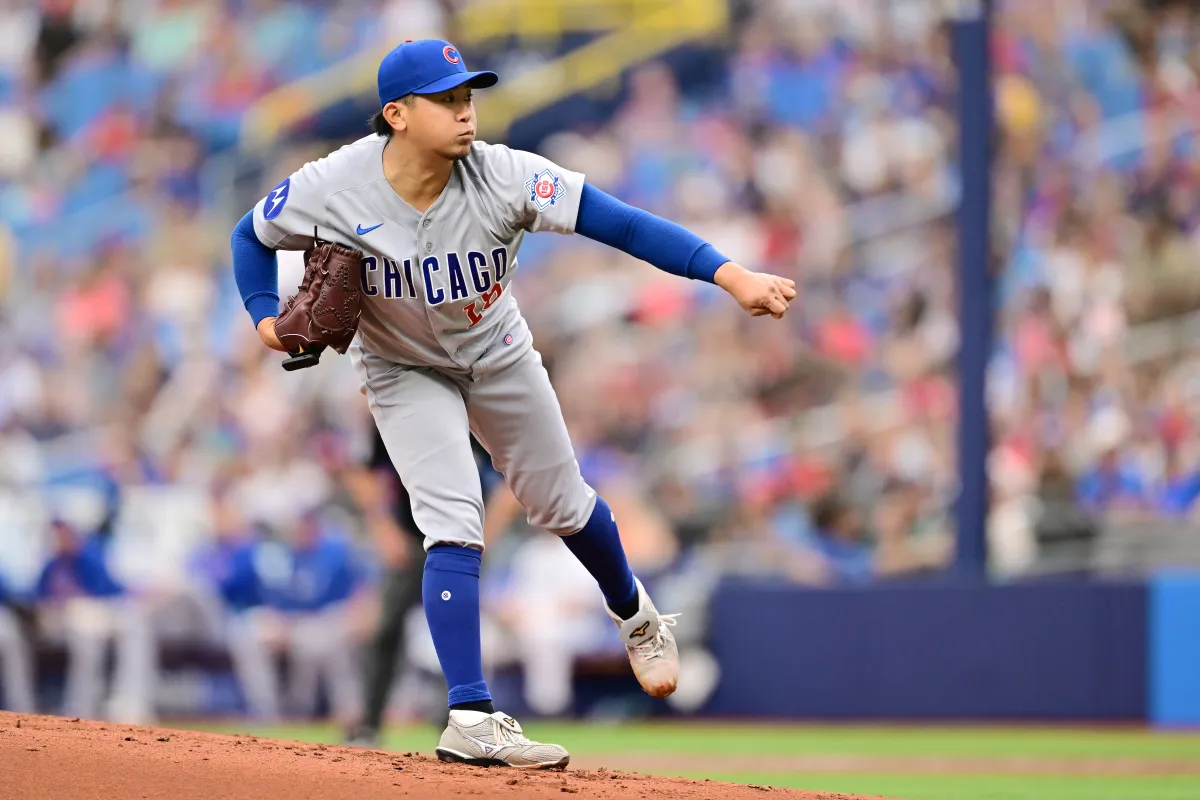
The end of a baseball season always brings a strange mix of emotions. For Chicago Cubs fans, the final out of the year doesn’t just close the book on summer; it opens the door to a winter of uncertainty. The Cubs have multiple free agents this offseason, and while the front office has plenty of decisions to make, no decision carries more weight than what happens with Shota Imanaga. The left-handed pitcher arrived from Japan before the 2024 season and immediately became something more than just a rotation piece. He became a reason to believe. His calm presence on the mound, his ability to change speeds, and his knack for rising to big moments made him a fan favorite. Now, as the hot stove begins to heat up, the Cubs are faced with the possibility of losing him. The offseason is officially here, and the rumor mill is already churning. For a franchise that has spent years trying to recapture the magic of 2016, losing a player like Imanaga would be a gut punch. But that’s exactly what some are predicting. In fact, one recent report suggests that Imanaga could be heading to a National League rival, and the idea is already sending ripples through the fanbase. It’s not just about stats, though his stats are excellent. It’s about what he represents: a bridge between the Cubs’ past and future, a player who made Chicago feel like a destination again for international talent. The offseason is a time of hope, but it’s also a time of fear, and for Cubs fans, the fear of losing Imanaga is very real. Let’s take a closer look at the prediction, the reasoning behind it, and what it all could mean for Chicago and Miami.
The prediction comes from Bleacher Report’s Tim Kelly, who recently named Imanaga as a free agent signing with the Miami Marlins. According to Kelly, Imanaga would sign a two-year, $34 million contract with Miami. That’s a surprising thought for many Cubs fans, not just because Imanaga has been so good in Chicago, but because the Marlins are a division rival. The National League Central and National League East aren’t the same division, but they are both in the National League, and they will face each other multiple times a year. The idea of Imanaga wearing a Marlins uniform feels wrong to Cubs fans who have grown attached to his quirky personality, his glasses, his postgame interviews, and his steady excellence. But baseball is a business, and the hot stove doesn’t care about sentiment. Kelly’s reasoning is straightforward. He wrote, “Imanaga could join the Marlins to serve as insurance if they trade Sandy Alcantara this offseason or lose him in free agency next winter.” That quote captures the essence of the prediction. The Marlins are a team in flux. They have talented arms, but they also have questions. Alcantara, a former Cy Young winner, has been the anchor of their rotation, but his future in Miami is far from certain. If the Marlins trade him, they’ll need a proven replacement. If they lose him later, they’ll need someone already in place. Imanaga, with his track record and his team-friendly contract projection, fits that need. For a team like Miami, which often struggles to attract big-name free agents, Imanaga would be a statement signing. He’s not just a pitcher; he’s a brand. He’s the kind of player who can put fans in seats and stabilize a rotation at the same time. The two-year, $34 million deal is interesting because it’s not a massive commitment. It’s a short-term, high-value contract that gives the Marlins flexibility while also giving Imanaga a chance to hit the market again in his early thirties. It’s a smart baseball move, and it makes sense on paper. But that doesn’t make it any easier for Cubs fans to hear.
To understand why the Marlins would be interested, you have to look at their current starting rotation. Miami has always been a franchise built on pitching. From the days of Josh Johnson to Jose Fernandez to Sandy Alcantara, the Marlins have prided themselves on developing and deploying elite arms. But pitching depth is fragile, and the Marlins know this better than anyone. Alcantara has been the ace, but he’s also been the subject of trade rumors for months. The Marlins are not in a position to compete right now, and trading Alcantara could bring back a haul of prospects. But if they do that, they need someone to lead the rotation. Imanaga would be that someone. He’s a proven pitcher who has been effective since his MLB arrival in 2024. He’s not a project. He’s not a reclamation case. He’s a reliable starter who can eat innings, keep his team in games, and provide a steady presence for younger pitchers. The Marlins have a lot of young arms, but young arms need guidance. Imanaga’s experience in Japan and in the big leagues gives him a unique perspective. He’s pitched in front of massive crowds, in high-pressure playoff races, and in a foreign country where the culture and language were completely different. That kind of resilience is invaluable. For the Marlins, adding Imanaga would be about more than just replacing Alcantara. It would be about building a culture. It would be about showing the rest of the league that Miami is serious about winning. The Marlins have often been seen as a stepping stone or a place where players go to rebuild their value. Signing Imanaga would challenge that narrative. He’s a player who could choose to go almost anywhere, and if he chose Miami, it would send a message. It would also give the Marlins a legitimate reason to believe they could compete sooner rather than later. Of course, this all depends on whether Imanaga actually wants to leave Chicago. But from Miami’s perspective, the fit is obvious. They need pitching. They need leadership. They need a player who can handle the spotlight. Imanaga checks every box.
And what about Imanaga himself? Let’s look at the numbers, because they tell a story of consistency and growth. In 32 games this season with Chicago, Imanaga posted an 11-10 record, a 3.77 ERA, and 174 strikeouts. On the surface, that might not look like a superstar season. But context matters. The Cubs were not always a great team behind him. There were games where the offense went silent. There were games where the bullpen let leads slip away. And yet, Imanaga kept going out there, inning after inning, giving his team a chance to win. A 3.77 ERA in today’s game, especially in the National League, is solid. It’s the kind of number that makes a team feel confident every fifth day. But what’s even more impressive is the trend. This marked the third straight season that Imanaga had an ERA under 4.00. That’s not a fluke. That’s a pattern. That’s a pitcher who knows who he is and what works. It all started with his All-Star season in 2024, when he had a 15-3 record and a 2.91 ERA. That season was a revelation. Imanaga came over from Japan with a lot of hype, but no one really knew how his game would translate. It translated beautifully. He was one of the best pitchers in baseball, and he did it with a style that was almost old-school. He didn’t overpower hitters with 100 mph fastballs. He out-thought them. He changed speeds. He located his pitches. He made hitters uncomfortable. That’s why his success has lasted. That’s why he’s not just a one-hit wonder. Even in 2025, when his ERA rose a bit, he still struck out 174 batters in 32 starts. He still showed the ability to miss bats. He still showed the durability to make every start. For a team like the Marlins, or any team, that kind of reliability is worth real money. Imanaga is not a pitcher who is going to break down. He’s not a pitcher who is going to lose his stuff overnight. He’s a craftsman, and craftsmen age well. That’s why the two-year, $34 million projection might actually be a bargain. If Imanaga continues to pitch like he has, he’ll be worth every penny. And if he does it in Miami, the Cubs will be left wondering what went wrong.
From the Cubs’ perspective, the thought of losing Imanaga is difficult to process. He wasn’t just a good pitcher; he was a symbol. When the Cubs signed him before the 2024 season, it was a sign that the franchise was willing to invest in international talent. It was a sign that they could still attract big names. And it worked. Imanaga embraced Chicago. He seemed to love the city, the fans, the ivy on the walls, the pressure of Wrigley Field. He became one of the most popular players on the team. His postgame interviews were must-watch television. His calm demeanor was a perfect contrast to the chaos of a long season. And on the mound, he was exactly what the Cubs needed. He gave them stability. He gave them innings. He gave them hope. But now, the Cubs have to decide how much that’s worth. Re-signing Imanaga won’t be easy. He’s going to have plenty of suitors. The Marlins are just one team. There will be others. Teams with deeper pockets. Teams with stronger rosters. Teams that can offer him a clearer path to the postseason. The Cubs can offer him familiarity, but familiarity doesn’t always win out. In free agency, players often look for the best combination of money, opportunity, and comfort. The Cubs can offer money, but can they offer opportunity? Can they promise him that the team will be competitive in 2026? That’s a hard question to answer. The Cubs have a solid core, but they also have holes. They need offense. They need bullpen help. They need to prove to Imanaga that they’re serious about winning. If they can’t, he might walk. The front office knows this. That’s why the next few months will be so important. Re-signing Imanaga would be a statement. It would show the fanbase that the Cubs are willing to do what it takes to keep their best players. Losing him would be the opposite. It would be another disappointment in a long line of disappointments. The Cubs have been stuck in a cycle of mediocrity since their World Series run. They’ve made the playoffs, but they haven’t been a true contender. Losing Imanaga would make it harder to break that cycle. It would be a step backward. And that’s why the prediction from Bleacher Report is so alarming. It’s not just a rumor. It’s a wake-up call.
So what does this all mean? For now, it’s just a prediction. Tim Kelly at Bleacher Report is making an educated guess, not reporting a done deal. The offseason is long, and anything can happen. Imanaga could re-sign with the Cubs. He could sign with the Marlins. He could sign with a dozen other teams. The only certainty is that there will be drama. That’s the nature of baseball in the winter. Fans will refresh their feeds. Writers will speculate. Agents will leak information. And somewhere, in a quiet moment, Imanaga will have to make a decision that will shape the rest of his career. For the Cubs, the hope is that he chooses to stay. For the Marlins, the hope is that he chooses to start something new. For Imanaga, the choice is about more than just money. It’s about legacy. It’s about comfort. It’s about winning. He’s already proven he can pitch in the majors. He’s already proven he can handle the pressure. Now he gets to decide where he wants to do it. The Cubs have given him a home. The Marlins are offering him a new challenge. There’s no right answer, only the answer that feels right to him. As fans, all we can do is wait. We can hope. We can worry. We can debate. But in the end, it’s his decision. And no matter what happens, the offseason will continue. There will be other free agents. There will be other trades. There will be other stories. But this one feels different. This one feels personal. Shota Imanaga is not just another pitcher. He’s a player who captured the hearts of Cubs fans and made the game fun again. Whether he stays or goes, that won’t change. He gave Chicago two years of memorable baseball. He gave them a reason to believe. And if he leaves, he’ll leave with the gratitude of a fanbase that appreciated every moment. The prediction is just a prediction. But the possibility is real. And that’s enough to make the winter feel a little colder for Cubs fans, and a little more exciting for Marlins fans. Only time will tell where Imanaga ends up, but one thing is certain: he’ll be worth watching no matter what uniform he wears.