

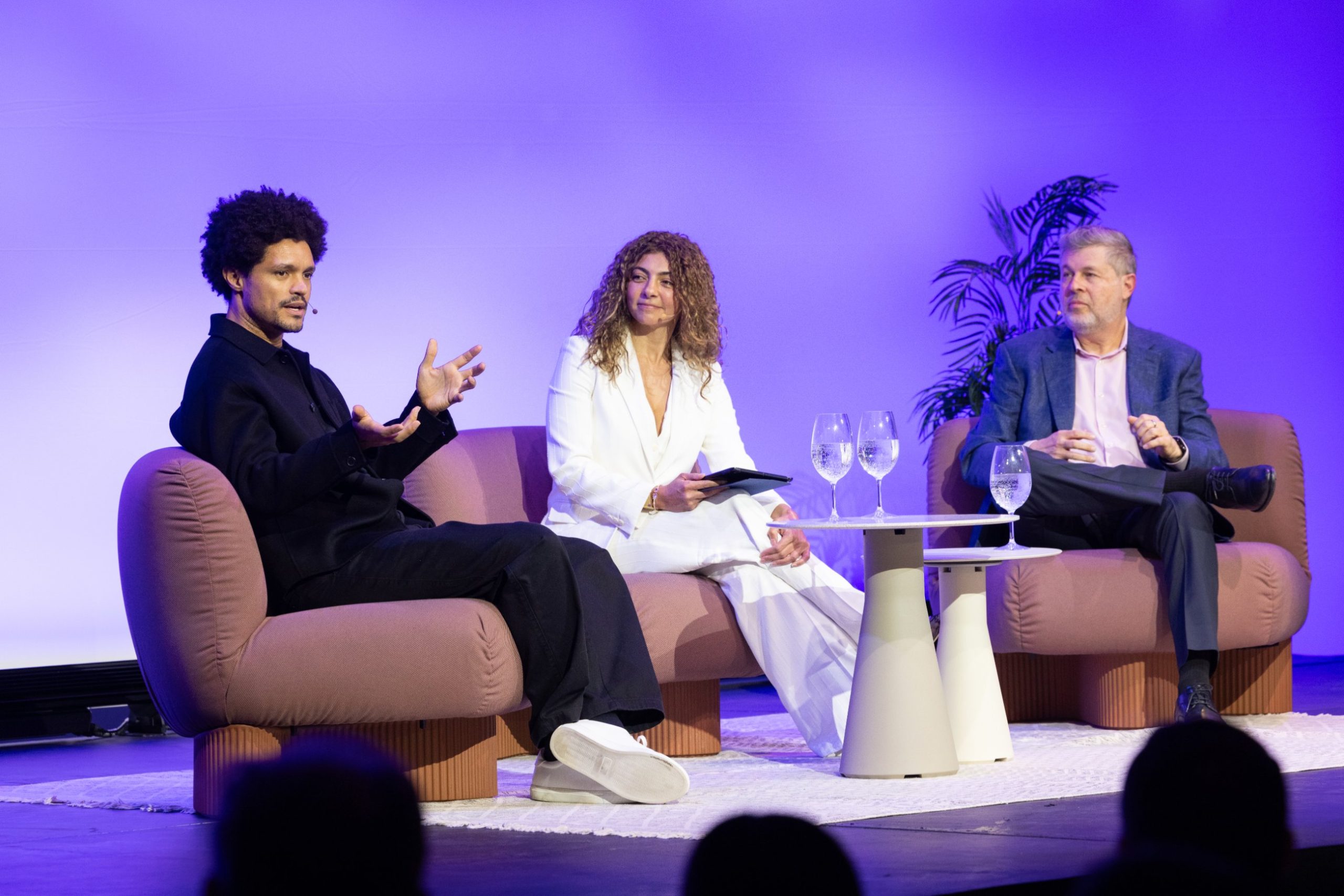
On a crisp October evening, Boston’s Museum of Science became the backdrop for a conversation that felt less like a tech summit and more like a gathering of curious minds trying to make sense of a strange new world. Trevor Noah had come to launch Luminaries, a series intended to put science in dialogue with the arts, culture, and everyday life. On stage with him were Rana el Kaliouby, a pioneer in emotion AI, and Oren Etzioni, a veteran AI researcher and thoughtful critic of the field. The topic was artificial intelligence, but from the opening moments it was clear that Noah was not going to deliver a conventional celebrity talking point. He was going to ask questions. He was going to challenge assumptions. Kaliouby, who hosts her own podcast about AI pioneers, had expected the former Daily Show host to be witty and quick; what she hadn’t expected was the depth of his thinking. She wrote afterward that she was “blown away by his humanity and depth of ideas.” That phrase captured what made the evening special. Noah did not treat AI as a villain or a savior. Instead, he used it as a lens to examine human habits, human frailty, and human resilience. In the warm glow of the museum’s hall, surrounded by centuries of human invention, the conversation became a meditation on what we value, what we fear, and what we refuse to let machines take from us. There were laughs, of course, but the laughter often gave way to a quieter kind of recognition. Noah had a way of making the abstract feel personal, and by the end of the night, the audience had not just learned about AI; they had learned something about themselves.
One of the most memorable moments came when Kaliouby revealed that she had built an AI matchmaker in ChatGPT, and that it had selected Noah as her ideal match. The audience laughed, but Noah quickly turned the moment into a lesson. He pointed out that the AI knew almost nothing about either of them. It had simply assembled a plausible answer from the scattered data of the internet, stitching together a story that looked like understanding but was really just pattern recognition. “AI is particularly good at seeming like it has gone beneath the surface,” he said, “when in fact it’s calculating everything above the surface.” The line drew knowing nods. It spoke to a deep truth about the current moment: machines have learned to mimic depth so convincingly that we often forget they are not actually going deep. Noah went further, describing the experience of correcting an AI. It thanks you, he said, but often fails to fix the mistake. He compared it to a friend who has been to a lot of therapy but doesn’t actually change. The image was funny, but it also captured something profound about the limits of current AI. These systems are trained to be agreeable, not to learn from us in any genuine sense. They perform humility, but they don’t practice it. In that way, Noah suggested, they are less like brilliant assistants and more like charming but shallow companions. We project intelligence onto them because they speak in fluent sentences, but fluency is not the same as insight. His point was not that AI is useless. It is useful in astonishing ways. But we need to be honest about what it is doing: scanning surfaces, predicting patterns, and producing answers that sound thoughtful because they are statistically likely. It does not know us. It knows about us. And that distinction matters, especially as we begin to trust AI with decisions about love, work, and truth.
When the conversation turned to protecting ourselves from AI’s harms, Noah offered an answer that surprised many in the room. It had nothing to do with regulation, technical fixes, or better algorithms. It was about community. He invoked Robert Putnam’s book Bowling Alone, the classic study of how social bonds have frayed in American life. Places where people actually know their neighbors, where they bowl in leagues rather than alone, tend to have more accountable governments and more resilient citizens. Noah argued that our defense against dystopian technology is not more technology; it is each other. Etzioni, whose own father helped found the communitarian movement in the 1990s, pushed back gently. Communitarianism, he said, had failed. Noah responded with characteristic humor and honesty. He said we hand too many good ideas to intellectuals, who then apply too much academia to them. Communitarianism failed, he deadpanned, because it’s called communitarianism. The name itself was a kind of poison. People don’t want to join a movement that sounds like a sociology textbook. But the underlying need for community never disappeared. Noah pointed out that nobody calls a phone a failure when the first version doesn’t sell. Companies keep iterating, keep re-releasing, keep improving. He vowed to keep investing in community, even if the first attempts stumble. His optimism was grounded in a simple, almost radical idea: real presence matters. “I don’t need to see if you’re a deepfake,” he said, “because I’m sitting here with you.” The line drew laughter, but it was also a profound statement about trust. In a world of synthetic media and virtual relationships, the physical act of sitting with another person remains irreplaceable. It is not nostalgia; it is survival. Community, Noah suggested, is the oldest technology we have, and we keep forgetting how to use it.
Despite his clear-eyed view of AI’s dangers, Noah’s optimism about technology was striking. He said he has yet to see a technology that blew up and then left everyone behind. Cars, computers, and the internet all eventually spread to ordinary people. AI, he argued, has reached what he calls “work intelligence.” It can perform many of the jobs we have invented, but human beings keep inventing new ones. He used a simple example: salt and ice were once precious commodities; now restaurants give them away for free. Our sense of what is valuable shifts constantly. If we define ourselves only by the tasks we currently do, then yes, we are expendable. But if we are the creatures who drew pictures on cave walls and sang songs for no real reason, then we are infinitely capable. This led to one of the most powerful exchanges of the night, about jobs. Noah described touring as a comedian and seeing towns hollowed out after factories closed, like Kodak and Studebaker. Factory workers were told automation was progress. Now, he said, white-collar workers are experiencing what blue-collar workers have experienced for decades. The difference is that white-collar workers sit closer to power, so their pain finally gets coverage. Noah is confident new jobs will come, just as they did after telephone exchange operators disappeared. What worries him is not the end of work, but the gap between losing one way of life and finding the next. He used a highway analogy: the “following distance” is the space that lets you stop before hitting the car ahead. “There is no job that will last forever. There is nothing that won’t be displaced. The question is, how long is the following distance between the two things?” He also took a gentle dig at tech leaders, noting that it is easier to be patient from a position of privilege, “but ironically, they don’t have patience when it comes to quarterly earnings.” It was a sharp observation about power, timing, and who gets to wait for the future to arrive.
Noah also explained why AI is not coming for his job—at least not yet. After ChatGPT took off, talk show hosts kept sending him weak jokes that the bot had written in a pale imitation of his style. He rattled off four reasons why AI struggles with humor. First, there isn’t enough comedy data. Second, AI models are frozen snapshots, while society’s sense of what is acceptable keeps shifting. Third, comedy depends on knowing your audience; there are jokes you know are funny but would never tell your mother. Fourth, tech companies have made their models risk-averse. Humor requires risk, timing, and a feel for edges. “I’m trying to understand where the edges are in society,” Noah said, “and I want to play with those edges.” It was a perfect description of his craft—and a subtle critique of machines that are built to stay safely in the middle. Etzioni reminded him of Picasso’s famous verdict on computers: “They are useless. They can only give you answers.” He joked that Noah, as Microsoft’s Chief Questions Officer, has something rare these days: job security. Noah laughed, but his real security comes from something deeper than a title. It comes from his humanity, his curiosity, and his ability to make people feel seen. Kaliouby noted that everyone seems to be getting replaced by AI, except Noah, who had actually played an AI, voicing Griot in Black Panther: Wakanda Forever. Noah quipped, “Yeah, I’m coming for AI’s job.” The line was a perfect closer—playful, confident, and true to the spirit of the evening. It also reminded everyone that humor is one of the last frontiers, not because machines can’t generate jokes, but because they don’t understand why a joke matters to a particular person in a particular moment.
By the end of the conversation, a clear vision had emerged. AI is not simply a tool or a threat; it is a mirror. It reflects our habits, our values, and our blind spots. Noah’s insights reminded the audience that the future is not written by algorithms alone. It is shaped by the choices we make about how to live together. He acknowledged the real dangers—displacement, deception, the erosion of trust—but he refused to surrender to fatalism. His faith in human creativity, in our strange ability to sing and draw and make each other laugh, was not naive. It was hard-won, born of watching communities survive and change and invent new ways to thrive. The evening at the Museum of Science was not a lecture about AI. It was a reminder that the most important intelligence is still the human kind: the intelligence to ask good questions, to sit with someone in a room, to wait for the world to catch up, and to laugh in the face of uncertainty. Trevor Noah, the comedian who came for AI’s job, ended up doing something more valuable. He showed us that our deepest humanity is not a bug in the system. It is the whole point. And as the audience filed out into the cool Boston night, the conversation stayed with them, not because it answered every question, but because it made them feel that the questions themselves were worth asking—together, out loud, in a room full of other people. That, perhaps, is the best defense we have.