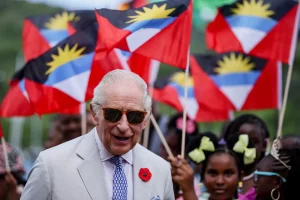


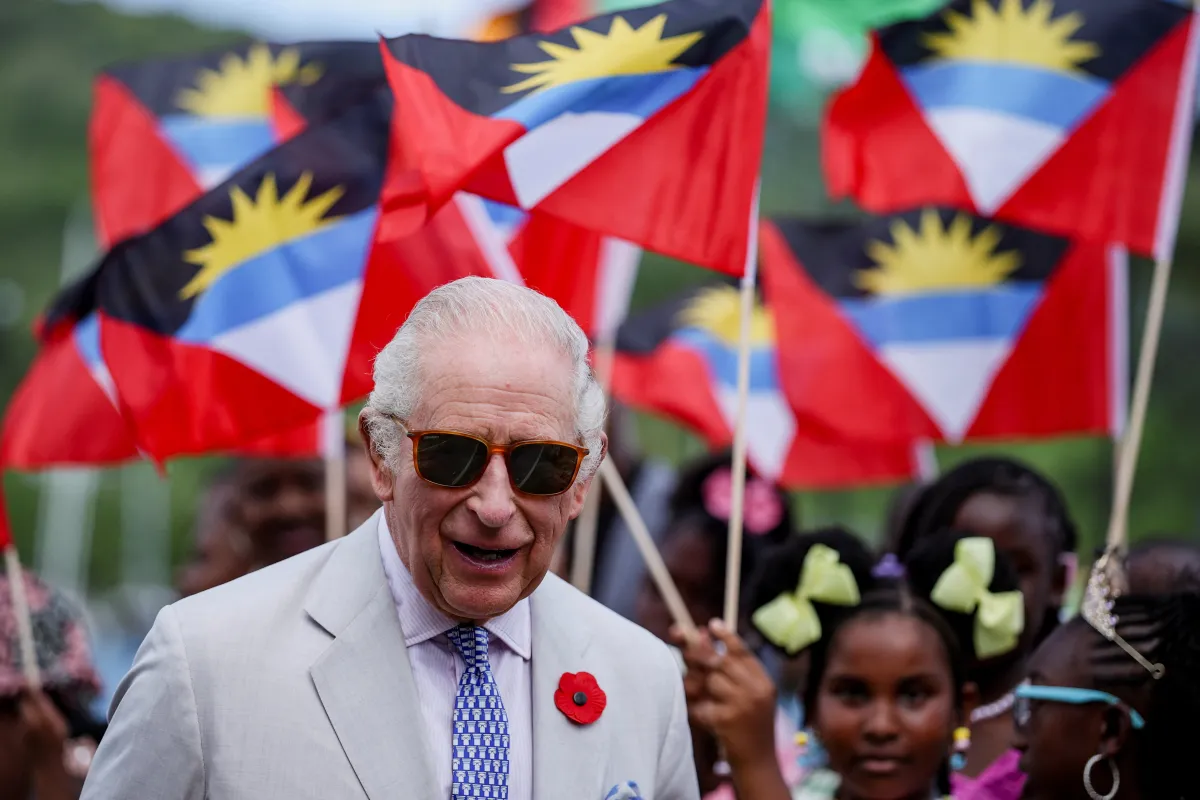
King Charles III stood under the Caribbean sun in Antigua and told Commonwealth leaders that the transatlantic slave trade fills his heart with horror and his soul with “the most profound personal sorrow.” It was a carefully shaped phrase, a human sound from a monarch whose job is mostly to stay above the argument. And the sorrow, we can assume, was real. But a king’s sorrow, however sincere, is not an apology. It is not a check. It is not a restoration of a stolen life or a stolen language or a stolen future. It is simply feeling bad, and feeling bad is free. Days before the King’s visit, the British political leader Andy Burnham had made headlines by going further than anyone in his position had gone before. He said he was open to calls for a formal state apology for the slave trade. Then he promptly closed the door on financial reparations, insisting that Britons alive today cannot be held responsible for historical wrongs, no matter how appalling those wrongs were. In other words, we are sorry, but we are not liable. It is a neat position, and a comfortable one. The shame is passed around like a feeling, while the bill stays with the descendants of the people who were enslaved. The Caribbean Community, known as CARICOM, heard the softer tone and immediately rejected the line drawn around money. Its chair, St. Lucian Prime Minister Philip J. Pierre, said that an apology without repair is incomplete. That one word, “repair,” is where the whole argument becomes difficult. Because repair is not a speech. Repair is money, or land, or debt cancellation, or something that actually costs the people who are supposed to pay. And when it comes to that, the sorrow becomes much harder to find.
History, if we honestly look at it, tells us exactly how reparations have usually been paid. They were not paid because someone felt guilty. They were paid because someone had no choice. Reparations were typically war reparations, extracted after defeat and enforced by armed men. France paid a huge sum after Waterloo, an amount historians estimate at more than a fifth of the country’s annual output. It paid again after the Franco-Prussian War, and German troops stayed on French soil until the last installment was settled in 1873. Germany and Japan paid after the two world wars, not because they were emotionally moved but because they were occupied and forced to comply. Iraq is the cleanest example for our time. After the 1991 Gulf War, the United Nations Security Council created a compensation commission that awarded fifty-two billion dollars to claimants whose property was destroyed or lives upended by Iraq’s invasion of Kuwait. The money was not donated by a generous nation; it was deducted from Iraq’s oil revenues. Saddam Hussein’s government could complain, but it could not refuse. When the last payment was made in 2022, the Security Council declared the process complete and final. Notice what made that work: there was a mechanism of coercion, a way to collect the money, and an authority that had the final word. The Haitian exception makes the same point from the opposite angle. Haiti defeated France and declared independence in 1804. Twenty-one years later, France demanded 150 million francs as compensation for the loss of French colonists’ property, including the human property they had enslaved. A squadron of French warships made the demand unignorable. Haiti, the victor, ended up paying the defeated side for decades. The real rule is not that the loser pays. The rule is that whoever cannot refuse pays. Britain’s own abolition settlement followed this strange kind of logic. When Parliament abolished slavery in most of the Empire in 1833, it paid the enormous sum of twenty million pounds to slave owners, the people who had owned other people. The enslaved themselves got nothing, because the law did not recognize their claims. That debt was only fully repaid in 2015. So if you are waiting for moral outrage to produce a check, history has a cold answer: moral outrage is not enough. There must be power behind it.
Today’s slavery reparations movement has moral power, but moral power alone has never collected a dollar. What the movement lacks is the ability to force the supposed debtor to pay, and it lacks any authority that can declare the debt settled. Jamaica has managed to push the question before the Judicial Committee of the Privy Council in London, which still serves as the final court of appeal for some Commonwealth countries. Jamaica is asking whether Britain owes a reparatory remedy, and a preliminary hearing is scheduled for March 2027. But even if the answer is yes, the opinion is only advisory. It cannot instruct Britain’s Treasury to open its vault. Britain has already told the United Nations that it recognizes no duty to provide reparation for historical acts that were not illegal under international law at the time they were committed. Jamaica disagrees, but disagreement does not enforce itself. There is no world court for ancestral guilt, no international police force for historical debt, no sheriff who can knock on the door of 10 Downing Street and demand payment. And even if Britain and the United States were somehow willing to pay, a massive extraction of wealth would produce an enormous popular backlash from ordinary people who feel they have no connection to the transatlantic slave trade. They see themselves as inheritors of a history they never chose, living in countries with poverty, inequality, and public debt of their own. Imagine trying to tell a British nurse or a factory worker, whose ancestors may never have owned anyone, that the country must hand over trillions of dollars for events that ended two centuries ago. The politics would be catastrophic. The movement would be portrayed not as justice but as a tax, and the door to honest conversation would slam shut. That is why the lack of a coercive mechanism matters. It does not merely block the payment; it blocks the discussion.
But let us imagine that the politics were somehow solved. Even then, the question would not be over, because no one has actually agreed on what the money would settle. A 2023 study from the Brattle Group tried to calculate certain harms of transatlantic slavery and came up with a range of one hundred trillion to one hundred thirty-one trillion dollars. Britain’s share, across fourteen countries, was estimated at more than twenty-three trillion dollars. The United States was even higher, close to twenty-eight trillion dollars. To make those numbers feel human, try this: Britain has roughly sixty-seven million people. Twenty-three trillion dollars divided among them would be more than three hundred thousand dollars for every man, woman, and child in the country. That is more than the median house price in many parts of Britain. And the study’s authors said they had left many harms unquantified, because some things cannot be priced. The CARICOM Ten-Point Plan, meanwhile, covers public health, education, debt cancellation, monetary compensation, and decolonization, and its scope extends beyond slavery to Indigenous genocide and the indenture of workers brought from India and China. There is no single invoice. There is no agreed total. There is no mechanism for deciding who would qualify as a victim, who would be the right recipient, how far down the generations the payment would travel, or whether African states that participated in the slave trade would be counted among the payers or the paid. International relations scholars Adam B. Lerner and Pauline Heinrichs call it the paradox of international reparations. They count only twenty-one international reparations programs since 1940, most paid by former Axis powers. No state has ever paid for the slave trade. They argue that reparations are supposed to settle accounts, but in an international system with no final authority, they often inspire a cascade of further claims. Instead of ending a story, they open another. And then there is the practical question of inflationary time. If you pay trillions over fifty years, what is the money worth by the end? Who adjusts for the changing value of that promise? The numbers are so large they stop being numbers. They become symbols, and symbols are very hard to negotiate with.
Then there are the moral questions that are almost never asked in public, because they are uncomfortable. Why should today’s taxpayer pay for a crime committed by someone else’s great-great-grandfather? Many of those taxpayers are themselves poor, and some are descendants of enslaved people. Many, especially in Britain, have ancestors who were rural workers, industrial laborers, or starving Irish immigrants who had no stake in the slave trade at all. There is also the awkward fact that the slave trade did not happen solely through European agency. African rulers and traders captured, sold, and transported millions of people into the hands of European buyers. The transatlantic slave trade was a joint atrocity, and the moral accounting of it is not as simple as a clear line between an evil Europe and an innocent Africa. Why are African slave traders left out of the bill? Why is the transatlantic slave trade singled out when slavery existed across civilizations for thousands of years? Why stop at slavery at all? Every nation, every culture, every community has a wound in its history. If the bill is going to be written for one evil, it will have to be written for others. Once you enter that cave, there is no exit. In recent years, moreover, a growing number of economic historians have questioned whether the slave trade was really the engine of British and American wealth that activists and old textbooks claim. Perhaps the profits were real but small in relation to the entire economy, and perhaps they were concentrated in a handful of rich families. Some scholars even suggest the slave trade was a drain on the British economy, an expensive and inefficient business kept alive by violence and protection. If that is true, the moral argument for reparations may remain, but the economic foundation becomes shaky. You cannot both demand a huge payment on the grounds of enormous benefit and be told the benefit was not enormous. The word “reparations” carries so many layers of history, economics, identity, and memory that it sometimes feels like a wild animal no one can tame. The conversation is easy to begin, because the wound is real. It is almost impossible to end, because nobody can agree on what a clean ending would look like.
And yet there are examples of democratic states paying without being defeated. The United States apologized to Japanese-Americans who had been put in internment camps during the Second World War and, under a 1988 law, paid each living survivor twenty thousand dollars. Britain, in 2013, paid a settlement of nearly twenty million pounds to more than five thousand Kenyans who had suffered torture and abuse during the Mau Mau emergency. The Netherlands apologized for its historical role in slavery in 2022 and set aside two hundred million euros. Germany offered Namibia more than a billion euros after recognizing the genocide of the Herero and Nama people at the beginning of the twentieth century. Read through the fine print, however, and you see the pattern. Each of these payments was fixed, limited, and carefully bounded. They were directed at identifiable living victims, or framed as investment in development, or accompanied by explicit language saying they did not create legal liability. Germany’s payment was made with a clause stating that no legal claims for compensation could be derived from it. Britain denied liability in the Kenya case and insisted the settlement did not set a precedent for other former colonies. These were not open-ended acknowledgments; they were closings. States paid when they could contain the account. What they resist is a claim with no visible boundary. Burnham’s alternative plan fits this same logic. Along with his openness to an apology, he proposed a debt-restructuring initiative for the poorest Commonwealth countries, to be led by former British Prime Minister Gordon Brown. It is a way to offer something without offering justice, an act of charity that carefully avoids the word “compensation.” CARICOM’s response is that debt relief cannot substitute for reparative justice. Money given as charity is not the same as money given as responsibility. The label matters. When a payment is called reparations, it ties the payment to an admission of guilt, and that is exactly the combination governments fear. The Dutch Prime Minister Mark Rutte, when he delivered the apology, called it “not a full stop, but a comma.” He meant the comma as a beginning, a moment of continued conversation. But the metaphor captures the whole impasse. One side wants a comma, because a comma promises more honesty, more work, more repair. The other side wants a full stop, because a full stop means certainty, finality, and no new invoices arriving in the mail. In the history of reparations, the full stop was always written by power. The victors, or the occupiers, or the debt collectors, wrote the final line. The slavery reparations movement has no victor, no guns, no army. It has a wounded memory and an eloquent voice, but those have never been enough. King Charles is too polite to say it, and perhaps too conscious of his own family’s history, but his silence already speaks. The Caribbean leaders heard his sorrow, and they also heard what he could not bring himself to say: you and what army?