

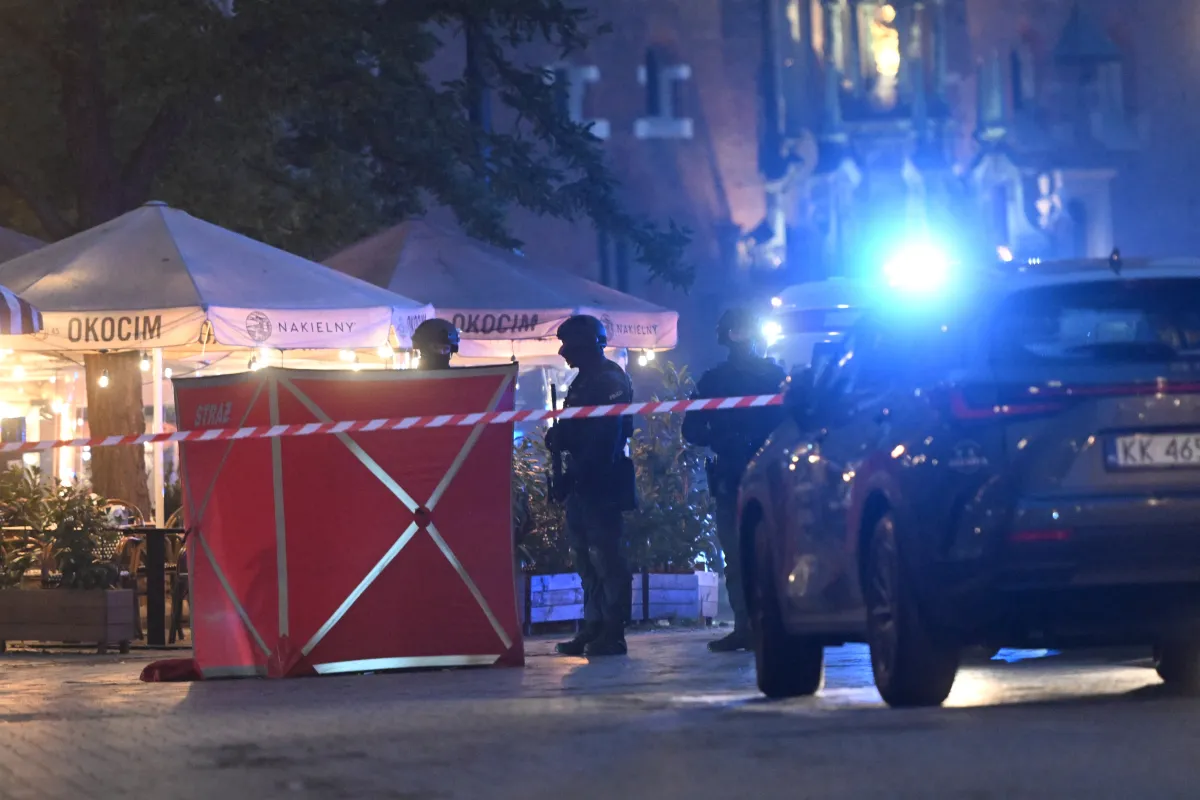
The quiet hum of a late Saturday afternoon in Kraków’s Main Market Square was shattered in an instant. What should have been a day of leisurely strolls, café conversations, and the timeless beauty of one of Europe’s most beloved historic squares turned into a scene of chaos, fear, and tragedy. Polish authorities confirmed that a gunman drove directly onto the square and opened fire on people at random, killing five people and wounding at least a dozen others. The attack began around 3 p.m. local time, when the vehicle entered the cobblestone expanse that has stood at the heart of the city for centuries. Witnesses described the sudden panic as the sound of gunfire echoed off the surrounding buildings, sending shoppers, tourists, and residents scattering for cover. Emergency services flooded the area within minutes, their sirens replacing the usual sounds of street musicians and horse-drawn carriages. By the time the shooting stopped, the square had been transformed into a secured crime scene, with police tape, ambulances, and the heavy presence of law enforcement marking the spot where ordinary life had been violently interrupted.
The human toll of the attack is still being measured as authorities work to identify those whose lives were taken and those who now face long recoveries. Five people were confirmed dead, while at least twelve others were injured, some seriously enough to require immediate medical evacuation. Among the wounded were police officers, first responders who had rushed toward danger in an effort to stop the gunman and protect others. Fire department spokesperson Hubert Cieply confirmed that two officers were among the injured, a detail that underscores the bravery and risk faced by those who responded to the unfolding emergency. The attacker himself was shot by police during a confrontation, then detained and transported to a hospital, where he remains under guard. His identity has not been publicly released, and authorities have not yet offered any explanation for what drove him to carry out such an act. The victims’ names have also not been made public, leaving families and friends in agonizing uncertainty as they wait for official notification. In the immediate aftermath, the focus has been on saving lives, securing the scene, and gathering the first threads of evidence that might begin to explain how such violence could erupt in a place known for its rich history and cultural warmth.
The location of the shooting only deepens the sense of shock and disbelief. Kraków’s Main Market Square, known in Polish as Rynek Główny, is not just a public plaza; it is the symbolic heart of the city and one of the largest medieval town squares in Europe. Dating back to the thirteenth century, it has witnessed centuries of trade, celebration, royal processions, and daily life. It is a UNESCO World Heritage site, surrounded by historic townhouses, the iconic St. Mary’s Basilica, and the Cloth Hall, drawing millions of visitors each year who come to absorb its atmosphere and history. Kraków itself is Poland’s second-largest city, located roughly 155 miles south of the capital, Warsaw, and is widely regarded as the country’s cultural capital. The idea that such a place, so associated with beauty, learning, and tradition, could become the backdrop for a random act of mass violence is difficult for many to process. Local residents and tourists alike have been urged to avoid the area while police and emergency personnel continue their work. The square, normally alive with activity, now stands as a silent witness to the tragedy, its cobblestones marked by the events that unfolded there.
Official reactions came quickly from the highest levels of the Polish government. Prime Minister Donald Tusk addressed the nation through social media, expressing his concern and confirming that he was being kept informed by the Minister of the Interior. Describing the event as a “tragic shooting,” Tusk assured the public that police were investigating both the background and all the circumstances of the attack. His words, while measured, carried the weight of a nation trying to make sense of an unthinkable event. The government’s response has been one of urgency and caution, with officials emphasizing that the investigation is ongoing and that many questions remain unanswered. In times like these, the public looks to its leaders not only for information but also for reassurance, and Tusk’s statement sought to strike that balance, acknowledging the gravity of the situation while affirming that authorities are working diligently to uncover the truth. The presence of an air ambulance deployed to the scene further highlights the severity of the injuries and the scale of the emergency response. Police, firefighters, and medical teams coordinated their efforts in the immediate aftermath, their professionalism on display even as the full scope of the tragedy remained unclear.
As the investigation unfolds, one of the most pressing and unsettling questions is motive. Authorities have not publicly identified the suspect, nor have they established whether the shooting was an act of terrorism. The randomness of the attack, with the gunman firing at people from his vehicle as he drove through the square, suggests a deliberate intention to harm as many people as possible, but the reasons behind that intention remain shrouded in mystery. Investigators are examining the attacker’s background, his movements before the shooting, and any potential connections to extremist ideologies or personal grievances. The lack of immediate answers has left room for speculation, but officials have been careful not to jump to conclusions. In the coming days, more details are likely to emerge as forensic evidence is analyzed, witnesses are interviewed, and the suspect’s history is pieced together. For now, the people of Kraków and the wider world are left with the raw emotions of grief, anger, and confusion, struggling to comprehend how a single individual could inflict such harm on innocent strangers. The investigation will also need to address the broader context of public safety, including how the gunman was able to drive into the pedestrian-friendly square and whether additional measures might have prevented the attack.
In the aftermath of tragedy, communities often find strength in unity, and Kraków will need that strength in the days and weeks ahead. The immediate focus remains on the victims and their families, on the wounded who are fighting for their lives in hospitals, and on the first responders who acted with courage under unimaginable pressure. The square, which has stood for centuries as a symbol of continuity and resilience, will eventually reopen, but it will carry the memory of this day. Vigils are likely to be held, flowers and candles placed, and moments of silence observed as the city mourns. The investigation will continue, driven by the need for answers and justice, but some questions may never be fully resolved. What is certain is that this attack has left an indelible mark on Kraków, a city that now joins the long and painful list of places where everyday life was violently interrupted by a single act of senseless violence. As the world watches, Poland’s leaders, law enforcement, and citizens will work to heal, to understand, and to ensure that the memory of those lost is honored not only in words but in a renewed commitment to the values of community, compassion, and resilience that define the city itself. This remains a breaking story, and updates will follow as authorities release more information.