



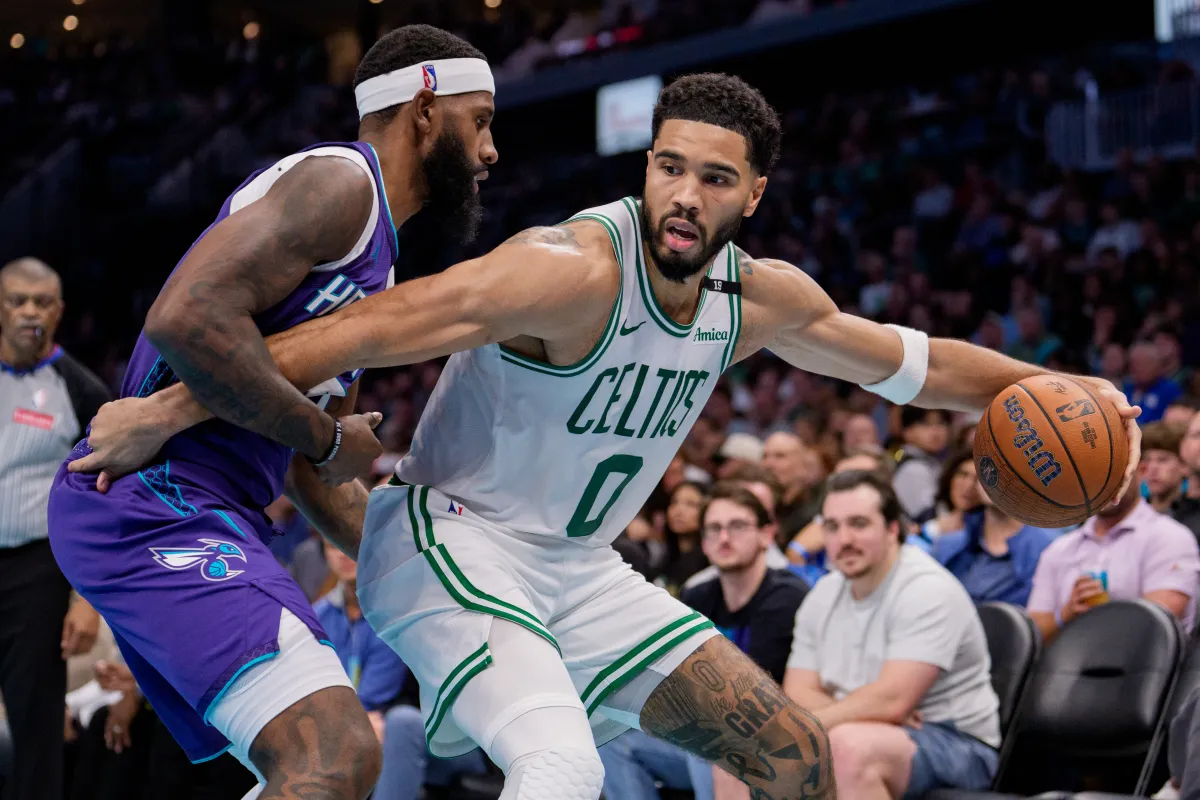
1. On a humid, buzzing Friday night in Charlotte, the Boston Celtics walked onto the court looking less like a team beginning a four-game road trip and more like a group of men who had just remembered how much fun basketball is supposed to be. The scoreboard would eventually tell a lopsided story—119-80, an absolute demolition in the NBA Cup—but the real narrative was written in the first twelve minutes, when Jayson Tatum took the floor and, almost casually, tied a piece of franchise history that had belonged to Paul Pierce for years. It was Tatum’s 106th quarter with at least fifteen points, matching the Hall of Fame forward who carried Boston through the darkest post-Larry Bird years and into a championship era. But this wasn’t a night for nostalgia. It was a reminder that Tatum, still in his prime, is rewriting the record book with the quiet confidence of someone who knows he isn’t done. He finished with 34 points, nine assists, and eight rebounds, but the raw numbers almost undersold the performance. In that first quarter alone, Tatum scored 18 points and set his teammates up for another 12, meaning he had a direct hand in 30 of Boston’s 40 first-quarter points. The Hornets, as a team, had 20. It was the kind of start that doesn’t just change the momentum of a game—it erases any doubt about the outcome before the second quarter even begins. For Celtics fans who have watched Tatum grow from a lanky rookie into a Finals MVP, it was another chapter in a career that seems destined for the rafters.
2. The backdrop made the performance even more striking. Two nights earlier, the Celtics had beaten the Milwaukee Bucks on a night Tatum spent resting, his first game off of the season. The extra time was meant to preserve his legs for the long grind ahead, and it worked exactly as Boston’s brain trust had hoped. Back in the starting lineup against Charlotte, Tatum moved with a freshness that looked almost dangerous for the opposing defense. He wasn’t hunting shots so much as flowing through the game, letting the action come to him. The Celtics opened with a 21-7 run, and the early spark came from beyond the arc, where Boston rained down four 3-pointers in the opening stretch. But Charlotte quickly learned that setting up a wall on the perimeter wasn’t enough. Once Tatum realized the Hornets were overcommitting to the three-point line, he changed gears and started attacking the rim. Late in the first quarter, he drove through contact for an acrobatic layup, drew the foul, and converted the free throw. Then, as if to remind everyone that he could hurt you from anywhere, he stepped back behind the line and buried a triple of his own. A few possessions later, he found Sam Hauser for a deep three, a pass that was so perfectly timed and placed that Hauser barely had to adjust his feet. It was a sequence that encapsulated Tatum’s evolution—no longer just a scorer, but a floor general who controls the pace and dictates the opponent’s nightmares.
3. What made Tatum’s first-quarter explosion feel different from the highlight-reel performances of earlier seasons was the ease with which it unfolded. The numbers were staggering—18 points and 12 more created through assists—but the eye test was even more impressive. Tatum wasn’t forcing anything. He was letting the game come to him, reading the defense, and making the simple play over and over again. When the Hornets collapsed, he kicked. When they backed off, he shot. When they tried to meet him at the rim, he absorbed contact and still finished. The box score said he tied Paul Pierce’s record for 15-point quarters, but the way he did it felt less like a milestone and more like a declaration. The Celtics led 40-20 after the first period, and Tatum had a hand in three of every four Boston points. Derrick White also got in on the action, pouring in 10 first-quarter points of his own, proving that opposing teams can’t simply stack their defense on Tatum and hope everyone else beats them. White’s production was a reminder of how dangerous the Celtics are when their star is humming—he draws so much attention that everyone else gets cleaner looks, and on this night, everyone was in a rhythm. The Hornets looked like they had come prepared to slow down one player, only to realize that Boston’s offense is a hydra. Stop one head, and two more appear.
4. If the first quarter was a warning, the second quarter was a full-blown catastrophe for Charlotte. The Hornets spent the entire period trying to chase Boston off the three-point line, but the Celtics were simply too sharp, too confident, and too deep. By halftime, Boston had connected on 17 of 31 attempts from beyond the arc, a scorching percentage that would be impressive in a single quarter, let alone two. Charlotte, by contrast, had made just 13 field goals from anywhere on the court. The contrast wasn’t just statistical—it was visual. The Celtics moved the ball with purpose, swinging it side to side until the defense broke down. The Hornets appeared uncertain, often scrambling after the first pass and leaving shooters open in the corners. Tatum went into the locker room with 24 points and six assists, White had 18, and the score read 70-39 in favor of Boston. It was the kind of blowout that turns a regular-season game into a glorified practice, with the Celtics checking off every box on the scouting report. The third quarter was more of the same, as Boston maintained a massive cushion and started to rotate in bench pieces while still keeping the pressure on. Tatum finished with a perfect 11-for-11 shooting from the free-throw line, which was perhaps the most underrated part of his night—a testament to his focus and his willingness to do the unglamorous work of drawing fouls and converting opportunities. Payton Pritchard came off the bench to add 12 points, and the Celtics cruised to their seventh win in eight games.
5. For Charlotte, the loss was another ugly mark in a season that has quickly spiraled. The Hornets missed 39 of their 50 attempts from three-point range, a staggering display of misfiring that left the home crowd deflated long before the final buzzer. Naz Reid led the team with 14 points, but it was the kind of night where individual stat lines felt almost meaningless. The Hornets lost their sixth straight game, and the gap between where they are and where Boston is—between a rebuilding team and a championship contender—was on full display for anyone watching. The Celtics, meanwhile, improved to 2-0 in NBA Cup play, continuing their pursuit of the in-season tournament title that has added a new layer of excitement to the early months of the schedule. The road trip still has three games left, and there will be tougher tests ahead. Opponents will study this tape, adjust their schemes, and try to find a way to slow down Tatum and the Celtics’ relentless three-point barrage. But on this night, there was no answer. Boston looked like a team that had rediscovered its identity after a brief rest, and Tatum looked like a man on a mission. The NBA Cup might not carry the same weight as a playoff series, but Tatum played like it mattered, and his teammates followed his lead.
6. As the final seconds ticked away in Charlotte, Tatum walked off the court with a quiet satisfaction, knowing he had tied a legend and inched closer to making that history his own. He needs just one more 15-point quarter to break the tie with Paul Pierce, a milestone that feels inevitable given how often he produces at that level. But numbers alone don’t capture what Tatum means to these Celtics. He’s the anchor, the engine, the player who makes everyone else better just by being on the floor. There’s a human element to his rise that transcends statistics: the late-night gym sessions, the adjustments after tough losses, the patience to let the game slow down instead of forcing his will. On Friday, those invisible efforts became visible. He tied Pierce, he lifted his team to a comfortable win, and he reminded everyone that Boston’s championship window is still wide open. The road ahead is long, and the NBA Cup will give way to the playoffs and the ultimate pursuit of another banner. But nights like this, in a small-market arena on a Friday in Charlotte, are where legends are built—one quarter at a time, one record at a time, one win at a time. Tatum is already among the best in the world, and he’s nowhere near finished.