

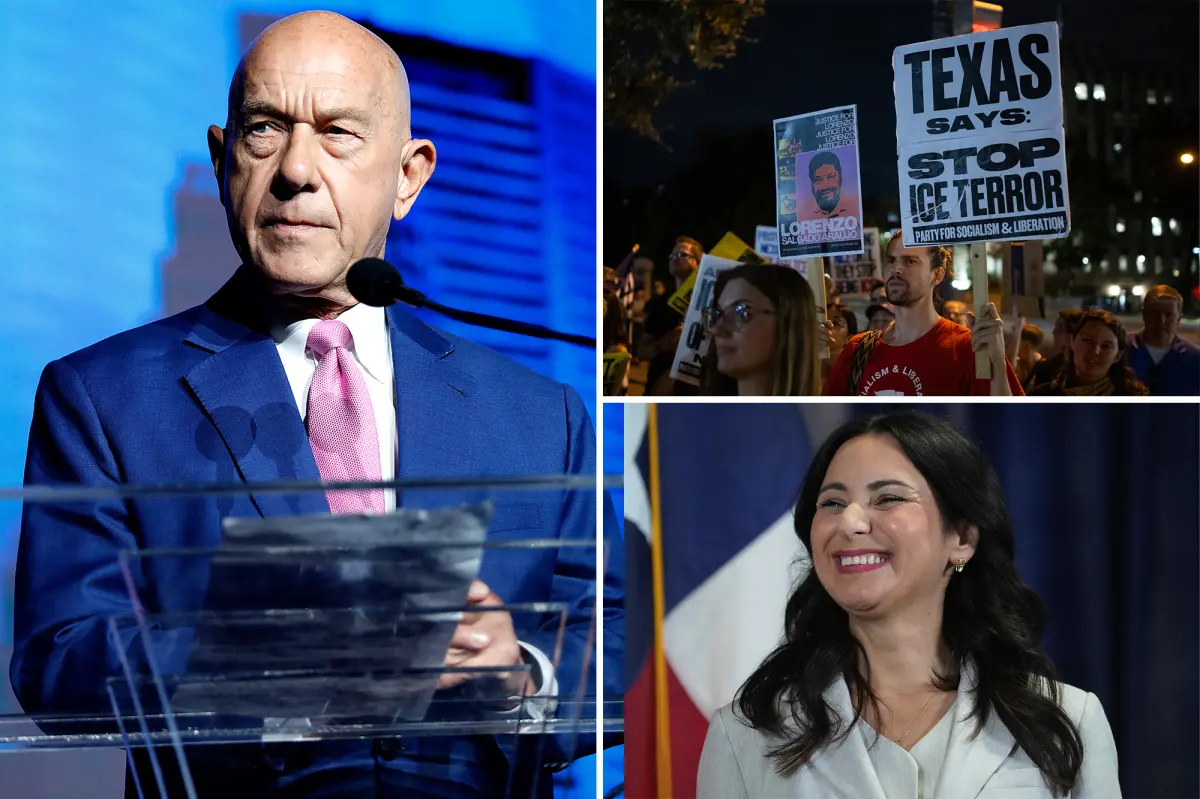
On a quiet Friday afternoon in Houston, one of the most diverse and dynamic cities in the United States, Mayor John Whitmire signed an executive order that effectively redrew the line between local policing and federal immigration enforcement. The move marked a sudden and significant reversal of the city’s previous cooperation with U.S. Immigration and Customs Enforcement, and it arrived at a moment of extraordinary political change across Texas. For decades, the Lone Star State has been a battleground for immigration policy, with Republican governors using their power to force local jurisdictions into compliance with federal authorities. But the political landscape shifted dramatically after the latest election cycle, when Texas voters denied a fourth term to Governor Greg Abbott, whose executive order had threatened Houston with the loss of more than $100 million in state funding unless local police assisted ICE. In the same election, James Talarico, a young Democrat, flipped a state Senate seat for the first time in nearly four decades, a symbolic and substantive break from the state’s rightward trajectory. Against that backdrop, Whitmire’s decision felt less like a routine administrative change and more like a statement about the kind of city Houston intends to be: a place where local officers are not automatically turned into federal immigration agents, especially during routine encounters with people who have not committed serious crimes.
What does Whitmire’s new policy actually mean for someone living in Houston? Imagine a traffic stop on a busy freeway, a broken taillight, a driver whose license reveals an immigration detainer. Under the previous rules, local officers might have been expected to contact ICE, then wait by the side of the road for federal agents to arrive, turning a minor stop into a moment of deep uncertainty and fear. Under the new order, that changes. Whitmire told the New York Times that city police are no longer permitted to notify ICE when they encounter undocumented immigrants in nonviolent situations, such as traffic stops or minor infractions. Instead, the line is drawn at the jailhouse door. “If they’re charged with a new crime, we’ll let ICE know as we get them to the jailhouse,” he said. For the mayor, this was a matter of public trust. He pointed to the “anxiety” that Abbott’s order had created among Houstonians, especially immigrants and their families, who worried that a minor encounter with local law enforcement could lead to deportation. In a statement released Friday afternoon, Whitmire explained his reasoning in plain and personal terms: “I have signed an executive order directing HPD to no longer contact ICE for nonviolent offenses, helping reduce fear in our communities. Thank you to Chief Diaz, our state and local leaders for their collaboration. A step toward building a stronger Houston. Let’s Go to Work.” The words were carefully chosen, reflecting not only a policy shift but a desire to refocus Houston’s police department on its core mission: keeping neighborhoods safe without turning every officer into an immigration enforcer.
Not everyone was satisfied, of course. The Department of Homeland Security quickly fired back at Whitmire’s announcement, with a spokesperson expressing disappointment and frustration. “We remain disappointed that sanctuary politicians seek to limit cooperation with ICE, as our law enforcement are simply fulfilling their sworn duties to serve and protect our communities,” the spokesperson said. The federal agency warned that partnerships with local law enforcement are essential to arresting undocumented immigrants who have committed serious crimes, and it pointed to several recent ICE arrests in Houston to underscore the stakes. Among those mentioned were Alexander Montano, a Cuban national convicted of willful homicide, burglary, and forced entry into a residence; Ding Nguyen, a Vietnamese national convicted of homicide; and Julio Camey, a Guatemalan national convicted of a sex offense against a child. These are not the kinds of cases that ordinarily inspire sympathy, and DHS used them to argue that restricting local cooperation could allow dangerous people to slip back into neighborhoods. The spokesperson also noted that seven of the top ten safest cities in the United States cooperate with ICE, suggesting that public safety and federal immigration enforcement are not incompatible. But for Whitmire and his allies, the issue was never about protecting violent criminals. It was about distinguishing between serious offenses and the everyday nonviolent violations that have historically made undocumented immigrants afraid to interact with police at all. The mayor’s approach is rooted in the belief that when local officers focus on building trust with all residents, including immigrants, the entire community becomes safer because people are more willing to report crimes, serve as witnesses, and cooperate with investigations.
Under the new policy, the practical effect is relatively straightforward. If a Houston police officer stops someone for a nonviolent, non-jailable offense, the officer will not contact ICE. “You write a citation or you warn them, and they go about their way. No contact with ICE over nonviolent, non-jailable offenses,” Whitmire explained to the Associated Press. The order applies to minor violations, not to serious crimes. If an individual is arrested and booked into jail on a new criminal charge, local authorities will contact ICE as part of the standard intake process. That is a significant distinction, and it addresses one of the central criticisms of sanctuary policies: that they refuse to cooperate with federal authorities in all cases, even when public safety is at stake. Whitmire has consistently said that his goal is not to shield criminals but to prevent minor encounters from escalating into deportation proceedings. He argues that an undocumented immigrant who is pulled over for a broken taillight should not fear being separated from their family. He also argues that this approach makes policing more effective, because immigrants who are afraid of local police are less likely to call for help when they are victims of crime. The new policy essentially restores the restrictions that Houston city lawmakers initially sought after a previous cooperation agreement was revised under pressure from Abbott and former Attorney General Ken Paxton. It is a return to a more localized vision of public safety, one that prioritizes community relationships over federal enforcement targets.
The journey to this moment was neither simple nor smooth. Earlier in the year, Whitmire and Police Chief Noe Diaz had implemented a policy that required an officer’s sergeant to be called to oversee any ICE involvement when a background check revealed an immigration-related warrant. Under that same policy, if ICE could not arrive within thirty minutes, the individual would be released. Then, in April, the Houston City Council passed an ordinance that limited how long officers could detain individuals while awaiting federal agents. That ordinance drew sharp backlash from Abbott, who threatened to withhold more than $100 million in state funding from the city. Paxton, then the state attorney general, also launched an investigation into Houston’s immigration policies, intensifying the pressure on city leaders. Facing the loss of critical resources, Whitmire backed down and supported revisions that restored greater discretion for officers to contact ICE and wait for federal agents during encounters involving civil immigration warrants. It was a defeat for immigration advocates and a victory for state officials who wanted to ensure that local police remained fully embedded in federal enforcement efforts. But the political landscape has shifted since then. Abbott’s electoral defeat, combined with Talarico’s historic Senate win, signaled that Texas voters were no longer uniformly supportive of the governor’s hardline approach. Whitmire’s new executive order takes advantage of that changing climate, effectively reasserting local control over municipal policing. It also sends a message to state leaders that the era of blind compliance with federal immigration demands may be ending, at least in Houston, and that the city intends to chart its own course on issues that affect the daily lives of its residents.
In the end, this is not just a story about law enforcement procedures or immigration law; it is a story about people and the places they call home. Houston has long been a beacon for immigrants from Latin America, Asia, Africa, and the Middle East, and its identity is inseparable from the diversity of its residents. Whitmire’s decision reflects a recognition that immigrants are not abstractions in a political debate; they are neighbors, coworkers, parents, and children who deserve to live without the constant fear that a routine interaction with a police officer could tear their families apart. The mayor has framed his choice as both “responsible” and “more effective policy,” and he has acknowledged that Governor-elect Gina Hinojosa will not take office until January. But the direction is clear. Houston is moving toward a model of public safety that draws clear lines between local policing and federal immigration enforcement, lines that protect victims and witnesses while ensuring that those charged with serious crimes still face the consequences. The reaction from DHS and federal immigration hardliners will likely continue, and legal challenges may follow. But for now, Houstonians have a clearer sense of what they can expect from their police department: less fear, more trust, and a focus on the offenses that genuinely threaten community safety. Whether other Texas cities follow Houston’s lead remains to be seen, but the political winds in the state are changing. Abbott is gone, Talarico has made history, and Whitmire has made it clear that his city will no longer be pushed into cooperation out of fear. As Texas enters a new chapter, Houston is staking out a future where local communities have the courage to decide what safety really means.