

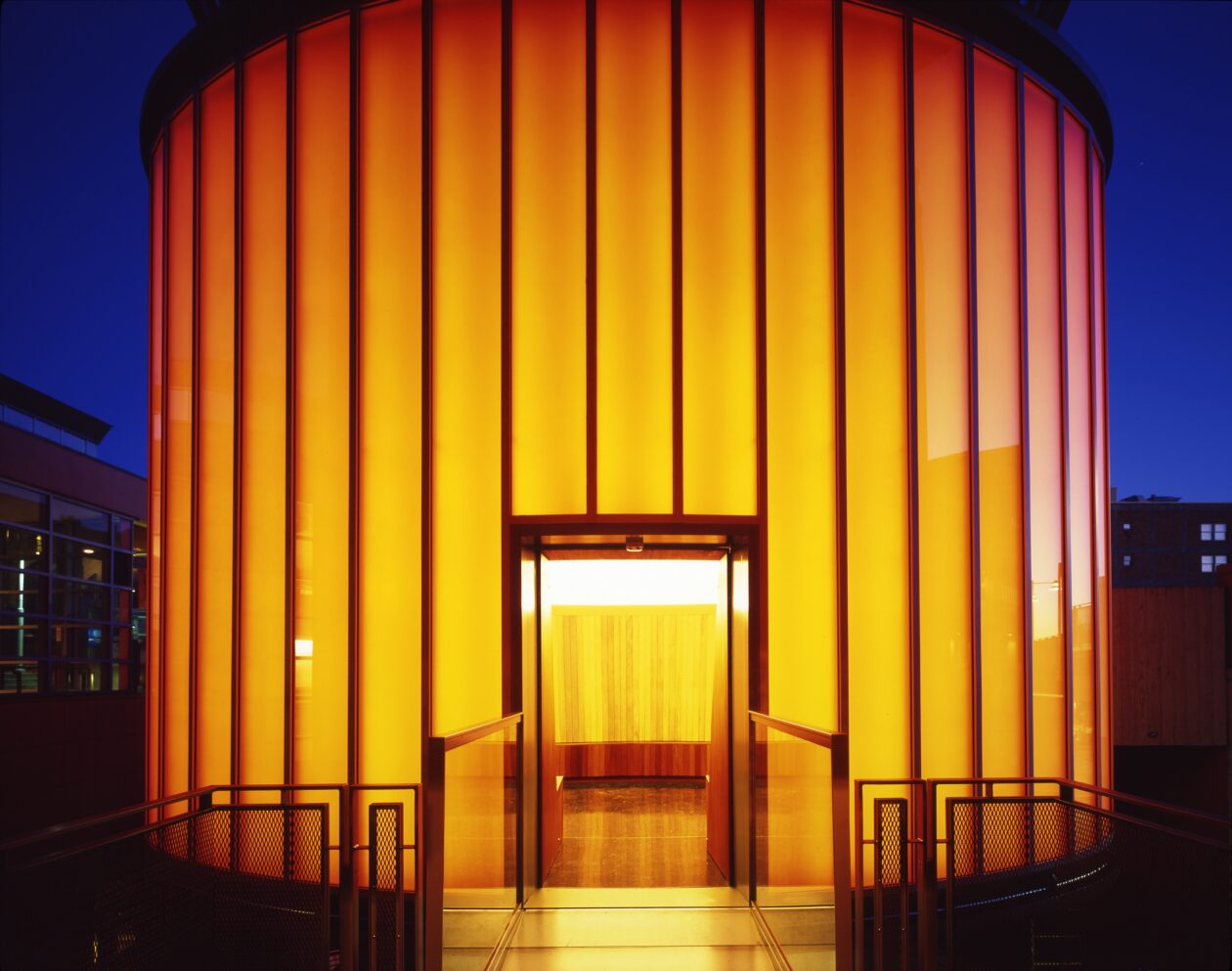
For years, if you walked past the Henry Art Gallery at dusk, you might have noticed a strange, quiet glow emanating from a glass shell near the entrance. Not a flashy sign, not a screen, but something softer—a building-sized lantern breathing color into twilight. That is “Light Reign,” James Turrell’s skyspace, a permanent installation created in 2003 on the University of Washington campus. From the outside, the faceted glass exterior shifts through vivid colors, a kind of architectural mood ring that responds to the sun and sky. Inside, an oval chamber invites you to sit on teak benches and gaze upward through an oculus, a circular opening in the roof that frames the sky like a living painting. When the weather cooperates, a hydraulic lid lifts and slides away, opening the room to clouds, birds, and the slow drift of weather. Turrell, now 83, has spent his career turning light itself into his medium, and “Light Reign” is one of dozens of skyspaces he has designed around the world. But for more than a dozen years, this one has been running on daylight alone. Its original lights aged and failed, and although visitors could still enter and meditate beneath the open sky, the color had faded from the experience. On November 14, that changes. The Henry will relight “Light Reign” after a painstaking restoration that replaced hundreds of outdated fixtures with new LEDs and a control system precisely synced to the sun. It is a moment of renewal not just for a beloved artwork, but for a museum about to mark its hundredth year.
The story of this restoration is deeply tied to the fragility of technological art. Turrell’s work depends on hardware: neon tubes made by Western Neon, early-generation LEDs, control systems, and a retractable roof engineered by submarine manufacturers in Everett. By 2015, those components were reaching the end of their lives. Sage Sommer, the Henry’s director of exhibitions and collections, said the museum gradually lost the ability to run the light program. The Skyspace stayed open—you could still go inside, sit in the calm, and watch clouds and birds cross the oculus—but the color program fell silent. Restoring it was not as simple as replacing a few bulbs. The museum did not work directly with Turrell; instead, it turned to Ryan Pike, a lighting designer whose company, RHMP, works exclusively on Turrell installations. Pike has been maintaining and upgrading Turrell’s art since 2013, and he described the exterior as the hardest part of the project. “It’s just over 700 lights, in nine DMX universes, so each fixture can output independently of the rest,” he said. DMX is the standard protocol for controlling stage and architectural lighting, and splitting the facade across multiple universes allows every single fixture to be programmed on its own. In total, the new system uses about 840 LED fixtures, roughly 710 outside and 130 inside. The result is not just a repaired artwork, but an upgraded one—one that incorporates ideas Turrell has developed in his newer skyspaces.
What will visitors experience when the lights come back? The magic begins before sunrise and before sunset, when the exterior program kicks in about half an hour before dawn and dusk. The morning show is brief, lasting only about 36 minutes, while the evening performance currently stretches about four hours after sunset. Because Seattle sits so far north, the artwork’s relationship to daylight is constantly changing. In summer, sunsets last late into the evening; in winter, the glow arrives just as commuters walk home through the dark. Sommer described this as the very coolest thing about the space: “Because we are so far north, it is just how connected to sunrise and sunset it is, and how drastically different it is throughout the year.” Inside, the newly installed LEDs bathe the walls in slowly shifting color, while the oculus remains the quiet centerpiece—a window to the sky that changes every second. The roof itself has an unusual pedigree: the hydraulic lid was designed by submarine manufacturers in Everett, and it stays firmly shut in the rain, which in Seattle means the chamber sometimes remains closed. The restoration also involved a great deal of physical care. The museum closed the Skyspace in late July, and crews repainted the interior, refinished the teak benches, waxed the floors, replaced worn locks, refitted doors that had swollen from moisture, cleaned out the gutters, and rewired everything. It took longer than expected, because old buildings and old artworks rarely reveal all their secrets at once. But the result is a space that feels both renewed and ancient—a place to pause, breathe, and look up.
The challenges of preserving “Light Reign” are not unique to the Henry. In 2023, the Walker Art Center in Minneapolis restored its own Turrell skyspace, “Sky Pesher,” after the cold cathode tubes that powered its lighting became impossible to find. Cold cathode technology dates back to the 1920s, and by the early 2020s, the Walker could no longer source the parts. Working with Turrell and his studio, the museum switched to LEDs, which allowed more control and a much wider range of color. What had once been “shades of tinted white” became multicolored, as Joe King, the Walker’s director of collections and exhibition management, described in an interview. This is the reality of time-based media, a museum term for art that relies on equipment and unfolds over time. Sometimes preservation is straightforward, like converting a VHS tape to a digital file. Other times, the hardware is integral to the work, and artists may insist that a piece be shown only on a CRT television, or they may create a remastered version and want only that one shown. The Henry works closely with artists to honor their vision, but it also recognizes that accessibility matters. “Light Reign” is the most visible piece in the Henry’s collection of about 30,000 objects, which includes more than 18,000 textiles and 7,000 works on paper. Only a sliver of that collection is ever on view, which is why the museum is putting its collection database online, funded by UW’s Student Technology Fee. Anyone can book an appointment at its study center to see a piece up close. The museum is trying to pull back its walls, to let light in and let people in.
The relighting arrives just as the Henry—Washington’s first public art museum, which opened on the UW campus in February 1927—prepares to celebrate its centennial. The anniversary exhibition, opening in late February, turns its gaze toward technology. Associate curator Swagato Chakravorty said he was surprised that no major museum had mounted a large, ambitious show on contemporary art and technology in decades, even as Seattle’s tech industries reshaped the city around it. His exhibition looks at technology “from below,” focusing on the people and communities most directly affected rather than a “great man” story. It is loosely organized around three threads. One is bioethics, including a work the Henry commissioned in 2002 with UW geneticist Mary-Claire King, which is being revived 25 years later. Another pairs Indigenous knowledge with tools like 3D printing and algorithms. The third explores technology’s material toll, from data centers to water use. Chakravorty deliberately avoids taking a side on whether technology is good or bad for art. “Writing is a technology. Cave painting was a technology,” he said. As for artificial intelligence, he is unbothered: “It’s not going to kill art.” That calm confidence fits the Henry’s spirit—a museum that has been adapting to new forms of expression for a century, just as Turrell adapted light itself into sculpture. The centennial has encouraged officials to hint that bigger changes are on the way, but for now, the focus is on renewal, memory, and the simple act of watching the sky.
On November 14, the public can experience the refurbished “Light Reign” for free, from 3:30 to 6 p.m., with remarks from Henry Executive Director Kris Lewis and the exterior illumination beginning at 4 p.m. The museum encourages RSVPs, and interior viewing is limited to 25 people at a time for about 10 minutes each—enough time for a short, contemplative sitting beneath the oculus. The first public glow will be a quiet homecoming for an artwork that has been waiting in the dark. For a century, the Henry has been a place where people bring their questions about what art is and why it matters. A James Turrell skyspace is one of the best answers: a room that does almost nothing except change the way you see. Stand outside as the glass shell begins to glow, just steps from a bronze George Washington who has watched the western sky since 1909. The old soldier faces the Olympics; the new light faces the future. The museum’s centennial hints at bigger changes ahead, but for now, the simplest pleasure is enough: watching a building breathe color into twilight, and remembering that some of the most profound art isn’t a painting or a sculpture—it’s the space between you and the sky.