



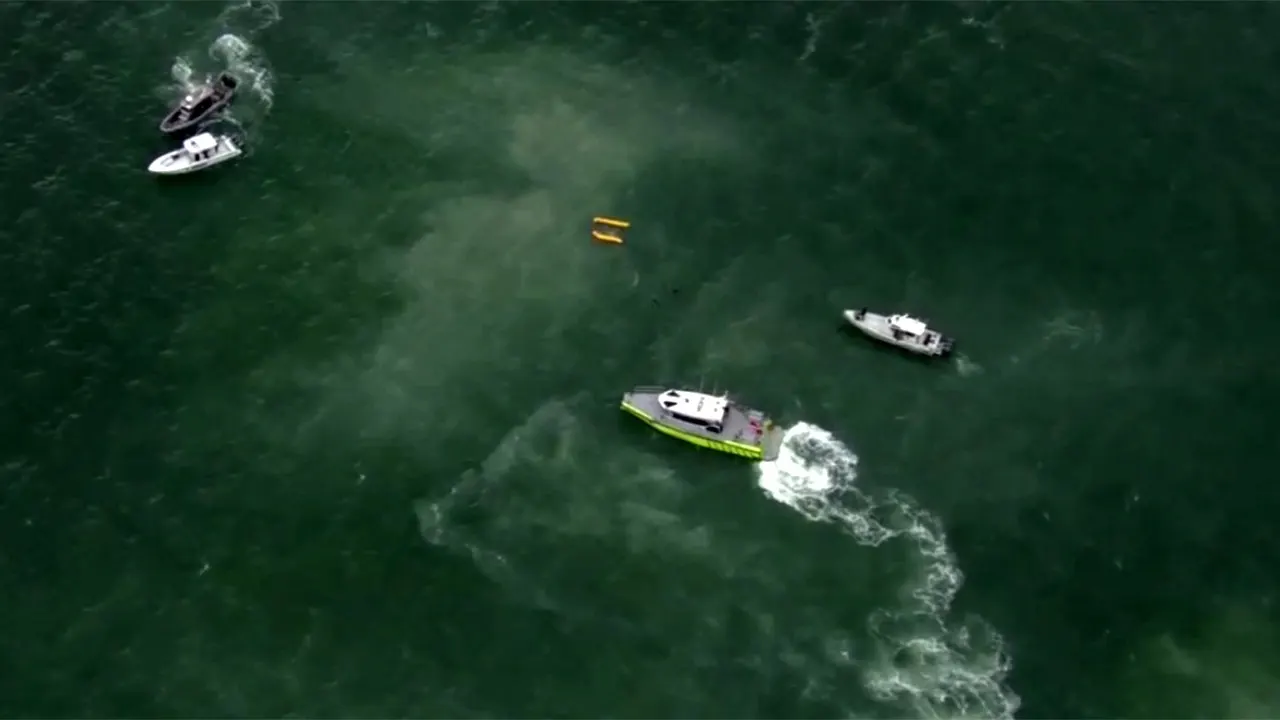
On a bright Wednesday morning, what should have been an ordinary flight over one of Florida’s most scenic coastal stretches turned into a scene of chaos and heartbreak. A small helicopter plunged into the shallow, turquoise waters off Key Biscayne, near the quiet stretch of Nixon Beach, shortly after 11 a.m. The sudden splash of metal and rotor blades shattered the morning calm, drawing startled beachgoers and nearby boaters to the shoreline. Within moments, the unmistakable sound of sirens began to fill the air as first responders raced toward the 1200 block of Crandon Boulevard, where the wreckage bobbed in the water. Witnesses described seeing the aircraft’s yellow emergency floats inflated and drifting on the surface, a stark reminder that this was not a typical water landing but a serious crash. The initial report from local news station WSVN confirmed that at least two people had been injured, but the full scale of the tragedy was still unfolding. As helicopters from news outlets hovered overhead and rescue boats cut through the waves, the scene below was a jumble of debris, emergency lights, and the grim reality that someone may not have made it out alive.
The rescue effort was swift but painful in its outcome. Miami-Dade Fire Rescue crews arrived on the scene within minutes, coordinating with City of Miami Fire Rescue and Key Biscayne Fire Rescue to pull two survivors from the water. These two individuals, described as adult trauma alert patients, were quickly stabilized and transported by ground rescue units to a designated landing zone, where MDFR Air Rescue helicopters were waiting to fly them to the area’s main trauma center. The exact nature and extent of their injuries were not immediately known, but the designation “trauma alert” indicated that their condition was serious enough to require immediate, specialized medical attention. Yet even as those survivors were being rushed to care, another, more somber reality settled over the rescue site. Aerial footage captured by local news teams showed a yellow tarp covering what was believed to be a third victim, a silent and devastating confirmation that not everyone aboard the helicopter had survived. Divers were seen entering the water near the wreckage, carefully navigating around the floating debris and the aircraft’s emergency floats, while the tarp remained a fixed, sorrowful point in the frame. For the families waiting on shore, the news was fragmentary and terrifying, each update carrying both hope and grief in equal measure.
The coordinated emergency response was a testament to the professionalism of Miami’s first responders, even in the face of such tragedy. Multiple agencies worked together seamlessly, each unit knowing its role and executing it under immense pressure. Ground rescue teams from the city and Key Biscayne rushed to the landing zone, while MDFR Air Rescue provided the critical airlift that would get the injured to the trauma center as quickly as possible. Fire rescue boats surrounded the crash site, their crews pulling survivors from the water and securing the area for divers and investigators. The decision to use a designated landing zone rather than attempting to transport the victims directly from the crash site was a strategic one, allowing for a safer and more controlled transfer of patients. Meanwhile, the aerial footage from news helicopters painted a vivid picture of the scene: the yellow floats rising from the water like small buoys, the rescue boat bobbing alongside the wreckage, and divers disappearing beneath the surface to search for anything or anyone that might still be there. It was a scene of controlled urgency, every action deliberate, every move calculated to save lives and preserve evidence. Yet for all their skill and speed, the first responders could not change the outcome for the third person, whose body remained under that tarp, waiting for the next step in a process that was only just beginning.
This crash is a jarring reminder of the risks inherent in helicopter travel, even in ideal weather and familiar surroundings. Helicopters are remarkable machines, capable of vertical takeoff, hovering, and navigating terrain that fixed-wing aircraft cannot reach. But they are also complex and demanding, with a wide range of potential failure points, from engine and rotor issues to sudden changes in wind or visibility. When a helicopter goes down over water, the outcome depends on a narrow window of time and the effectiveness of safety equipment. Emergency floats, like the yellow ones seen in the aerial footage, are designed to keep the aircraft afloat after a water landing, giving occupants precious time to escape and rescuers a visible target. But a crash is rarely a gentle touchdown; the impact can be violent, causing injuries that make escape difficult or impossible. The fact that two people were pulled from the water alive suggests that the floats may have done their job, at least partially, but the loss of a third life underscores how precarious survival can be in such situations. The helicopter’s final moments, the pilot’s actions, and the cause of the mechanical or human failure that led to the crash are all questions that investigators will now try to answer, knowing that each answer could help prevent a future tragedy.
As the day wore on, the focus shifted from rescue to investigation. The Federal Aviation Administration and the National Transportation Safety Board were expected to lead the inquiry, working alongside local authorities to piece together what happened. Investigators would examine the wreckage, retrieve the flight recorder if one existed, interview witnesses, and review maintenance records for the aircraft. The cause of the crash remained unknown in the immediate aftermath, and officials were careful not to speculate. Was it an engine failure? A mechanical issue? Pilot error? A sudden weather shift? The waters off Miami are generally calm in late morning, but conditions can change rapidly, and the area is busy with boat traffic and other aircraft. The presence of divers near the wreckage indicated that investigators were already combing the site for clues, documenting the position of debris, and searching for any components that may have broken off before impact. The helicopter itself, or what remained of it, would eventually be recovered and taken to a secure facility for a thorough examination. Every detail, no matter how small, could be significant. For the survivors, the road to recovery would be long, both physically and emotionally. For the family of the victim, the beginning of grief was compounded by the need for answers. And for the broader community, the crash served as a somber reminder of how suddenly life can change.
In the aftermath of the crash, the mood along Crandon Boulevard and the surrounding neighborhoods was one of shock and reflection. Key Biscayne is a close-knit community, and news of the accident traveled quickly, sparking conversations among residents and visitors alike. Many gathered near the water, staring out at the spot where the helicopter had gone down, trying to process the day’s events. The beach itself, so often a place of joy and relaxation, now carried a different energy, a quiet heaviness that lingered long after the emergency vehicles had departed. Local officials offered their condolences and promised a full investigation, while community members reached out to support the families affected. The two survivors, once stabilized, would face a difficult recovery, both from their physical injuries and from the trauma of having lived through such a terrifying ordeal. And for the family of the one who did not survive, the loss was immeasurable. As the sun set over the Atlantic, painting the sky in shades of orange and pink, the waters off Nixon Beach were calm once more, hiding beneath their surface the evidence of a tragedy that would not be forgotten. The investigation would continue in the coming days, but for now, the community could only wait, hold onto its hopes, and mourn. In the end, this was not just a story about a helicopter crash; it was a story about human fragility, the swiftness of disaster, and the resilience of those who respond, those who survive, and those who are left behind.