


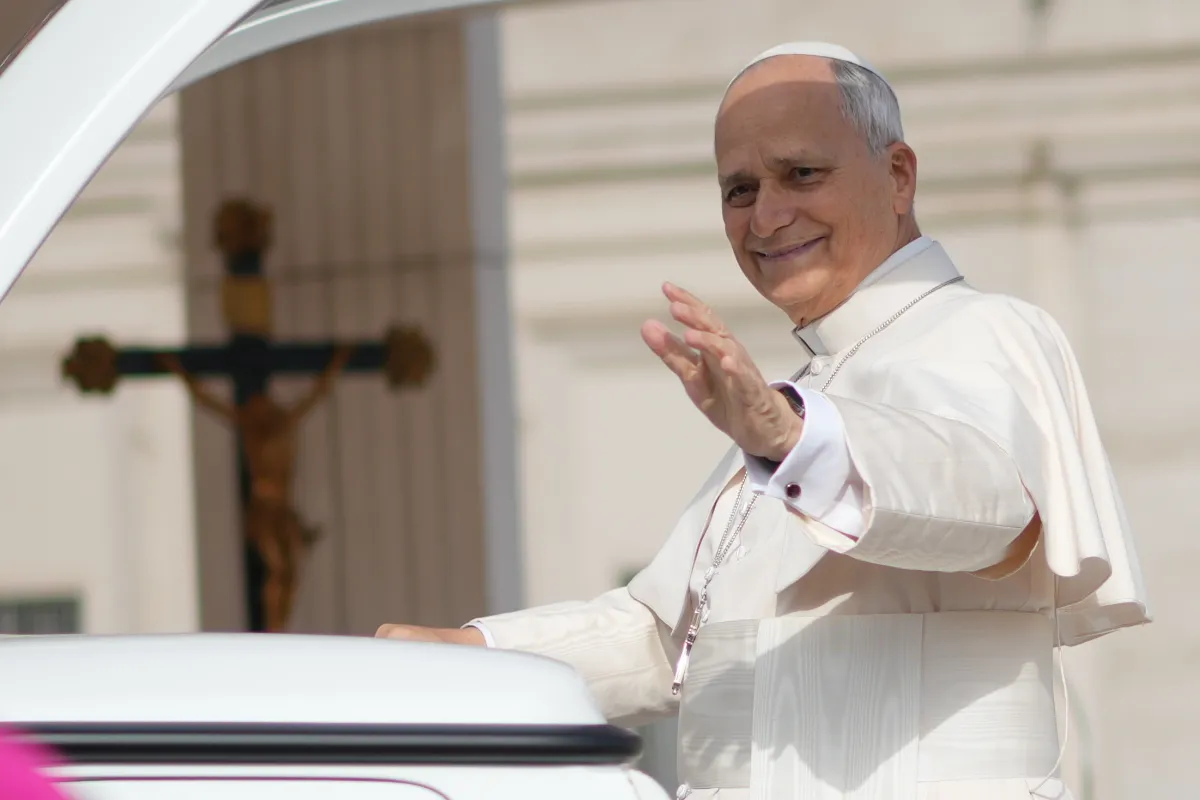
On Wednesday, the day after America’s 2026 midterm elections, Pope Leo XIV stood before a crowd of several hundred pilgrims and onlookers in St. Peter’s Square. He was the first pope to vote in an American election, and he had come to talk about what that vote meant. The Vatican had just confirmed that the Chicago-born pontiff, born Robert Francis Prevost, had mailed his ballot from Rome to Illinois, exercising his right as a United States citizen. The image was almost impossible to process at first. Here was the Bishop of Rome, the sovereign of the world’s smallest state, the spiritual father of more than a billion Catholics, quietly participating in the messy, beautiful, frustrating ritual of democracy in a country he left long ago but never forgot. He was not standing at a polling place in Chicago, but his ballot was somewhere in the American postal system, making its way to an election office in Illinois. For the crowd, the news landed like a gentle shock. They had come to hear a pope; they were also seeing a fellow citizen. And when he opened his mouth to speak, he did not talk about the election results or the winners. He talked about something much older and deeper: the meaning of political authority, the duty to serve the common good, and the hope that politics could heal rather than wound. His voice, amplified by the square’s speakers, was calm and measured. He spoke in Italian, the language of his office, but the words were meant for every nation. The crowd listened in silence, some nodding, some holding up phones. It was a quintessentially Roman scene, but the subtext was unmistakably American. A pope from Chicago had cast a vote in Illinois, and now he was explaining why it mattered. He did not mention Democrats or Republicans, did not celebrate the blue wave that had reshaped Congress, did not claim any victory. Instead, he reached for the language of Catholic social teaching, a tradition that sees politics not as a battlefield for power but as a workshop for justice. In that single moment, the ancient office of the papacy and the modern experiment of American democracy seemed to stand side by side, each asking the other a question about what we owe to strangers.
Who was this man who had just made history? Pope Leo XIV had not always been a figure in white. He was born Robert Francis Prevost in Chicago, a city of neighborhoods and parishes, of machine politics and reformers, of great wealth and stubborn poverty. He grew up in a country where voting was both a right and a responsibility, where people argued about taxes and wars and civil rights at dinner tables and in barbershops. As a young man, he joined the Order of St. Augustine, a community known for its intellectual life and its commitment to service. He went to Peru as a missionary, learned Spanish, lived among people who had experienced both the indifference of the powerful and the cruelty of corruption. For years, he worked as a pastor, a teacher, a bishop in a world far from the marble halls of the Vatican. He saw what happened when politics was treated as a game of winners and losers, when the common good was sacrificed for the interests of a few. He also saw what happened when ordinary people found the courage to organize, to demand justice, to vote. That experience shaped him. When he was eventually called to Rome, made a cardinal, and then, to the surprise of many, elected pope, he did not shed his American skin. He kept his citizenship, his memories, and, apparently, his voter registration. The Vatican’s confirmation that he had submitted a mail-in ballot in Illinois was not a political statement. It was a personal one. It said that the man who now wore the fisherman’s ring still considered himself part of a nation, still believed that the voice of a citizen mattered, still wanted to be counted. In a world where leaders so often seem detached from ordinary life, there was something profoundly human about a pope who would take the time to fill out a ballot, sign it, and send it across the ocean. He was not above the fray. He was in the fray, as a participant, not as a partisan.
His address on Wednesday was not a sermon about any particular election, but it was impossible to hear it outside the context of the American midterms. The Pope’s message was about the nature of power itself. “The exercise of political authority must always be directed towards the common good,” he said, “which must be structured and operate according to local and historical circumstances, but always with the good of the entire human family at heart.” The phrase “common good” is a cornerstone of Catholic social teaching, but Leo gave it a distinctly human face. He spoke of authority not as a prize to be seized but as a service to be rendered. He acknowledged that political systems must fit their local and historical circumstances; there is no one-size-fits-all blueprint for justice. But he insisted that every system, no matter how different, must be measured by one standard: whether it serves the good of the entire human family. That is a demanding standard. It asks leaders to think beyond their own borders, their own donors, their own parties. It asks citizens to look at the stranger, the poor, the displaced, the forgotten. It asks voters to consider not just what is good for me, but what is good for us. For a pope who had spent years in Peru, who had seen the wounds of colonialism and inequality, this was not abstract theory. It was the lesson of a lifetime. And he delivered it not as a scold but as a gentle reminder, in the tone of a pastor who believes that people, given the right encouragement, will choose the better path. The crowd in St. Peter’s Square seemed to feel that warmth. They applauded, not loudly, but with the kind of appreciation that comes when someone says something true and necessary. The Pope did not need to mention the election results. His words had already drawn the line between politics as domination and politics as care.
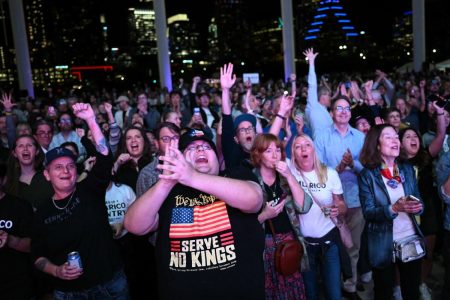
And what results they were. While the Pope was speaking, the American political map was being redrawn in a shade of blue. The 2026 midterm elections had produced what commentators were already calling a blue tsunami, a wave of Democratic victories that swept through states and districts that had not been competitive in generations. At the time of writing, Democrats had flipped at least seven Republican-held Senate seats. Among the most stunning was Texas, where a Democrat had not won a Senate race since 1988, and Kansas, where a Democrat had not been elected to the Senate since 1932. Those numbers were not just statistics; they represented a fundamental shift in the political landscape, a repudiation of the status quo that had seemed unshakeable just a few years earlier. In the House, the wave was even broader. More than two dozen seats had flipped, including a district in Kentucky that President Donald Trump had carried by about fifteen points in the last presidential election. To put that in perspective, only four times since World War II had a party captured both chambers of Congress in a midterm election. This was one of those rare nights. The returns came in state by state, and by the time the Pope stood in St. Peter’s Square, the contours of the new Congress were already visible. Yet the Pope did not mention any of this. He did not congratulate the winners or console the losers. He did not offer a political analysis. Instead, he offered something more enduring: a reminder that elections are not the end of politics, but the beginning of a new chapter of responsibility. The blue wave would eventually recede, as all waves do. But the task of governing, of healing, of building a common life, would remain. In that sense, the Pope’s words were not about the midterms at all. They were about the days after the midterms, when the cheering stops and the work begins.
Near the end of his address, the Pope offered a sentence that seemed to gather up the entire day. “Politics that tends to the wounds of peoples and of those who suffer injustice offers grounds for hope for the future of humanity,” he said. The phrase “tends to the wounds” is a striking choice. It evokes a nurse cleaning a cut, a parent kissing a scraped knee, a doctor setting a broken bone. It is not the language of a campaign rally or a legislative strategy. It is the language of compassion. The Pope was saying that politics, at its best, is a form of healing. It is not about winning for the sake of winning, or about humiliating one’s opponents, or about accumulating power for its own sake. It is about looking at the world and seeing where people are hurting, and then using the tools of law, policy, and governance to ease that hurt. That is a radically different vision from the one that dominates much of modern public life, where politics is often treated as a blood sport and compromise is seen as betrayal. But Leo spoke from a tradition that has always insisted on the dignity of every human person, especially the poor and the vulnerable. He had seen the wounds of peoples in Peru, in the United States, in the shadow of the Vatican itself. He knew that injustice is not an abstraction. It is a child without food, a family without shelter, a worker without dignity, a refugee without welcome. And he knew that politics, for all its flaws, is one of the ways human beings have devised to respond to those wounds. It is not the only way, and it is not always effective, but it is a way. To say that such politics offers “grounds for hope” is to make a bold claim. It means believing that the future is not fixed, that human action matters, that the arc of history can bend toward justice if enough people bend it. It means seeing the ballot box as an instrument of mercy. For a pope who had just voted in an American election, this was not a distant ideal. It was his own act, held up as an example.
What are we to make of this moment? A pope voting in an American election is one of those facts that seems like a headline from a satirical newspaper, yet here it was, confirmed by the Vatican, witnessed by a crowd, and woven into the fabric of a historic midterm night. It is easy to focus on the novelty: the first pope to cast a ballot in the United States, the Chicago-born son of the Midwest, the mail-in envelope postmarked from Rome. But the deeper significance is not the novelty. It is the humanity. Pope Leo XIV did not have to vote. He is a sovereign of a city-state, a spiritual leader whose authority does not depend on the approval of American voters. No one in Illinois would have known if he had simply let his registration lapse. But he chose to participate. He chose to stand in the long line of American citizens who, for more than two centuries, have believed that their voice matters. In doing so, he reminded the world that democracy is not a machine that runs itself. It is a living thing, sustained by the small, unglamorous acts of ordinary people: registering, researching, deliberating, voting. If a pope, with all his responsibilities, can make time to fill out a mail-in ballot, then surely the rest of us can find time to do the same. His words in St. Peter’s Square will be studied and quoted, but his action may speak even louder. It said that no one is too important to participate in the common life of their country. It said that the common good begins with a single vote. It said that hope, for the future of humanity, is not a vague sentiment but a choice. This is a breaking news story, and there will be more to learn in the days ahead. But for now, the image of a pope and a citizen, standing in the light of St. Peter’s Square, offering his voice to the world and his ballot to Illinois, is enough. It is a reminder that politics can be sacred, that citizenship can be holy, and that the wounds of the world are not healed by power alone, but by love, justice, and the stubborn belief that every person counts. And that is a message that transcends any election, any party, any nation.