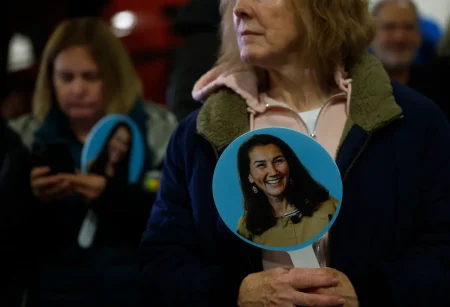



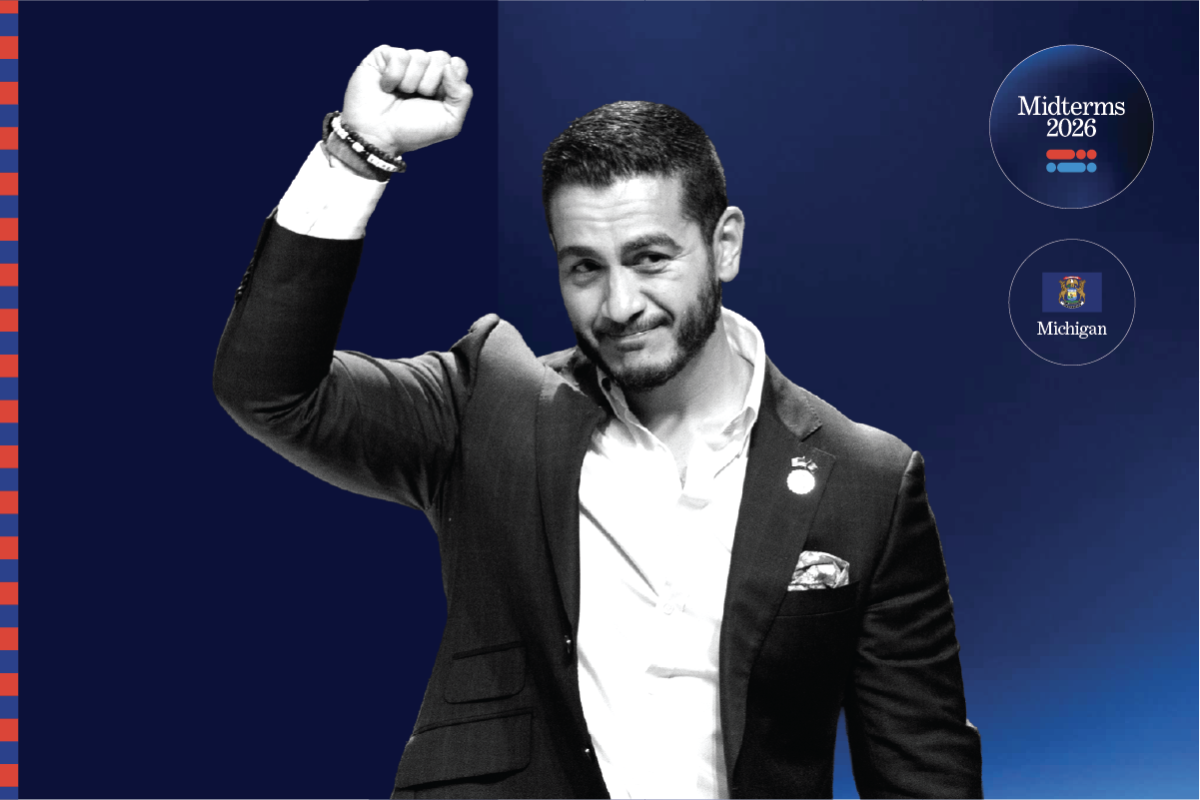
On a night thick with tension and hope, Abdul El-Sayed stood before a room of exhausted, ecstatic supporters and delivered a line that felt less like a concession speech and more like a benediction. “Mike, enjoy your retirement,” he said, his voice carrying the weight of a campaign that had tested every ounce of his patience and resolve. Then came the line that would define the night: “You chose hate. Michigan chose hope.” The room erupted. For months, this race had been called one of the most expensive, most closely watched, and most bitterly fought contests of the midterm elections. It had dragged through primaries, super PAC onslaughts, accusations of antisemitism, and a stunning Democratic betrayal that threatened to sink him in the final days. But in the early hours of Wednesday, Fox News projected that El-Sayed had defeated his Republican opponent, Mike Rogers, and Michigan Democrats could finally breathe again. The victory meant more than a single Senate seat. It meant that the party would hold on to a seat they had occupied since 1979, and that El-Sayed would become the first Muslim American ever elected to the United States Senate. For a state that had been battered by political warfare, for a candidate who had been mocked by name and attacked for his faith, it was a moment of improbable, almost poetic vindication. Supporters wept, hugged strangers, and chanted his name as the reality sank in: against the money, against the odds, against the last-minute chaos, hope had won.
But the road to that victory party was not a gentle one. It was paved with millions of dollars, vicious attack ads, and a political environment that seemed to shift with every news cycle. El-Sayed entered Election Day with a lead in the RealClearPolitics average—49.8 percent to Rogers’s 44.9 percent—but that margin had never felt entirely safe. A New York Times/Siena University poll conducted in late October and early November gave him his largest advantage of the campaign, 53 percent to 42 percent among likely voters, but that survey had ended just as the race took its strangest turn. Other polls told a more anxious story: a Trafalgar Group survey had him up by just one point, 47 percent to 46 percent; a YouGov poll showed a four-point race; and while a Mitchell Research poll for CBS Detroit found him leading 51 percent to 44 percent, with a strong advantage among independents, no Democrat in Michigan could shake the memory of a state that had twice voted for Donald Trump. The money was staggering. El-Sayed raised more than $30 million from mid-July through September, triple what Rogers brought in, but outside groups tried to drown him in cash, spending nearly $95 million to boost Rogers in the general election by mid-October, compared with $42 million for El-Sayed. By the end, The Detroit News estimated total spending in the race had surpassed $400 million. For voters, that meant nonstop television ads, text messages, and mailers, each one more desperate than the last. Rogers painted El-Sayed as a socialist radical. El-Sayed painted Rogers as a Trump loyalist who would rubber-stamp an agenda of division. And at the center of it all was a candidate who had spent his career as a physician and public health official, not a career politician, trying to convince a wary electorate that his vision for Michigan—Medicare for All, economic fairness, and a rejection of fear-based politics—was not a fringe fantasy but a necessary future.
The most dramatic twist came in the final week, and it threatened to unravel everything. Representative Haley Stevens, a Michigan Democrat who had lost to El-Sayed in the August primary by about one point, had warned during that primary that he could not beat Rogers. She had also said she would vote for him. But on November 1, just two days before the election, Stevens appeared with Mike Rogers at a Detroit church and endorsed him. She said she remained a Democrat, but her reasoning was muddled and her timing was devastating. The announcement came after days of public feuding. On October 30, Stevens had demanded that El-Sayed apologize for remarks tying Israel to Michigan’s unmet needs and condemn an outside group’s ad she called antisemitic. El-Sayed responded that she seemed “intent on relitigating a primary that ended three months ago,” and his campaign asked her to stay away from his final events. Then she crossed the line entirely. Michigan Democrats erupted in fury. Prominent figures in the party rebuked her, and El-Sayed’s campaign reported raising $2.4 million in a single day—their largest one-day haul of the entire race. What was meant to be a fatal blow instead became rocket fuel. Supporters who had been complacent suddenly felt a surge of urgency. Donations poured in from across the country. The image of a fellow Democrat abandoning the party’s nominee in the final hours, and siding with a Republican backed by Donald Trump, did not read as courage to most voters; it read as betrayal. El-Sayed used the moment to sharpen his closing argument, telling a news outlet that night, “Mike Rogers is going to be a vote for Donald Trump.” Meanwhile, Rogers stuck to his own script, warning supporters that a vote for El-Sayed was a vote for socialism. But in the end, Michigan voters seemed less interested in labels than in the person behind them.
No issue in the race was more fraught than the question of Israel and Gaza. Rogers repeatedly accused El-Sayed of fostering antisemitism, pointing to El-Sayed’s criticism of Israel’s military campaign and his appearances with commentator Hasan Piker. The attacks were relentless and often personal, designed to cast El-Sayed as dangerous and un-American. El-Sayed condemned antisemitism and Hamas clearly and repeatedly, but he refused to accept the premise that criticizing Israel’s actions was equivalent to hatred of Jewish people. He argued that it was possible—and necessary—to separate the policies of a foreign government from the dignity of a people. His own Muslim faith became a target as well. Donald Trump mocked his name, and Rogers’s campaign leaned into the bigotry, hoping to turn Michigan’s substantial Jewish and Arab American communities against one another. But El-Sayed refused to be defined by the attacks. One of the most powerful moments of the night came when he addressed AIPAC, the pro-Israel lobby that had spent more than $30 million in the primary trying to stop him, and then reportedly moved to send up to $9 million to a pro-Rogers super PAC in the final weeks of the general election. “To AIPAC who spent $42 million against us,” El-Sayed said, a wry smile spreading across his face. “Thank you for giving me the opportunity to beat you twice.” The crowd roared. It was a rare moment of pure, unvarnished catharsis—a candidate who had been outspent, out-attacked, and out-maneuvered standing on stage and thanking his enemies for making him stronger. For many voters, that moment captured the essence of El-Sayed’s campaign: not a man running from his identity or his beliefs, but someone willing to meet the storm head-on and emerge still standing.
The stakes of the Michigan race extended far beyond one state’s borders. Republicans entered the midterms holding a 53-47 Senate majority, and Michigan was the only Democratic-held seat that the Cook Political Report rated as a toss-up in the final stretch of the campaign. For Republicans, it was their clearest opportunity to offset losses elsewhere. For Democrats, it was the place where their hopes of holding the Senate could live or die. As results began to roll in on election night, the picture became increasingly clear: this was a glorious night for the Democratic Party. Flips in Texas, Iowa, Kansas, and South Carolina gave them commanding control of the Senate, and Michigan was the exclamation point. The race had been seen as a test of the party’s progressive wing, and El-Sayed ran proudly on that banner. He had the backing of Vermont Senator Bernie Sanders and New York Representative Alexandria Ocasio-Cortez, and his platform of Medicare for All represented a clear break from the cautious centrism that had defined many Democratic campaigns. Republicans argued that his politics were too far left for a state that had twice chosen Donald Trump. But El-Sayed made the case that the old assumptions were wrong—that voters were hungry for candidates who spoke honestly about healthcare, economic inequality, and the ways government had failed ordinary people. His victory, alongside the other Senate flips, suggested that the progressive message could win not just in deep-blue enclaves but in battleground states where the working class had been drifting away from the Democratic Party.
As the celebration continued into the early morning, El-Sayed’s words hung in the air like a promise: “You chose hate. Michigan chose hope.” It was a simple phrase, but it captured the moral weight of the entire campaign. He had been attacked for his name, his faith, his alliances, and his ideas. He had been abandoned by a member of his own party at the worst possible moment. He had watched hundreds of millions of dollars flow against him, and he had refused to bend. In the end, Michigan voters had a choice between two very different visions of America: one rooted in fear, resentment, and division; the other rooted in dignity, compassion, and the belief that everyone deserves a chance to be healthy, to work, and to thrive. They chose the latter. For El-Sayed, the victory was not just personal. It was a message to the rest of the country that identity is not a weakness, that a Muslim American can represent a diverse state with pride and principle, and that the Democratic Party’s future lies not in abandoning its ideals but in fighting for them with courage and conviction. The first Muslim senator in American history had not merely survived the ugliest race in Michigan’s modern political memory; he had transformed it into a testament to what is possible when hope refuses to surrender. And as the room began to empty, supporters lingered, unwilling to let go of the feeling that something historic had happened. They had watched a man rise from the wreckage of a brutal campaign, and in doing so, he had given them a new reason to believe that politics could still be a place where decency wins.