

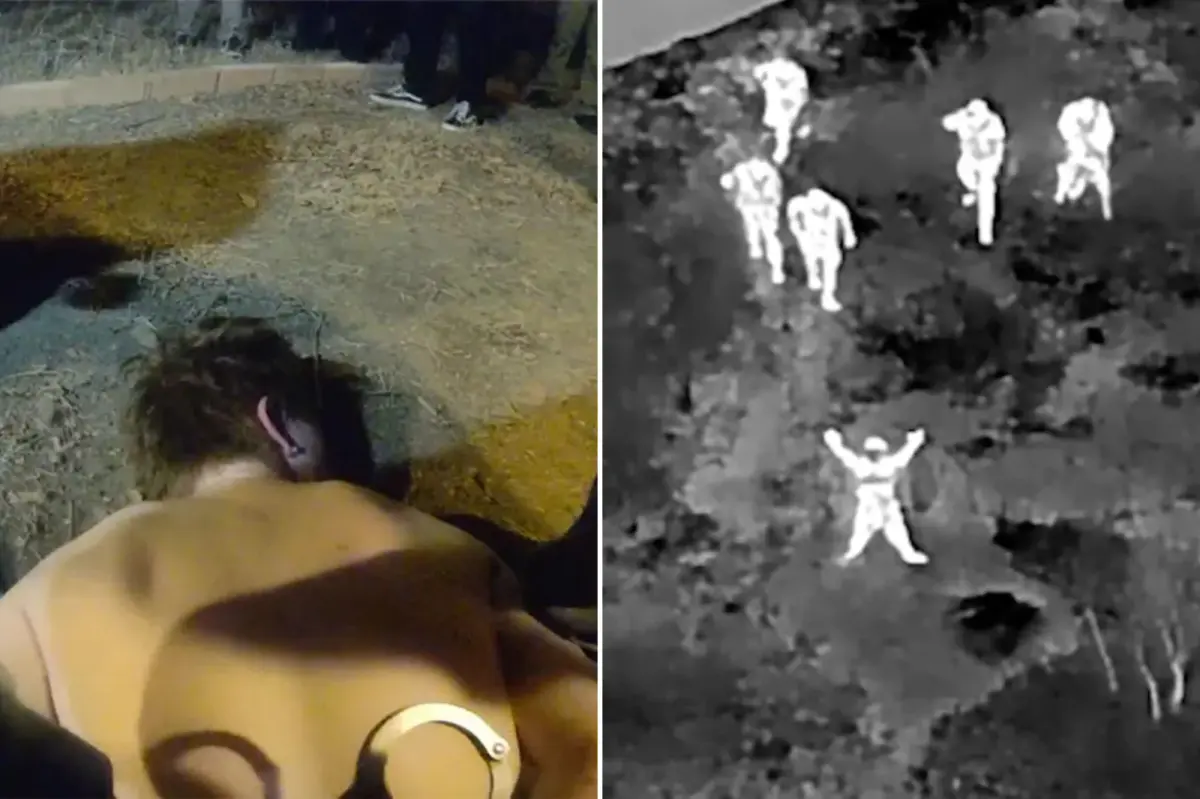
In the quiet, sprawling suburbs of Douglas County, Colorado, an ordinary January morning was shattered by a reckless spectacle of criminality that would end with a nearly naked man being plucked from beneath a porch. It was a scene that seemed ripped from a darkly comedic crime drama, yet the stakes were deadly serious, involving a high-speed chase that endangered countless lives. The protagonist of this drama was Zakary Dean Hirschfield, a 24-year-old with a rap sheet as long as his apparent list of poor decisions. His desperate bid for freedom began with a routine traffic stop and culminated in a tense standoff that underscored a simple, unwavering message from local law enforcement: in Douglas County, you cannot run.
The saga began when a Douglas County deputy attempted to pull Hirschfield over for a routine violation. What should have been a simple interaction escalated in the blink of an eye. Instead of pulling over, Hirschfield slammed on the accelerator, his SUV lurching forward in a menacing maneuver that nearly struck the deputy who had approached his vehicle. The officer’s urgent radio call, captured on body camera footage, painted a stark picture of the immediate danger. “He’s taking off, he just tried to hit me,” the deputy reported, his voice a mix of shock and adrenaline. From within the fleeing SUV, the panicked shouts of a passenger could be heard, a chilling vocal backdrop to a situation spiraling out of control. The deputy’s words weren’t just a call for backup; they were a declaration that this was no longer a traffic stop but a violent flight from justice.
What followed was a harrowing, hour-long pursuit that tore across the county, transforming public roadways into a treacherous gauntlet. Hirschfield’s driving was nothing short of suicidal and homicidal, a chaotic ballet of steel and speed. He careened into oncoming traffic, forcing innocent drivers to swerve wildly to avoid a catastrophic collision. He crossed over the grassy medians, treating the highway dividers as his personal racetrack, and pushed his vehicle to speeds exceeding 100 miles per hour. This wasn’t a calculated escape; it was a frenzy of panic and disregard, a whirlwind of recklessness that placed the lives of his passenger, pursuing officers, and every unsuspecting motorist on the road in grave peril. The pursuit wasn’t just a car chase; it was a moving crime scene, a high-velocity threat that seemed destined for a tragic end.
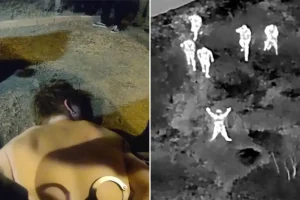
Yet, as quickly as the chaos erupted, it came to an abrupt and almost absurd halt. The trail eventually led law enforcement—a coordinated force of patrol cars, a K9 unit, and aerial drones—to a residential neighborhood where the fleeing SUV was found abandoned. The net was closing in. Officers, aided by the keen senses of a police dog, began a meticulous search of the area. They finally discovered Hirschfield, but not in the hardened, defiant posture one might expect from a man who had just led a multi-county chase. Instead, he was found cowering underneath a porch, stripped down to nothing but his underwear, as if being semi-nude might somehow make him invisible. The images from the scene are almost surreal: a man in his skivvies, splayed out on the cold ground, surrounded by nearly a dozen officers who converged to handcuff him. The dramatic, high-octane flight had ended in a moment of pathetic, comical surrender.
The aftermath of the chase revealed the deeper layers of a life mired in criminality. A search of his abandoned SUV uncovered cocaine and drug paraphernalia, providing a clear motive for his desperate attempt to evade the law. He wasn’t just a man who made a bad choice that morning; he was a repeat offender with an extensive criminal history. At the time of the chase, Hirschfield was on probation for a significant drug distribution felony in neighboring Arapahoe County, a sentence he had managed to have reduced to “straight probation” through a previous plea deal. However, his behavior on probation was a testament to his inability to adhere to the rules of society. During the first eight months of his supervision, he accumulated new violations, leading to a revocation of his probation. In a frustrating cycle of leniency, he was nevertheless reinstated, only to be arrested again in August 2025 for an alleged robbery in Jefferson County. He was released on a personal recognizance bond—a trust he immediately violated by committing another crime, the very chase that finally brought his freedom to an end.
The judicial system, which had seemingly given him chance after chance, finally delivered a resolute message. In a courtroom, Hirschfield was sentenced to five years in the Colorado Department of Corrections. The sentencing was a moment of vindication for the officers who had risked their lives to capture him and a stern warning to anyone considering a similar act of defiance. Douglas County Sheriff Darren Weekly articulated the department’s zero-tolerance stance, stating, “Don’t run from our deputies. We will catch you and hold you accountable. This defendant learned that the hard way and is now headed to prison. Putting our deputies and the public at risk will not be tolerated in Douglas County.” His words were a direct rebuke to Hirschfield’s brazen actions, framing the sentence not just as punishment, but as a necessary measure to protect his deputies and the community they serve.
District Attorney George Brauchler echoed this sentiment, weaving a narrative of consequence and jurisdiction. He highlighted the sheer danger Hirschfield posed, pointing out that he “put a deputy, his own passenger, and countless innocent motorists in danger because he refused to stop.” Brauchler’s commentary cut through the legal jargon, focusing on the human cost of the chase. He also took a pointed jab at Hirschfield’s criminal history, revealing the revolving-door nature of his prior encounters with the justice system. “Some criminals seem to think the rules don’t apply to them, and they can simply run from the law when they’re caught,” Brauchler said. “He now has five years to realize he picked the wrong county from which to run from the law.” The message was clear: the court had taken a stand, and the community could breathe a little easier knowing that a man who had consistently shown a contempt for public safety was now off the streets. In the end, the tale of Zakary Hirschfield is a stark reminder that no matter how fast you run, or how cleverly you think you can hide, the long arm of the law—with its drones, K9s, and relentless deputies—will eventually catch you, often in the most undignified of ways.