



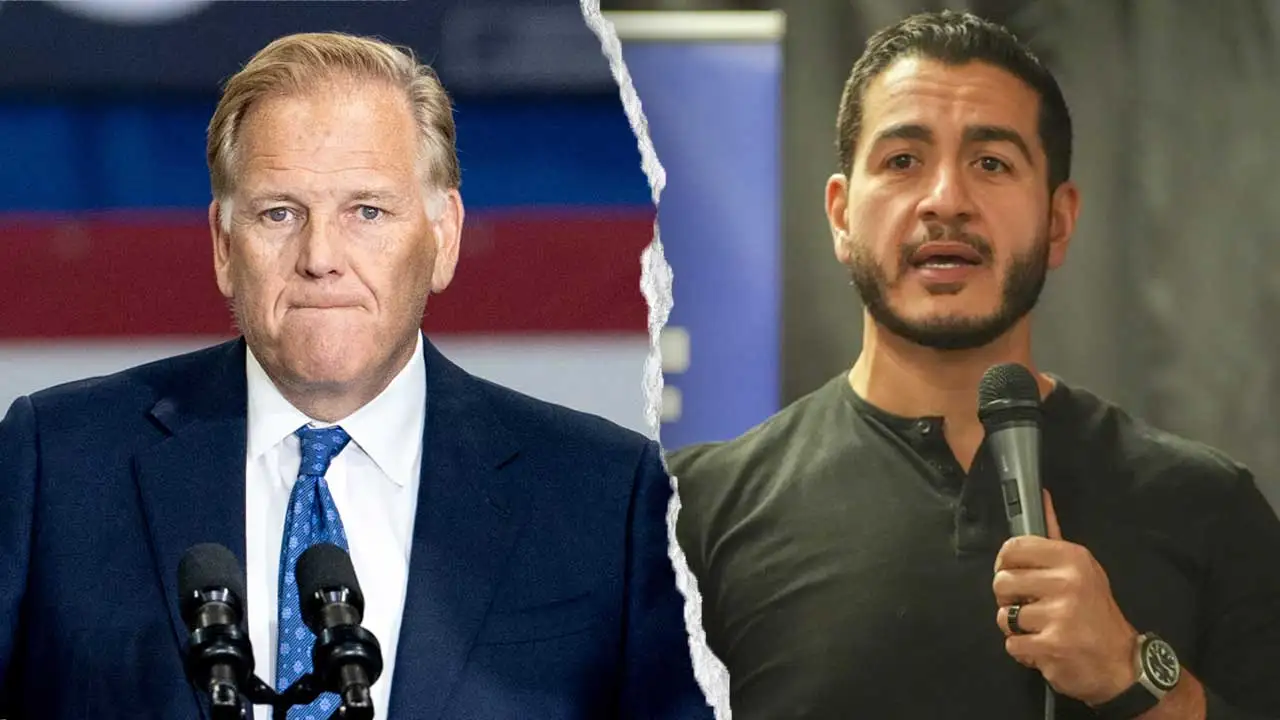
In the high-stakes, hair-splitting drama of American politics, where party loyalty often trumps personal conviction, a thunderbolt from the political wilderness has shaken up the hotly contested Michigan Senate race. Former Congressman Justin Amash, a man whose ideological journey has led him from Republican stalwart to Independent to Libertarian, took to social media on Monday to deliver a verdict that defies conventional partisan expectations. In a race pitting Republican Mike Rogers, endorsed by former President Donald Trump, against Democrat Abdul El-Sayed, a progressive physician and public health advocate, Amash declared that he cast his ballot for neither man. Yet, in a striking act of political triage, he nonetheless articulated a clear preference for which candidate poses the greater threat to the nation’s foundational principles. With the aplomb of a constitutional scholar rather than a partisan soldier, Amash argued that while both candidates would be problematic in the U.S. Senate, El-Sayed would be “far less dangerous in practice” than Rogers. It is a statement that lands with the weight of a philosophical manifesto, forcing voters to reconsider the binary choices that dominate the electoral landscape. Amash’s pronouncement is not an endorsement in the traditional sense, but rather a chillingly pragmatic ranking of constitutional hazards, delivered by a man who has often stood alone in his defense of civil liberties.
At the heart of Amash’s surprising statement lies a deeply held, almost radical, political philosophy. He wrote, “It goes without saying that I have major disagreements with both Mike Rogers and Abdul El-Sayed, and neither one particularly likes me.” This admission immediately strips away any pretense of personal affinity or political convenience. He went further, explaining, “I also don’t vote for ‘the lesser of two evils.’ I believe you should support a candidate only if you truly want the person to hold that office.” This is a profound and human declaration of integrity—a refusal to participate in what he sees as a moral compromise that degrades the democratic process. He confirmed that he has already voted, and consistent with his principle, his ballot did not feature either front-runner. Yet, in a twist that highlights the complexity of his reasoning, he acknowledged that even while refusing to choose between them, he can discern a stark difference in the danger they represent. “But I do know which one would be more dangerous in the U.S. Senate — and it’s not even close,” he asserted. This juxtaposition—refusing to vote for someone while simultaneously warning of their relative danger—reveals a nuanced mind that separates the act of endorsement from the act of political risk assessment. It humanizes the struggle of the principled voter, who often feels trapped between a rock and a hard place, yet refuses to surrender the power of discernment, particularly when the foundations of liberty hang in the balance.
To illustrate his point, Amash invoked the specter of Senator Bernie Sanders, the Independent socialist from Vermont who has thrown his support behind El-Sayed. Amash proposed using Sanders as a stand-in for El-Sayed, acknowledging their shared progressive worldview. He admitted that several of Sanders’s key proposals, particularly on economic and social policy, would, in his opinion, be exceptionally bad for the country. However, Amash drew a crucial distinction rooted in the structure of American government. “But given the structure of our government, he’s in no position to get those ideas enacted and enforced,” Amash wrote, suggesting that a single senator’s radical economic vision is largely checked by the broader legislative process. What truly matters, in Amash’s libertarian calculus, are the issues where an individual member of Congress serves as the decisive vote. In these arenas—war powers, surveillance, privacy, freedom of speech, criminal justice, and government oversight—Amash posits that Sanders is actually far superior to the average member of the chamber. This is a surprising and counterintuitive claim, but Amash backs it up with his own legislative experience. He served alongside both Sanders and Rogers, witnessing firsthand their divergent approaches to the most fundamental checks on executive power. For Amash, the threat to liberty is not always found in the flamboyant socialist, but often in the hawkish mainstream conservative who votes unthinkingly for defense authorizations and surveillance reauthorizations. By framing the debate around these constitutional flashpoints, Amash pulls the conversation away from the tired debates of left versus right and refocuses it on the timeless struggle between the individual and the state, a perspective that is uniquely foreign to the partisan pundits he criticizes.
The core of Amash’s argument rests on a starkly pragmatic assessment of Mike Rogers’s record, one that is rooted in the visceral realities of legislative power. He contrasts the “imaginary world” of partisan pundits—who see political dangers in the ideologies of either camp—with the “real world” of congressional votes that shape the boundaries of American freedom. In that real world, Rogers has amassed a record that Amash finds profoundly troubling. Rogers, a former FBI agent and House Intelligence Committee chairman, has long been a champion of expansive surveillance powers and aggressive military interventionism. Amash’s critique is scathing: “In contrast, Rogers is extraordinarily bad on all the issues on which an individual member of Congress may be the deciding vote. Again, these are issues like war powers, surveillance, privacy, the freedom of speech, criminal justice, and government oversight and accountability.” He concludes that in this specific, constitutionally-grounded arena, Rogers poses a far greater threat to individual liberty than Sanders ever could. The logic is relentlessly focused on the mechanics of power. While a senator like Sanders might dream of massive government programs, those dreams are diluted by the need for broad consensus. But a single vote against a warrant requirement, a single vote to authorize an endless war, or a single vote to shield intelligence agencies from oversight can irrevocably erode the rights of every American. Amash is highlighting the agency of the individual lawmaker, arguing that the quiet, procedural votes are often the most consequential. Because Rogers has built a career on such votes, Amash views him as a singularly dangerous figure, one who would happily trade away constitutional protections for a perceived sense of security.
Amash’s commentary lands in an already volatile political ecosystem, adding yet another layer of unpredictability to a race that has defied simple categorization. The timing is particularly fascinating given the recent endorsement of Rogers by Democratic Representative Haley Stevens, who lost the Senate primary to El-Sayed. Stevens’s endorsement of a Republican—driven presumably by intra-party squabbles or a perception of electability—has sent shockwaves through Michigan politics, blurring the lines of party loyalty. In sharp contrast, Amash, a former Republican, finds Rogers so objectionable that he cannot lend him his vote, while a current Democratic congresswoman is embracing him. This juxtaposition highlights the fractured nature of modern political alliances, where policy opinions often take a backseat to raw electoral strategy. Amash’s history with Rogers is also deeply personal; he lost the 2024 GOP Senate primary to Rogers, a race that underscored the ideological purge within the Republican Party. While Amash has long since left the party system’s mainstream, his assessment of Rogers is rooted in a bitter political rivalry. Yet, rather than expressing pettiness, his analysis is measured and deeply philosophical. It suggests a man who has moved beyond party politics entirely, viewing the candidates through the cold, hard lens of historical constitutionalism. In a political climate where voters are increasingly desperate for authenticity, Amash’s willingness to break ranks—while simultaneously refusing to align with the opposition—positions him as a curious and respected, albeit lonely, oracle of political integrity, a man who speaks truth to power without regard for tribal allegiance.
Ultimately, Justin Amash’s intervention is a stark reminder of the challenges facing the American electorate in an era of hyper-polarization. By refusing to vote for either major party candidate, he is making a powerful statement about the deficiencies of a system that forces Americans to choose between flawed alternatives. Yet, by insisting that there is a resounding difference in the level of danger they pose, he is urging voters to dig beneath the surface of partisan narratives and examine the actual records of the individuals seeking power. His warning is a clarion call to prioritize civil liberties and constitutional checks above all else. “I think it’s fair to view El-Sayed as someone who mostly will follow in Sanders’s footsteps on policy and therefore will be far less dangerous in practice than Rogers,” he wrote, carefully limiting his praise to a relative assessment. He was quick to note that El-Sayed would still do many things that are bad, but that the question is not whether he is good, but whether he is better on the whole than Rogers. This framing offers a lifeline to voters who feel morally sickened by their options. It acknowledges the human reality that sometimes there are no perfect choices, but that the decision of who occupies the seat matters profoundly. In a world where votes are often cast out of fear of the other side, Amash’s plea is a radical call to vote out of love for the Constitution. It is a reminder that the most dangerous threats to liberty are often those who cloak their power grabs in the rhetoric of safety and security, and that the true measure of a leader lies not in their party label, but in their fidelity to the principles that make the country free.