

Sure — here’s a humanized and expanded version of the article, written in six flowing paragraphs and kept to roughly 2,000 words.
—
With Election Day now just hours away, the atmosphere in Washington State is the same mix of nervous energy, civic duty, and information overload that elections always bring. Mailers are stacked on kitchen counters, texts from campaigns buzz at odd hours, and social media is doing that thing it always does — serving up passionate opinions alongside confused arguments, half-remembered headlines, and an occasional outright fabrication. It’s enough to make even the most engaged voter feel a little woozy. But this year, there’s some unexpected help coming from two very different corners of the Pacific Northwest. One is a free online quiz built by a Seattle-area tech entrepreneur with a background in rockets and video games. The other is a bingo card created by University of Washington misinformation researchers who have spent years studying how election rumors are born and spread. Neither is trying to tell you how to vote. Instead, they’re trying to make the last few hours before the polls close feel a little less chaotic, a little more transparent, and even — in their own geeky, playful ways — a bit of fun. It’s a reminder that while the stakes are real, the anxiety doesn’t always have to be. Sometimes the best thing you can do is slow down, take a breath, and find a tool that helps you see clearly through the fog.
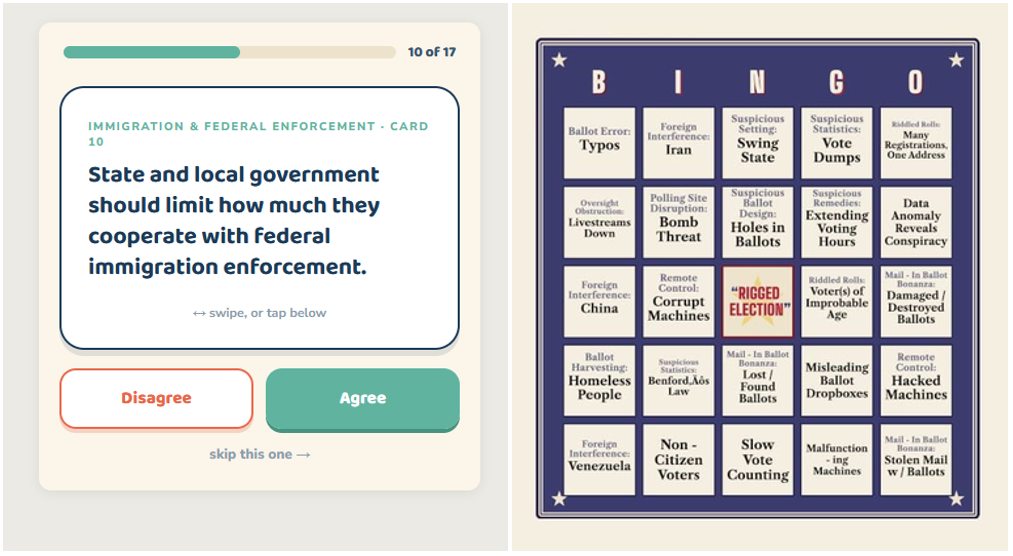
The first tool is called Voter Lifeboat, and it’s the brainchild of Mike Dussault, a former SpaceX and Valve engineer who has spent much of his career building things at the intersection of technology and human curiosity. Dussault has founded multiple startups, but this particular project wasn’t about revenue. It was about helping people feel more confident when they step into the voting booth. Voter Lifeboat is a free quiz that asks Washington voters seventeen straightforward questions about the issues that actually shape their lives — taxes, climate change, housing affordability, the rapid growth of data centers, and a handful of other policy areas. Once you’ve answered, the tool generates a personalized report card showing which candidates and ballot measures line up most closely with your responses. It’s a bit like having a smart, patient friend sit down beside you with a highlighter and walk you through your choices, except that friend also happens to be powered by a serious amount of research. Dussault made a point of emphasizing that he’s not making money from it. “I built it to help people vote,” he said simply. That spirit comes through in every detail, from the anonymous design to the published methodology that explains how each alignment is calculated. The quiz doesn’t ask for your name or email, so there’s no data harvesting, no follow-up marketing blasts. It’s just you, your values, and an honest attempt to connect those values to the names and measures on your ballot.
What’s especially charming about Voter Lifeboat is that it doesn’t pretend to be the final word on anything. It’s not a replacement for the official voters’ pamphlet, and it doesn’t tell you to ignore endorsements from newsrooms or community organizations. Instead, it offers something that those resources often can’t: a direct, interactive way to think through where you stand. The questions force you to make choices, and those choices reveal assumptions you might not have examined before. Maybe you’ve always identified with a particular party, but after answering a handful of questions about housing policy and energy infrastructure, you discover that your actual positions are more complicated than a label can capture. Or maybe you go in expecting to support a candidate and come away with a more nuanced view. The quiz takes only a few minutes, which means it fits neatly into an evening when you’re already juggling a dozen conflicting obligations. But it feels more substantial than that. It turns voting from an act of passive trust into an act of active reflection. What makes it even more fun is knowing how it was built. Dussault leaned heavily on artificial intelligence to research and vet the candidates and ballot measures, and he shared on LinkedIn that he enjoyed giving Claude, his AI assistant, such a demanding assignment that it maxed out an entire Claude Ultra subscription. That detail makes the project feel both impressively ambitious and slightly mischievous. Here’s a guy who could be working on any number of lucrative ventures, and instead he spent his time building a free tool and pushing an AI assistant to the limits of its research abilities — all in the name of helping a few thousand people feel more grounded at the ballot box. It’s a small act of civic generosity, and it stands in stark contrast to the polished political machines and dark-money advocacy groups that usually dominate the final days of an election.
But knowing what to vote for is only half the battle. The other challenge is learning to navigate the storm of claims about the election itself. For that, there’s “Rigged Election” Bingo, a wonderfully absurd and genuinely useful creation from the University of Washington’s Center for an Informed Public. For seven years, the center has served as a watchdog of election-related misinformation, tracing where falsehoods originate and how they travel through social media, partisan outlets, and even the mainstream press. This fall, the center’s Election Rumor Research team decided to turn that research into a game. The bingo card is packed with familiar phrases that keep showing up every election cycle: allegedly hacked voting machines, mysterious lists of dead voters, suspicious statistical anomalies that supposedly prove the system is broken. Reading through the card feels a little like déjà vu, which is exactly the point. These claims aren’t new. They’re recycled, repackaged, and recirculated in slightly different forms, but the underlying stories are old. The researchers responsible for the card are quick to stress an important nuance: some of these claims begin with real incidents. Maybe a ballot is mailed to a deceased person’s address, or a software glitch causes a brief delay in tabulation, or a clerk notices an error in a voter roll. Those things happen, and they’re usually isolated, routine, and corrected in ways that don’t make headlines. The trouble starts when those isolated incidents are exaggerated, stripped of context, or repackaged to suggest a coordinated conspiracy. The bingo card is designed to help people recognize those patterns — to notice when a story is following an old script and to pause before sharing something that plays on understandable fears about fairness and trust.
The bingo card feels especially timely because Washington has been living through a real-time example of exactly the kind of rumor it was created to expose. In the weeks leading up to the election, U.S. Attorney Charles Neil Floyd, the top federal prosecutor in Seattle, made a startling claim. He said that more than four hundred noncitizens had been voting in Washington State, and he asked state officials to sequester their ballots so they would not be counted. For anyone who follows election administration, it was a dramatic moment. It immediately raised questions: Is this true? How could so many people have slipped through the cracks? What does it mean for the integrity of the election? The bingo card’s creators might have recognized the chord being struck. But Washington’s Secretary of State, Steve Hobbs, responded in a measured way that cut through the hype. He said his office was reviewing the allegations, but he also made a point that should be front and center in every conversation about election integrity: voter fraud in Washington is incredibly rare. And then he said something even more telling. The timing of the announcement, coming just a week before Election Day, was, as he put it, “no doubt intended to cast unfounded suspicion on the results.” That is exactly the dynamic the UW researchers have been documenting for the better part of a decade. A formal accusation from an official source doesn’t automatically make it true. It can still be an isolated claim that overshadows the many safeguards built into the system — the signature checks, the ballot tracking, the audits, the counting processes that involve observers from both parties. The bingo card can’t stop an allegation from being made, and it won’t magically restore faith in institutions that some people already distrust. But it can give ordinary voters a framework for seeing what’s happening in real time. When you hear a phrase like “dead voters,” you can recognize it as a trope rather than as a fresh, shocking revelation. When someone points to a statistical anomaly, you can ask whether it has been verified, whether it has a mundane explanation, and whether it’s being used to smear an entire process. That kind of critical thinking is a civic skill in itself.
In the final stretch before the polls close, these two tools offer something that’s often in short supply: perspective. Voter Lifeboat is a reminder that voting is ultimately a personal act, grounded in what you care about, not what the loudest voices on the internet insist you should believe. It encourages you to take ownership of your choices and to understand the reasoning behind them, even if the results are surprising or complicated. The “Rigged Election” bingo card, meanwhile, is a reminder that voting is also a communal act, one that depends on a shared willingness to hold the process accountable without tearing it apart. It invites you to bring a sense of humor to the darkness — not to make light of real problems, but to bring them down to size. You can play bingo while reading the news, chuckle at how the same old claims keep showing up in new costumes, and then go cast your ballot anyway. That might be the most human response of all. You don’t have to be an expert. You don’t have to read every county audit report or know the history of every ballot initiative. You just have to show up, do your best, and resist the forces that want to make you feel powerless. The tools built by Dussault and the UW researchers aren’t flashy. They won’t light up a news show or go viral in the way that a manufactured scandal might. But they represent something that feels increasingly rare: an honest attempt to help people make sense of a complicated world. As the final hours of the campaign season tick by, that’s worth holding onto. Vote as if your voice matters, because it does. And keep a little room for levity — it may be the very thing that keeps you sane.