



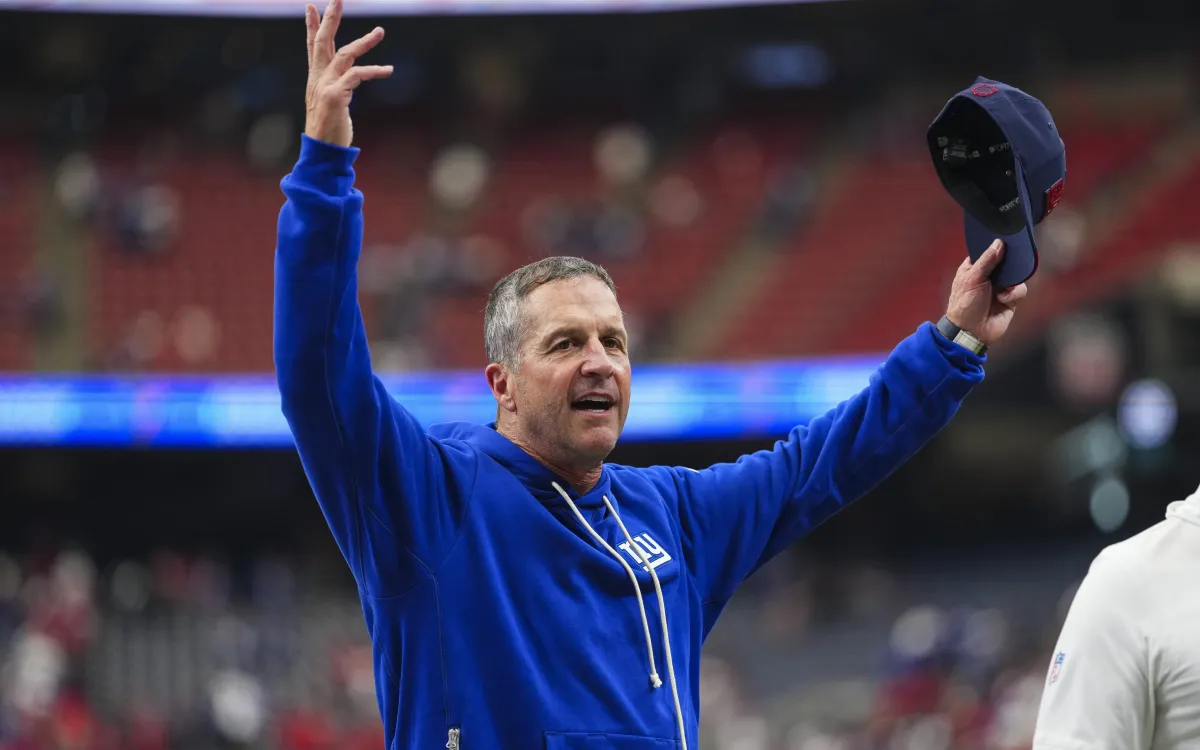
The NFL season is a long, unforgiving march, so when a team enters its bye week with a division lead, the standard play is simple: get healthy, exhale, and prepare. The New York Giants had every right to take that breath. They were sitting at the top of the NFC East, a place that carries equal parts pride and pressure, and for at least one weekend, they could watch the other contenders beat each other up from the comfort of a couch. But head coach John Harbaugh, according to a report from The Athletic’s Jonathan Jones, decided that rest was not a priority. In the quiet days of the bye, Harbaugh made a bold, direct play for one of the most disruptive defensive linemen in the game—Tennessee Titans All-Pro Jeffery Simmons. The move didn’t involve a lot of diplomatic layers. Harbaugh reportedly called Titans owner Amy Adams Strunk directly. Not through a messenger. Not through intermediaries. He picked up the phone and tried to make something happen with the person at the very top. The only problem was that the Titans had already said no to the official route. Before Harbaugh’s call, Giants general manager Joe Schoen had been informed by Titans general manager Mike Borgonzi that Simmons was not on the table. So the coach’s personal call did not exactly come as a welcome surprise. It was a second question after an answer had already been delivered, and it made some people around the league squirm. The whole scene could be read as an act of conviction—a coach so desperate to win that he was willing to break decorum. But in the tightly connected ecosystem of the NFL, it looked more like a mistake.
To understand why Harbaugh would go to such lengths, you have to understand the gap on the Giants’ defensive line. Earlier in the year, the Giants had made a painful and controversial trade, sending three-time Pro Bowl defensive tackle Dexter Lawrence to the Cincinnati Bengals for the No. 10 overall pick in April. That trade left a hole the size of a truck right in the middle of the defense. For most franchises, losing a player like Lawrence changes the entire identity of the defensive front. Offenses no longer fear the interior. Running backs and guards suddenly have lanes. Quarterbacks can step up in the pocket without looking over their shoulders. It’s exactly the kind of void that can derail a promising season, and the front office knew it. Jeffery Simmons, a 29-year-old All-Pro defensive tackle, would have been one of the few human beings capable of fixing that problem. He brings the same kind of power, tenacity, and game-wrecking ability that forces offensive coordinators to change their plans at the line of scrimmage. He is exactly the kind of player a contender trades for in late October when the window suddenly feels urgent. So it’s easy to picture the phone call happening: a coach with a singular vision, a star player on the market, and a roster that was almost begging for an upgrade. In that context, Harbaugh’s aggressive behavior almost makes sense. The Giants were not just trying to make a move for the sake of making a move. They were trying to replace an irreplaceable force in the middle of their defense, and they saw a narrow opportunity to do it with a proven, physical, All-Pro talent. That’s the calculus that must have been running through Harbaugh’s mind when he dialed the Titans owner. It doesn’t excuse the decision, but it explains it.
Almost, because the NFL’s front-office culture is built on a specific kind of trust. There is an unofficial code among primary football decision-makers: GMs deal with GMs, and nobody should have to look over their shoulder wondering if the person they just turned down is going to go above them. This is the unwritten rule Harbaugh reportedly violated. One GM who became aware of the phone call said it broke that code, explaining that general managers agree to deal only with each other because that’s how the league functions. Another source in a key football position went further, using a distinctly human word to describe Harbaugh’s actions: shameful. That’s a powerful charge in a business that usually prefers quiet leaks over loud condemnations. But the message was clear: bypassing a GM to call an owner isn’t just aggressive. It’s disrespectful. It undermines the very structure of how teams communicate. It also puts the owner in a terrible position. Amy Adams Strunk had already given Mike Borgonzi full control over football decisions. When Harbaugh called her, she was suddenly being used as an alternative channel to a decision she had deliberately entrusted to someone else. She wasn’t going to overrule her GM just because a rival coach called. But she still had to answer, still had to restate the no, and still had to deal with the awkwardness of knowing Borgonzi would eventually hear about it. In a league that operates on relationships, that kind of friction leaves marks. The GM grapevine is small. Everyone knows everyone. When one call crosses a line, it becomes the story of the week, then the cautionary tale for the next several weeks. People around the league started talking, not because the Giants tried to make a trade, but because they attempted it in the wrong way, through the wrong person, after the wrong answer had already been given.
The attempt becomes even stingier when you look at what the Titans actually accepted from the Bears. Chicago landed Simmons plus a 2028 fifth-round pick, and in exchange sent Tennessee a 2027 first-round pick, a 2028 first-round pick, and a 2027 fourth-round pick. That’s a substantial package, no question. Two first-round picks are nothing to sneeze at, especially for a team like the Bears that has spent years trying to build a sustainable foundation. But according to Pro Football Talk’s Mike Florio, the Giants were willing to offer even more than that. They were reportedly prepared to beat Chicago’s proposal if the Titans had given them the chance. Florio was quick to note that this is an easy claim to make after the fact, and we all know that in football, the truth of what a team “would have done” is often shaped by the disappointment of not actually doing it. Still, if the report is accurate, it makes the whole sequence feel like a double loss for New York. Not only did the Giants fail to get Simmons, but they also became the team that wildly pursued the player, got turned down by the general manager, tried to go around him to the owner, got turned down again, and then watched the player go somewhere else for a price they were apparently willing to top. That leaves a bitter taste in the mouth. It also raises a question: if the Giants were willing to outbid the Bears, why didn’t they put together a trade that would have been impossible to refuse? Maybe because the Titans didn’t want to deal with them. Maybe because the direct call to the owner scared the deal before it could ever gain momentum. And there is no guarantee the Bears’ package would have been accepted if another team came in with two firsts and something extra. Tennessee wanted to move Simmons to a team that felt safe, familiar, and respectful of the process. The Giants, in one short phone call, made themselves feel like none of those things.
Part of the reason this is so awkward is the strange geography of power within the Giants organization itself. The report notes that Harbaugh reports to Giants ownership, not to Schoen. So on an internal organizational chart, the coach was not actually going over his own GM’s head. He had every right to communicate with the people who sign his paychecks. But that doesn’t mean it was smart. When a coach calls another franchise’s owner, he is making the whole football operation look out of step. The league doesn’t distinguish between “GM’s boss” and “coach” in these moments the way an org chart might. All they see is a team that can’t get on the same page. Schoen had just been told no. Did Harbaugh know that? And if so, why did he make the call anyway? There are a few possible explanations. One is that he was trying to be creative, to push the envelope in a way that GMs can’t. Another is that he believed his relationship with Strunk might open a door that Borgonzi had locked. But the net effect is that it made the Giants’ front office look divided, the coach look reckless, and the team look exactly like the kind of organization that can’t be trusted to negotiate in good faith. It also changes how other owners and executives answer the phone in the future. The trade deadline is Nov. 10, and the Giants reportedly remain interested in upgrading the roster. But after this episode, it might be wise for Harbaugh to step away from the phone and let Schoen do the talking. The Giants still have a good football team. They still have draft capital and the kind of winning record that makes players eager to join. What they need now is to rebuild a little bit of credibility around the way they do business.
At its core, this story isn’t just about a failed trade for a defensive tackle. It’s about the difference between urgency and desperation, about the fine line between doing whatever it takes and doing too much. The Giants are in first place because they’ve shown resilience and talent. That’s a fragile position. In a division like the NFC East, one bad decision can change everything. The good news for New York is that they still have time to fix this. The trade deadline is only days away, and if the team is truly committed to winning, it can still find ways to improve the roster through the proper channels. The front office has relationships, assets, and a winning record. The bad news is that the Simmons episode has put the entire league on notice. Every GM who picks up the phone to talk to Schoen in the coming days will wonder whether he’s speaking to the actual decision-maker or whether the coach is going to swoop in at the last minute and try to orchestrate something from above. That’s a reputation that doesn’t disappear quickly. Amy Adams Strunk’s refusal may have cost the Giants an All-Pro, but John Harbaugh’s decision to call her may cost them something even bigger: the trust of the people they’ll need to deal with for years to come. In a sport defined by collaboration, leverage, and respect, the best way to win a trade is usually to make sure everyone feels okay about the conversation after it ends. That simply didn’t happen here. The Giants are still in first place, still have time, and still have plenty of reasons to believe. But they’ve also learned, maybe the hard way, that the phone numbers in their contacts are not all the same. Some calls should be made. Others should wait. And in the NFL, the best decision-makers know the difference.