


France Protests: How Student Anger Over Schools Ignited a Nationwide Movement
A Crisis That Started in the Classroom
What began as a handful of student demonstrations in the suburban classrooms of Paris has snowballed into one of the most destabilizing waves of civil unrest France has experienced in recent memory. The France protests now sweeping the country are no longer solely about education. Antigovernment marchers have poured into the streets to voice anger over soaring living costs, punishing fuel prices and a public school system that many believe has been left to decay. But the movement has also attracted a darker element. Rioters and looters, operating under the cover of legitimate anger, have turned parts of French cities into battle zones, burning cars, smashing storefronts and setting fire to historic buildings. The police have arrested thousands, and political leaders are increasingly divided over how to respond. What makes this moment so volatile is its speed. In a matter of weeks, a dispute at a single high school outside Paris has become a national crisis, with no clear off-ramp in sight. All of this has left the country bracing for more confrontations while France’s political class struggles to find a unified response. Some see these protests as an overdue reckoning with inequality and neglected public services. Others see an inexcusable breakdown of law and order. The reality, as with any great upheaval, lies somewhere in between. This is how the unrest in France developed from a local school protest into a full-blown national emergency.
Student Demonstrations Spread Across French Schools
The spark came on Sept. 18, when students at a high school in Créteil, a working-class Parisian suburb, staged a protest just weeks after returning from summer break. According to videos shared on social media, the high schoolers were objecting to inadequate resources and overwhelming workloads. Within days, similar student demonstrations emerged at schools across the capital’s poorest suburbs. In these communities, students began blocking entrances to protest crumbling infrastructure, overcrowded classrooms and what they described as deep flaws in the admissions system for higher education. By Sept. 29, the unrest had reached roughly 400 schools around the country, according to rally organizers. The high school students’ union said the blockades were rooted in a broader frustration with “a lack of teachers and staff, dilapidated schools, overcrowded schedules and classrooms.” Some of the protests were peaceful, but others quickly turned confrontational. Students barricaded entrances with e-bikes, threw projectiles and set fire to trash cans. The French education minister, Édouard Geffray, acknowledged that some of the students’ demands were “legitimate” but strongly condemned the confrontational nature of the protests. He described scenes in which teachers had been chased and principals targeted by students using firework-launching tubes. By the end of September, nearly 80 people had been injured and more than 440 people had been detained, many of them minors. What had started as a localized education dispute was clearly beginning to take on a life of its own.
University Students Join the France Protests as Violence Escalates
Within days, the movement had doubled in intensity. By Oct. 2, the Interior Ministry said protests had spread to more than 1,000 schools across France, including 220 that were blockaded. Around that time, university students also began to join the growing wave of marches and occupations, adding an older and more organized layer to the France protests. At Sciences Po in Paris, students staged sit-ins and blocked streets, signaling that the school-based revolt was evolving into something with much broader political ambitions. The authorities, increasingly alarmed, warned that the demonstrations were mutating. What had begun as an expression of educational grievances, they said, was now being infiltrated by people shooting mortar-style fireworks, burning public buildings and looting. The numbers were staggering. By Oct. 2, nearly 400 police officers and more than 230 school employees and students had been injured, and the total number of arrests had climbed to 3,000. The character of the unrest had shifted. No longer just a protest about classrooms and teachers, the movement was beginning to look like a nationwide security challenge. Even as union leaders and left-wing politicians expressed sympathy with the students’ core demands, law enforcement officials made clear they would not tolerate the slide into violence. Yet each attempt to crack down seemed to add new fuel to the fire, drawing in more demonstrators who were frustrated not only with the state of French schools but with the broader direction of the country.
Antigovernment Marches Broaden the Movement
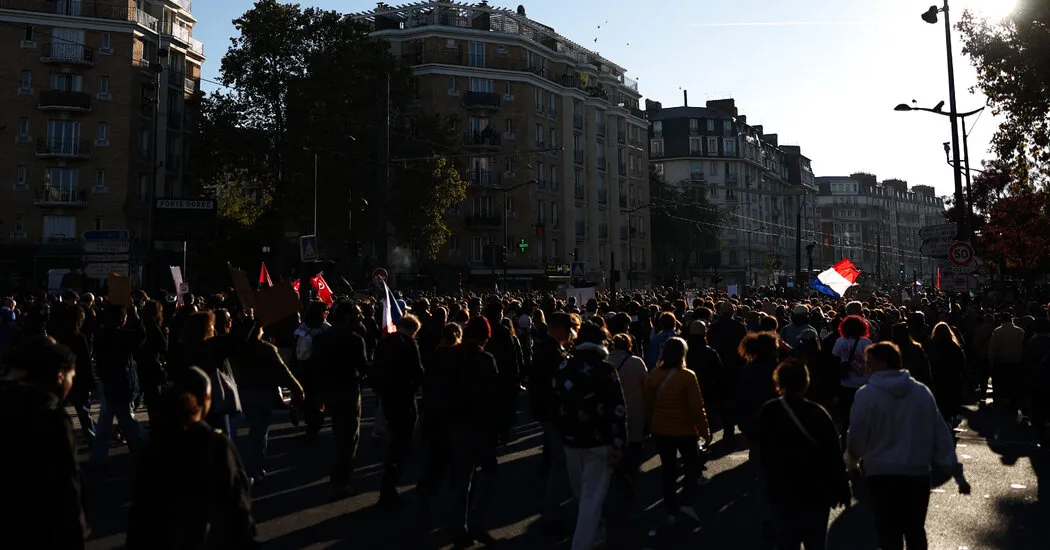
By October, the movement had entered a new phase. It was no longer simply a student affair. Labor unions, parents, community organizations and activists of all stripes began to converge on the streets, turning scattered school protests into a mass antigovernment mobilization. On Oct. 6, around 256,000 people marched through Paris and 40 other French cities, according to the Interior Ministry. A union of high school students said protesters had occupied some 1,800 high schools. Many of the day’s demonstrations were peaceful, but violence continued to simmer. A fire was ignited in Lyon, and police officers in several cities, including Paris, fired tear gas into crowds. The total number of arrests since the start of the movement rose to 6,000. As the protests grew, so did scrutiny of the authorities’ response. A major union of French judges and prosecutors, together with a prominent human rights group, accused the police of using disproportionate force, including against children as young as 14. The accusations added a new layer of tension to an already heated national debate. Two days later, on Oct. 8, smaller demonstrations were held across the country, drawing around 71,500 people. The following week, the Interior Ministry reported that 160,000 people joined marches on Oct. 13. The original grievances about schools had not disappeared, but they had become part of a wider chorus of discontent. Expensive living conditions, high fuel prices and frustration with public institutions now carried the same weight as demands for better classrooms. Politicians were deeply split. Some advocated dialogue and investment in public services, while others insisted that restoring order had to come first. The gap between those positions grew wider with every passing day.
France Protests Reach a Boiling Point With Half a Million on the Streets
The movement reached its largest peak yet on Oct. 17, when more than half a million people joined 110 antigovernment marches throughout France, according to official estimates. The CGT, one of the country’s major labor unions, put the turnout even higher, at 800,000. Using either count, it was the biggest day of protest since the demonstrations began in September. The sheer scale of the mobilization made the moment feel historic. Many of the marchers were peaceful and orderly, but the day was also marked by serious destruction. According to the authorities, rioters vandalized around 1,500 shops across the country. In Paris, where more than 100,000 people marched peacefully, a few hundred rioters broke away from the main demonstrations and faced off against police officers. Officers said the rioters burned cars and smashed storefronts, turning parts of the capital into scenes of chaos. The most dramatic moment came in Limoges, a large town in central France, where rioters set fire to the 19th-century City Hall. In a video that quickly spread online, the building’s spire could be seen collapsing in flames. The image was a gut punch to a country already on edge. It also underscored the central dilemma facing the authorities: how to separate legitimate protest from outright lawlessness. The France protests had become impossible to ignore, but they had also become extremely difficult to define. Every peaceful marcher sharing the streets with a masked rioter made the challenge of finding a solution more complicated.
What Comes Next After the Largest Protests Yet?
As the France protests enter their third month, the country remains suspended between crisis and resolution. Schools are still disrupted, students are still organized, and the economic frustrations that brought so many people onto the streets have not disappeared. The government is under mounting pressure to respond, but its options are limited. Massive arrests have done little to calm the situation, and accusations of police violence have only deepened public anger. At the same time, the continued presence of rioters and looters has made it difficult for protesters to maintain the moral high ground. Political leaders across the spectrum have offered competing explanations, but consensus remains elusive. What is clear is that this movement has already changed the conversation in France. Topics such as living costs, fuel prices and the condition of public schools are now front and center in ways they were not before the unrest began. The challenge ahead is not only to restore order but to address the grievances that brought so many people into the streets in the first place. The country is at a crossroads. If the government chooses repression over dialogue, it risks inflaming the situation further. If it chooses compromise, it may be accused of rewarding violence. Either way, the streets of France will likely remain restless for some time. What began with a few students in Créteil has become a national test of whether the country can still hear the frustrations of its people without losing itself in the flames.