


France Protests: The Third Weekend of Rising Anger Over Living Costs and Education
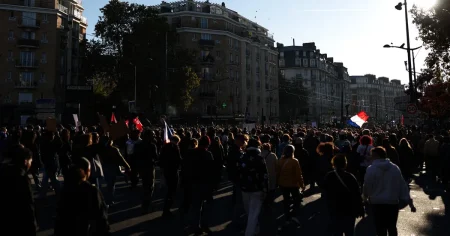
PARIS — The rhythmic pulse of marching feet echoed through the streets of cities and towns across France on Saturday, marking the third consecutive weekend of nationwide demonstrations that have coalesced around the twin grievances of a punishing cost-of-living crisis and the steady erosion of access to education. On a day when the country’s attention was diverted by the playful frights of Halloween, a more serious specter confronted the French government: a groundswell of public discontent that shows no signs of dissipating. The rallies, which drew participants from a broad cross-section of society—from students and teachers to retirees and industrial workers—were overwhelmingly peaceful in their first hours. Yet, as dusk began to settle over the historic boulevards and city squares, pockets of tension surfaced, transforming parts of the afternoon’s civic demonstrations into sharp, fleeting confrontations with riot police, their shields glinting under the cold October sun.
A Nation Grappling with Economic Pressure Cooker
To understand the simmering frustration that has once again propelled tens of thousands into the streets, one must look at the grim arithmetic shaping the everyday lives of ordinary French citizens. The protest movement, which has been steadily gaining momentum since its initial outpouring two weekends ago, is fundamentally rooted in the compounding pressures of inflation that have tightened their grip on household budgets. Staple goods, energy bills, and rent prices have all skyrocketed over the past year, far outstripping wage growth and forcing families to make impossible choices between heating their homes, filling their cars, and putting food on the table. Meanwhile, the educational component of the protests has struck a nerve with a younger generation who feel locked out of a system that was once the great equalizer of French society. Students and academics alike have voiced their alarm over chronic underfunding, classroom overcrowding, and a series of controversial reforms that, critics argue, favor elite institutions while squeezing the public universities that serve the majority.
Clashes Amid the Costumed Crowds
While the general tenor of Saturday’s gatherings was one of determined, solemn protest, the late-afternoon escalation in several major urban centers signaled that the patience of some demonstrators may be wearing dangerously thin. Reports from the ground noted that the first flashpoints emerged when small groups of masked individuals, often operating on the periphery of the main marches, began erecting barricades from municipal waste bins and launching projectiles at lines of police officers. Authorities responded with volleys of tear gas and, in some instances, baton charges to disperse the crowds, leading to chaotic scenes that were amplified across social media within minutes. It remains unclear how many of the instigators of these clashes were veteran activists affiliated with the broader movement or, alternatively, opportunistic elements with little stake in the picket lines and campus grievances. Nevertheless, the imagery of burning barricades juxtaposed against the costumed Halloween hoopla of ordinary passersby prompted widespread commentary on the surreal nature of the unfolding crisis.
Voices from the Street: Echoes of the Yellow Vests
Looking through the crowd at the demonstrations, the ecosystem of the protest is unmistakably diversified, yet its underlying message binds the participants in solidarity. Teachers with brightly colored union vests marched alongside university students sporting backpacks, while pensioners intermingled with workers from the transport and energy sectors. In many ways, these images serve as a direct callback to the Gilets Jaunes (Yellow Vests) movement that paralyzed the nation in 2018, though the current iteration appears to carry a distinct generational and political breadth. Many of those interviewed at the rallies expressed profound disillusionment with the political establishment, lamenting that their concerns over purchasing power and educational opportunity are consistently sidelined in favor of elite-driven policy agendas. The movement, as articulated through its banners and chants, is demanding immediate governmental intervention—be it through price caps on essential goods, windfall taxes on corporate profits, or a complete re-evaluation of the government’s university funding strategy.
The Macron Government’s Stance and the Challenge of Dialogue
In the days leading up to the weekend’s demonstrations, officials within the administration of President Emmanuel Macron had called for calm, framing the unrest as a reaction to global economic turbulence rather than a failure of domestic policy. The government has pointed to existing subsidy programs designed to ease energy costs and has argued that long-term educational investment remains a priority. However, these reassurances appear to have done little to assuage the anger of a populace that demands solutions for the here and now. The government now stands at a critical crossroads; engaging too aggressively with the protestors risks painting the administration as autocratic and out of touch, while appearing too conciliatory could be interpreted as a sign of weakness. Political analysts suggest that the volatility of the situation is heightened by the absence of a clear, singular leader of the protest movement—a decentralized structure that gives it organic resilience but complicates any potential for meaningful negotiation with state actors.
A Perilous Road Ahead for the Republic
As the last demonstrators were being dispersed into the night, and the cleanup crews began their work to clear the rubble and graffiti, a pointed question hung over the French Fifth Republic: what happens next month? History has shown that French protest movements either dwindle quickly or escalate dramatically, and the sheer consistency of the turnout over three consecutive weekends points towards the latter. Sights are now set on the upcoming week, where union leaders are expected to call for further strike action, and university students plan to hold assemblies to determine the next phase of their campaign. For the public at large, the Halloween weekend has concluded, but the haunting specter of sustained social instability remains. In a country where the streets have repeatedly proven to be the ultimate check on executive power, the coming days will be a defining test of whether the concerns raised by the republic’s citizens can be channeled into legislative change, or whether the anger that has simmered for months is destined to boil over into a wider, more consequential confrontation.