

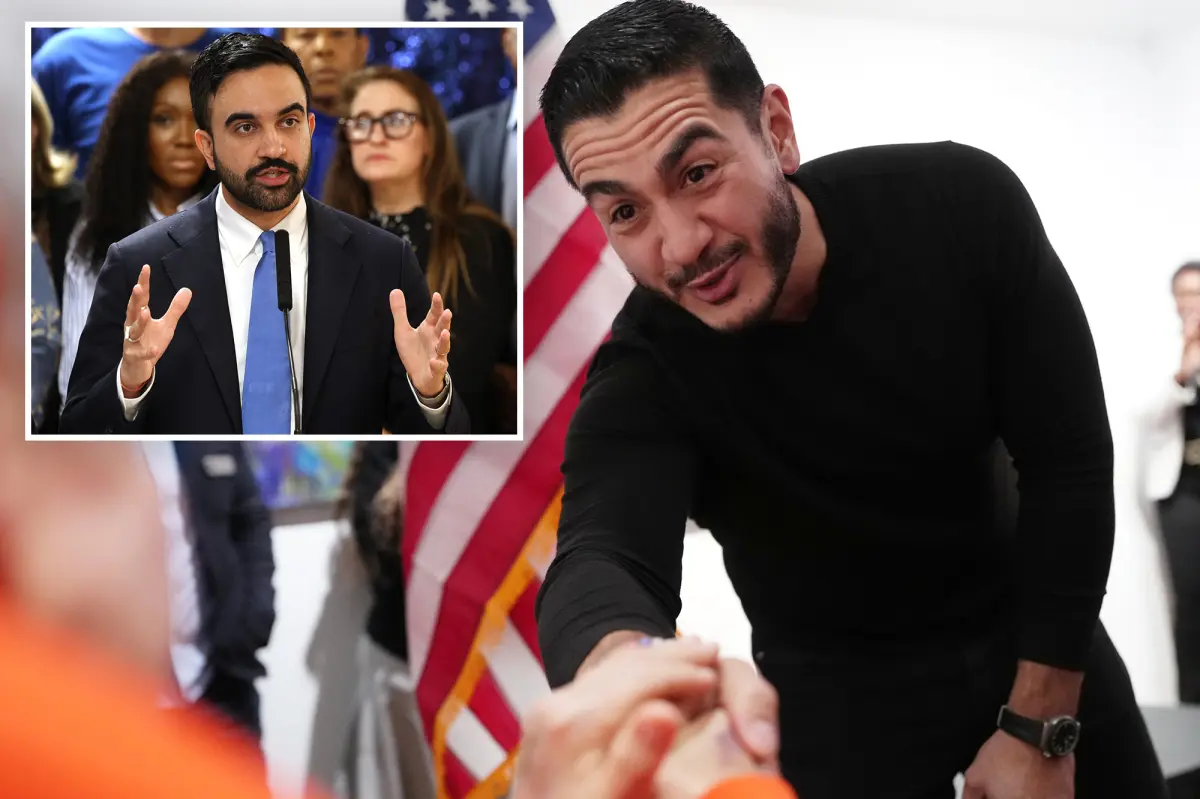
Politics is not a debating society. It is a grinding, exhausting struggle that asks candidates to smile through attacks, to answer questions that have no good answers, and to keep moving forward even when the ground beneath them is burning. Abdul El-Sayed, the progressive Michigan Senate candidate, is living that struggle in a particularly brutal way. He is running as a Democrat in a race that has become a national referendum on identity, on the future of the left, and on whether someone with his name, his faith, and his politics can win in a state that will help decide control of the Senate. His Republican opponent, former Representative Mike Rogers, has spent enormous sums trying to define him as dangerous. President Trump has called him a “jihadist.” Vice President Vance has called him a “psychopath.” And to make things even more complicated, El-Sayed is not only fighting Republicans; he is also feuding with a Democrat, Representative Haley Stevens, in the final stretch of the primary. The race is no longer just about issues. It is about survival, about the stories told about him, and about whether he can make himself heard above the noise.
Into that storm came Zohran Mamdani, the socialist New York political figure who has become something of a champion for the left. In an interview this week, Mamdani said El-Sayed was handling the pressure “admirably.” His words were striking not because they were political, but because they were personal. “A race of that magnitude is difficult enough as it is; to have to contend with blatantly racist attacks on a regular basis, and the silence of so many around him in the face of that — that is immensely difficult,” Mamdani said. He spoke of his own experience running for mayor in New York, and how he had “to experience a version of it” in that race. He described the daily struggle to keep the campaign focused on the issues that matter, to “lean on those around you,” and to keep going when millions of dollars are being spent to turn your own identity into a weapon. “It becomes incredibly difficult to both respond to it and continue to move forward,” he said. “And it’s a challenge that I think he’s rising to admirably.” There is something human in that observation. It acknowledges that a campaign is not just a collection of speeches and advertisements, but an endurance test that takes place in the small hours of the night, in the quiet moments before another brutal news cycle begins.
The attacks Mamdani referred to have been relentless. Trump and Rogers have centered much of their criticism on El-Sayed’s apparent family tie to the Muslim Brotherhood, a subject that is not, strictly speaking, about race. But for a candidate with an Arab name, a Muslim faith, and a background that has been endlessly scrutinized, the distinction can feel like a technicality. When the president of the United States calls you a “jihadist” and the vice president calls you a “psychopath,” the message is clear: you are not one of us. You are dangerous. You are not to be trusted. This kind of language does not invite debate. It invites fear. Mamdani’s phrase about “millions of dollars being spent trafficking in that same racism” gets at something essential: no matter how many policy papers a candidate writes, no matter how many town halls he holds, no matter how much he talks about Medicare for All or bringing jobs back to Michigan, there is always a force on the other side willing to spend whatever it takes to reduce him to a cartoon. And the silence of so many around him, as Mamdani put it, makes it worse. It is one thing to be attacked by your enemies. It is another thing to be abandoned by your friends.
But no honest portrait of El-Sayed can ignore the uncomfortable parts of his record. He has repeatedly called himself a physician, yet he never completed his medical school residency. While at Columbia Medical School, he authored a paper, published in 2011 in the Journal of Immigrant and Minority Health, that concluded Arab women should have children within their own ethnic group for optimal health outcomes. The paper warned of the hazards of “interethnic mating,” insisting that it increased the risk of premature births. It was one of several papers he wrote that were hyper-focused on questions of race and religion. Senator Ted Cruz seized on the research, writing on X that this was “science” with “a pre-ordained racist & eugenics outcome” and called it “scary stuff.” Those are harsh words, and Cruz is a political opponent, but the paper itself is not an invention. It is a real document with real conclusions. El-Sayed’s defenders might argue that it was an early academic work, that it has been misinterpreted, that his record since then speaks to a very different set of values. But the paper exists, and it will continue to follow him. It makes him a more complicated figure than the simple martyr some of his supporters want to see. It also makes him more human. People are not single-note. They are capable of growth, of contradiction, of holding beliefs that later make them wince.
The political circle around El-Sayed makes the picture even more layered. He is being championed by Representative Alexandria Ocasio-Cortez, who has said that a Democratic victory in Michigan would prove “anyone can win anywhere.” El-Sayed campaigns on Medicare for All and wants to block U.S. aid to Israel. Both he and Mamdani have ties to the activist Linda Sarsour, a polarizing figure in American politics. The race is not simply about one man’s character; it is about the direction of the Democratic Party. The progressive wing, represented by Ocasio-Cortez, Mamdani, and a growing number of socialist-leaning candidates, sees El-Sayed as proof that their ideas can win in places that are not deep blue. The more moderate wing, represented by Stevens, sees him as risky. The tension between those two visions is playing out in real time. AOC is already touting her nationwide fundraising prowess in a new cash appeal, and if socialist candidates like El-Sayed do well, the movement could gather significant momentum. Mamdani, when asked directly whether he wants to see AOC herself run for president, refused to take the bait. “I want to see AOC do whatever it is that AOC wants to do,” he said. It was a graceful non-answer, the kind of thing a seasoned politician says when they want to stay on message.
And in the end, that may be the real lesson of this story. We like our political figures to be clean symbols, to be either heroes or villains, saints or frauds. But the human truth is messier. Abdul El-Sayed is a man being attacked with racist and religiously charged smears, and he is also a man who wrote a paper that many people find disturbing. Both things are true. He is a candidate who talks about health care for all, and he is a candidate who has claimed a medical title that his resume does not fully support. Both things are true. He is a figure of hope for the left and a target of fear for the right, and he is also a human being trying to get through the day without losing himself. Mamdani’s words matter because they remind us that behind every headline there is a person who feels the weight of every accusation, every betrayal, every moment of silence from those who should speak up. We can argue about his politics, his paper, his alliances, his past. But we should not pretend that any of it captures the whole of who he is. The campaign trail is not kind to nuance. It forces people into boxes and then punishes them for trying to climb out. El-Sayed, like everyone else in this strange and unforgiving moment, is simply doing his best to survive it.