


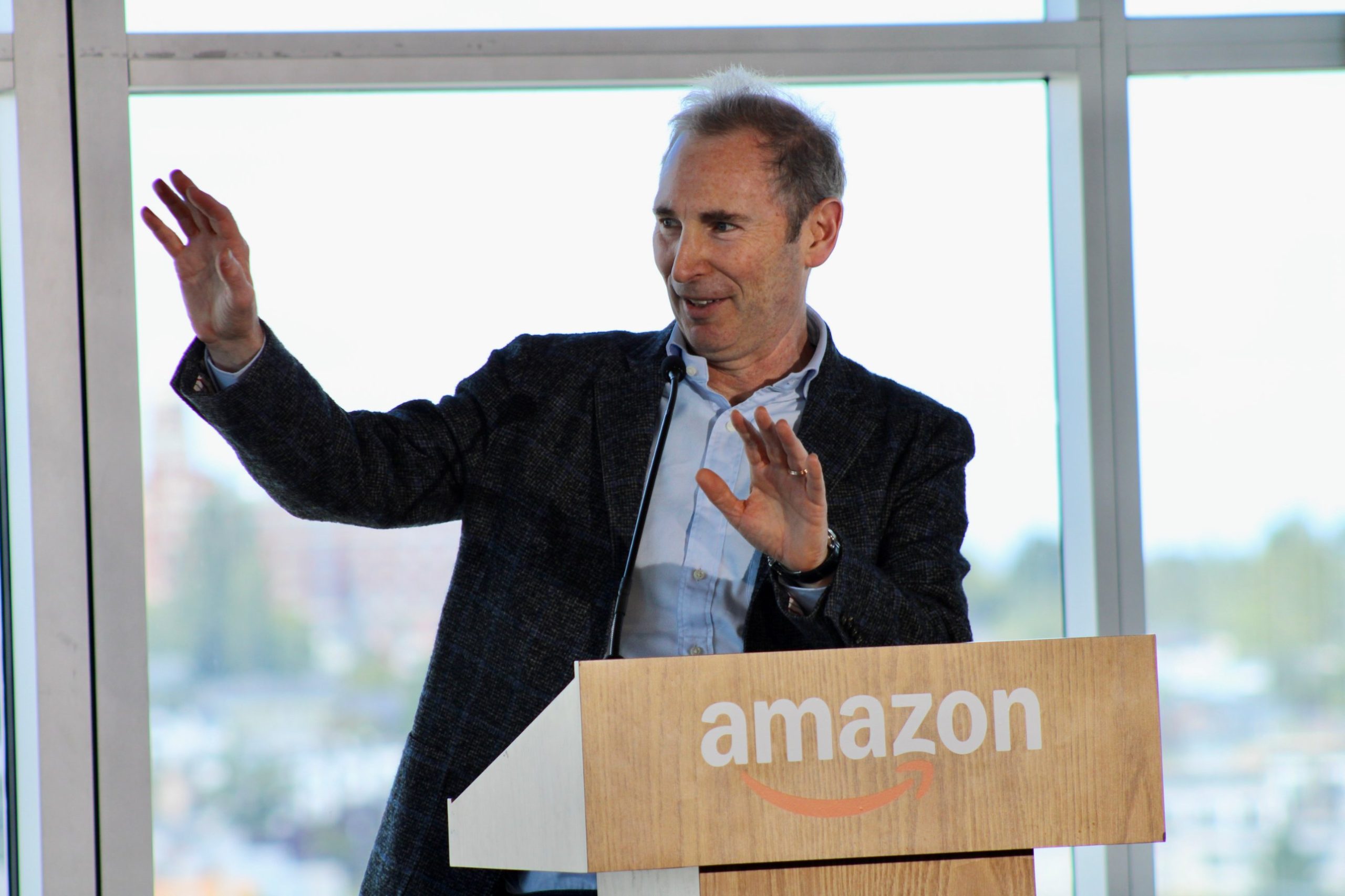
Try to wrap your head around an annual revenue figure of $1 trillion. It is a number so far beyond ordinary experience that it almost loses meaning: a trillion dollars is roughly the total economic output of the Netherlands, or enough to buy a new iPhone for every person on Earth and still have billions left over. No company in history has ever had a single business that generated that much revenue in a year. And yet Andy Jassy, Amazon’s CEO, told Wall Street on Thursday that he believes his company is on track to have two of them. Not one, but two. During Amazon’s third-quarter earnings call, Jassy said Amazon Web Services and Amazon’s stores business could each reach an annual revenue rate of $1 trillion within the next five to ten years. Morgan Stanley analyst Brian Nowak immediately called it “pretty rare” for Jassy, who tends to be cautious with long-range predictions, to project so far into the future. The moment was made even more striking by the fact that Amazon had just reported a profit shortfall that sent shares down about 6 percent in after-hours trading. Yet there was Jassy, almost calmly, describing a future that would dwarf anything the business world has ever seen. He did not present it as fantasy. He presented it as a logical extension of data his teams are already seeing in orders, contracts and customer behavior. Whether he is right or wrong, the statement offers a window into how Amazon’s leadership is thinking about the next decade—and the extraordinary amount of money the company is willing to spend to get there. It also raises a question that hangs over everything else: Can a company that has already reshaped modern shopping and modern computing do it all over again, at a scale nobody has ever attempted?
Start with AWS, the company’s cloud computing and artificial intelligence engine. In the third quarter, AWS hit a $184 billion annual revenue run rate, after growing 39 percent in the quarter—its fastest pace in nearly five years. Jassy says he expects growth of more than 40 percent in both 2027 and 2028. Those are not just hopes. He pointed to a $578 billion backlog of contracted AWS revenue, money that customers have essentially committed to spend. The largest customers reserve capacity in enormous blocks, sometimes as much as a gigawatt at a time—the kind of power that can run a midsize city. That gives Amazon “very good visibility” into 2027, 2028 and part of 2029. But how does a company go from $184 billion to $1 trillion in a decade? Jassy’s argument rests on the belief that businesses are still in the early stages of using AI. The cost of running AI models keeps falling, which makes new uses viable. He offered one example: AI models that can find and fix security flaws in software, work that once took human security teams days or weeks. As these use cases multiply, he said, demand for cloud computing could continue at a pace that seems implausible on its face. “You can’t predict with any certainty five to 10 years from now, especially at these types of growth rates,” Jassy acknowledged. “But it’s not a stretch for us to imagine that this could be over a trillion dollar business.” The scope of this forecast is a big jump from seven months earlier. In March, according to Reuters, Jassy told employees that AWS had a chance to reach at least $600 billion in annual revenue within about a decade—already double his earlier expectation. Now he is saying $1 trillion is not out of reach. That revision reflects how much the AI frenzy has accelerated everything around it, and how much of that acceleration Amazon expects to capture.
Amazon’s other candidate for trillion-dollar status is harder to define, because “stores” at Amazon is not just one thing. It includes online shopping, physical stores like Whole Foods and Amazon Fresh, and the network of large and small retailers who sell through Amazon’s marketplace. Over the past twelve months, sales from Amazon’s online and physical stores totaled $309 billion. If Jassy is counting third-party seller services and advertising—which are also tied to its stores business—the combined figure is about $575 billion. Amazon did not immediately clarify which definition Jassy was using. For comparison, Walmart, the world’s largest retailer, generated $713 billion in revenue in its most recent fiscal year. So Amazon still has a gap to close, but Jassy believes the company is closing it quickly. He said “some folks are sleeping a bit” on how much progress the stores business has made. He pointed out that Amazon added more than $90 billion in gross sales over the past twelve months and is adding about twice as much per quarter as its next-largest U.S. competitor. Units sold are up nearly 15 percent so far this year. And he noted that nearly 80 percent of retail sales still happen in physical stores—a share he expects to gradually shift online over time. The idea is not that Amazon will simply sell more of the same products. It is that more of the entire market will move to e-commerce, and Amazon will be there to capture a large share. For an ordinary shopper, this is the part of the story that feels most personal. Amazon is already the place many people go for everything from diapers to electronics. Jassy is essentially saying that the best years of that shift are still ahead, and that Amazon’s investments in faster delivery, AI-assisted product discovery and its physical store presence will make it an even bigger part of people’s daily lives. The “stickiness” of Amazon’s retail ecosystem, he suggested, is underestimated by outsiders.
The bold prediction came on a rough day for Amazon’s shareholders. Profit fell short of Wall Street’s expectations, and the stock dropped about 6 percent in after-hours trading. The reason the profit came up short is a reminder that grand ambitions have a price. Amazon expects to spend about $220 billion on capital projects this year, mostly on AWS, and Jassy said the company will spend “meaningfully more” in 2027. That includes money for data centers, chips, power infrastructure and real estate. The bill is already showing up on Amazon’s balance sheet. Over the past twelve months, Amazon’s free cash flow—the cash left over after capital spending—was negative $42.4 billion. A year earlier, it was positive $14.8 billion. In other words, Amazon is now spending far more than its operations are generating, a swing of more than $57 billion. To pay for it, the company has raised $115 billion through long-term debt this year. Interest expense more than tripled in the third quarter, reaching $1.7 billion, and that directly cuts into profit. For a company that spent years being celebrated for its free cash flow, the turnaround is significant. It is essentially a choice: Instead of signaling that it is pulling back in uncertain times, Amazon is doubling down on infrastructure, borrowing into the future to build what Jassy believes will be the cheapest, most capable computing platform on Earth. The risk is clear. If demand does not meet the optimistic projections, Amazon will be left with enormous debt and excess capacity. But Jassy says the strategy is working, and he expects it to keep working for the foreseeable future. “We’re in the very early days of this inflection,” he said.
It is worth pausing to appreciate how much that debt-fueled bet stands in contrast to the company’s past. Amazon has always been willing to endure painful years in order to build something that eventually became indispensable. It did that with Amazon Prime, with AWS in its early years, with its logistics network. Jassy’s argument now is that the AI buildout is another such moment. He says Amazon has “a clear line of sight to attractive financial returns” and is earning back its capital spending faster than it has in previous investment cycles. That is a crucial nuance. It is not just that he is spending more; it is that the money is being converted into revenue more quickly. The $578 billion AWS backlog and the gigawatt-scale customer commitments are evidence that the spending is not speculative—it is reacting to contracts already signed. “We’re in the very early days of this inflection,” Jassy said. “Our strategy is working, and I expect it will for the foreseeable future.” Those words are a CEO’s version of a promise to keep going. But they also invite a natural question: What if the next five to ten years bring a downturn, a regulatory challenge or a competitor that changes the math? Jassy acknowledged that uncertainty in his own cautious phrasing about predictions. Amazon’s stock drop after the earnings call is a reminder that investors are not entirely convinced. Yet Jassy is not gambling with other people’s money in the abstract; he is making a case that the fastest path to long-term growth is to build enormously expensive infrastructure now, while data and demand are visible, and then let the returns flow in over a decade. In that sense, the $1 trillion prediction is not just a forecast. It is also a justification for the pain in today’s earnings report.
What should the rest of us make of all this? For shoppers, it could mean more AI-powered conveniences, faster delivery, and a deeper integration of physical and online retail. For businesses, it could mean cloud and AI services that are cheaper and more powerful. For investors, it means a period of volatile earnings reports and large debt, with the hope of unprecedented returns on the other side. And for the broader economy, it is a test of whether one company can successfully straddle two massive industries—retail and technology—at the same time. Jassy’s prediction is not a guarantee. No company has ever generated $1 trillion from a single business, and there is no guarantee that Amazon will be the first. Five to ten years is a long time, and the assumptions that support today’s growth rates could be disrupted by any number of things: a shift in consumer behavior, a technological breakthrough that upends cloud economics, a global recession, or antitrust action that forces Amazon to separate its businesses. But Jassy’s willingness to say the words out loud, in an earnings call used to reassure investors, is itself notable. It tells you how seriously Amazon’s leadership takes the opportunities ahead. It also tells you why the company is willing to sacrifice short-term profit to be ready for them. If Jassy is right, the next decade will look like no period in business history: one company, two trillion-dollar engines, and stores and computing reinforcing each other in ways that are just beginning to become visible. If he is wrong, the debt and excess capacity will be just as huge. That balance between extraordinary possibility and extraordinary risk is the real story—and it is one that Amazon’s CEO is confident enough to put in front of the world.