


The eastern Pacific stretched calm and empty under a hazy sun, a vast blue expanse that most people would never associate with war. But on the morning of October 27, that stillness was shattered by a blinding fireball and a pillar of black smoke rising from the water. A U.S. military operation, directed by U.S. Southern Command and carried out by Joint Task Force Western Hemisphere, had targeted a “go-fast” vessel—a nimble, high-powered boat favored by drug smugglers—on a route long known to carry narcotics north from South America. When the smoke cleared, five people were dead. The military called them “narco-terrorists,” a term that has become increasingly common in official statements describing suspected drug traffickers. Yet the human reality behind that label remains complicated: these were five individuals, each with a name, a history, relationships, and a story that will likely never be told in an official press release. The strike was not an isolated incident. It was part of a sustained, aggressive campaign that has unfolded far from public view, mostly in international waters, where the rules of engagement are murky and the consequences are final.
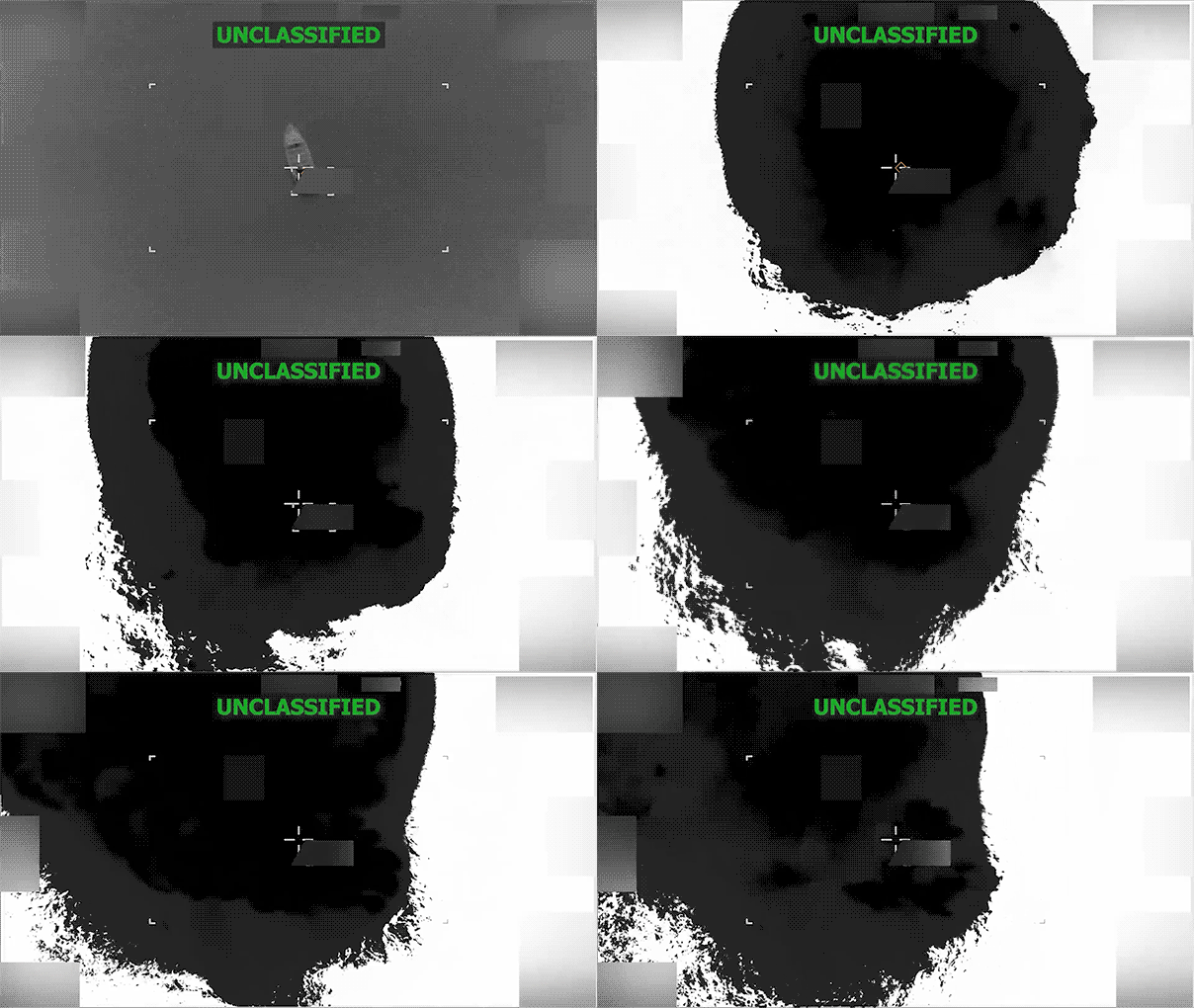
The official account from SOUTHCOM was brief and clinical. It stated that confirmed intelligence revealed the vessel’s active involvement in narco-trafficking, and that the strike was conducted along established drug-trafficking routes in the Eastern Pacific. No specific coordinates were given, and no further details about the boat’s origin, crew, or cargo were released. Video released by the command shows a small vessel bobbing on the waves, then suddenly erupting into a massive fireball—a stark, violent image that leaves little room for ambiguity about what happened. This was not an interception, a boarding, or a warning. It was a lethal, kinetic strike, a military phrase that sanitizes the reality of what it means to destroy a boat full of people. The campaign of which this strike is a part began under the Trump administration and has accelerated in recent months, with more than 70 strikes reportedly conducted and at least 240 deaths, according to The Associated Press. The numbers are difficult to fully grasp: 70 separate operations, 240 lives lost, each one a family’s tragedy, all carried out in the name of disrupting the drug trade. The military has presented the operations as necessary and justified, but it has rarely provided evidence of what was aboard the vessels beyond intelligence assessments, and it has not identified most of the dead.
There is a human side to these numbers that is easy to overlook when the story is told through official statements and aerial footage. The people on these boats are often poor, desperate, or coerced—some are low-level transport hands, others are trained as spotters or mechanics, and many are not the kingpins who control the cartels from safe houses far from the water. They are the expendable parts of a brutal industry, the ones who are sent out on the open sea in overloaded boats, sometimes with little more than a satellite phone and a fuel tank. The military’s use of the term “narco-terrorist” suggests a direct connection to designated terrorist organizations, and in some cases that may be true. But the label also serves a rhetorical purpose: it makes the killing of people on a boat in the ocean sound like an act of war rather than a law enforcement operation. It also absolves the military of the need to prove, in any public forum, that each person killed was directly involved in terrorism. Family members of those killed—if they ever learn what happened—are left with no remains to bury, no answers, and no one to hold accountable. The sea gives no testimony, and the fire leaves no evidence.
The legal and moral questions surrounding these strikes are profound, and they have not gone unnoticed. Lawmakers from both parties, legal experts, and human rights organizations have expressed concern about the expanding use of lethal military force against suspected drug traffickers outside of a recognized battlefield. The naval war at sea, once governed by rules of engagement that emphasized capture and interdiction, has shifted into something closer to targeted killing. Critics argue that the U.S. military is essentially conducting extrajudicial killings on the high seas, without due process, without transparent evidence, and without independent oversight. The government has cited classified intelligence and operational security, but that makes meaningful accountability nearly impossible. International law is also a gray area: while nations have the right to board vessels suspected of trafficking under certain agreements, using lethal force from the air against a boat is a different matter entirely. Treaties and established maritime law generally require that non-lethal force be attempted first, and that life be preserved if possible. The military’s own videos, however, show no such attempts—only explosions. The lack of public evidence that the targeted vessels were actually carrying narcotics further deepens the concerns, leaving observers to take the military’s word that each destroyed boat was a legitimate target.
The Trump administration has defended the campaign in no uncertain terms. Secretary of State Marco Rubio, during a news conference last month, acknowledged that the United States has the capacity to act unilaterally, but said it prefers to work with regional allies in Latin America and the Caribbean, because cooperation is the most effective way to combat the drug trade. He emphasized that the U.S. would continue to act when necessary, and when asked about the military’s tactics, he said bluntly that the U.S. would “still blow up ships if need be.” His comments reflect a broader policy posture: the war on drugs has been rebranded as a national security crisis, and the military has been given a leading role. SOUTHCOM, for its part, has released not only strike videos but also footage of troops boarding vessels and sinking them after removing the crews—operations that appear designed to send a message. The question is whether that message is reaching the cartels or just the families of the dead. There is little evidence that these strikes have reduced the flow of drugs into the United States; on the contrary, some analysts argue that disruption at sea simply pushes trafficking routes to other regions, or leads to more dangerous, decentralized methods. The human cost remains constant, even if the numbers shift.
In the end, the strike on that go-fast vessel in the eastern Pacific is a story about a policy that has become accepted as normal, even though its implications are extraordinary. The United States is waging a secretive, lethal war on the high seas, one that most Americans know little about and have never been asked to consider. The men on those boats may have been engaged in criminal activity, and the drug trade undoubtedly causes devastation in communities across the Western Hemisphere. But the manner in which this campaign is being carried out—without trial, without public evidence, without independent review—raises uncomfortable questions about what kind of nation we are becoming. Those five people in the fireball were not just abstractions; they were someone’s fathers, sons, brothers. Some may have been armed and dangerous; some may have been innocent. The sea does not tell the difference. What is certain is that the American public has been given only a carefully curated glimpse of these operations, filtered through videos and statements that frame every strike as a victory against evil. The real story is more complex, and it deserves a more honest and human conversation—one that acknowledges the pain caused by drugs, but also the pain caused by a policy that treats human life as collateral damage in a war that, by almost any measure, remains unwinnable.