



Tuesday night’s Israeli election did not produce a thunderclap, but rather a long, slow exhale. The exit polls from Channel 13 painted a portrait of a country still split down the middle, with Prime Minister Benjamin Netanyahu’s bloc projected to win 50 seats and the opposition bloc led by Gadi Eisenkot projected to win 53. In a Knesset of 120 members, that leaves both sides far from the magic number of 61 needed to form a government. But the real revelation, hidden in the raw arithmetic, was the role of Arab voters. For the first time in a long while, their political weight appeared to be not just a moral or symbolic issue, but a potentially decisive, tangible force in determining who governs Israel. Arab-led parties were projected to take 17 seats, a number that, if confirmed when the official count arrives, would make the relationship between Arab lawmakers and Jewish opposition leaders not a side conversation, but the central question of the coming political season. It is a delicate, almost theatrical situation: the two major camps hate to admit they need each other, and yet the votes are there, suspended in a strange limbo, waiting to see who will blink first.
If those numbers hold, the opposition and the Arab parties together would command 70 seats, a seemingly healthy parliamentary majority. But in Israeli politics, arithmetic is never enough. The combined strength of Eisenkot’s bloc and the Arab-led parties would only become a functioning government if enough lawmakers are willing to enter into an arrangement that crosses bitter ideological and ethnic fault lines. That is far from simple. The Arab parties themselves are not a monolith—the Joint List and Ra’am each carry their own histories, constituencies, and red lines. Ra’am, led by Mansour Abbas, emerged as a potential kingmaker in previous rounds, willing to negotiate with Netanyahu’s Likud from a position of pragmatic interest. The Joint List, more explicitly oppositional, has long framed itself as a force for Palestinian citizens of Israel, demanding equality and refusing to legitimize what it sees as a discriminatory occupation. To ask these parties to support a government led by a former army chief, while also asking Jewish parties on the center-left to swallow their own historic reluctance to sit with Arab lawmakers, is a heavy lift. The exit poll exposes a paradox: on paper, Netanyahu’s opponents could command a robust majority, but in practice, that paper is covered in ink that may never dry.
Meanwhile, the election appears to have strengthened Netanyahu’s own party, even if his coalition remains short. The Likud was projected to win 25 seats, making it the largest single party in the Knesset, ahead of Eisenkot’s Yashar at 23. That marks a significant improvement from the party’s standing just a few weeks ago—the same Channel 13 poll in late October had projected Likud at only 19 seats. Something happened between then and now that changed the mood, or perhaps the turnout, or both. Perhaps it was the war, the security concerns, the weight of a country still reeling from trauma. Whatever the cause, the result is a strange mathematical tragedy for Netanyahu: he is stronger individually, yet still trapped in the same coalition cage, unable to lock down the necessary 61 seats. His allies remain loyal, his base energized, but the ceiling remains stubbornly low. The numbers suggest that even as voters moved toward the right, they did not move enough to hand Netanyahu a victory. And so he is left with the worst possible situation for a politician who has built his career on survival: still in the game, but without a clean path to victory, forced to rely on maneuvers, pressure, and perhaps the hope that his opponents’ mutual distrust is even deeper than their shared desire to end his rule.
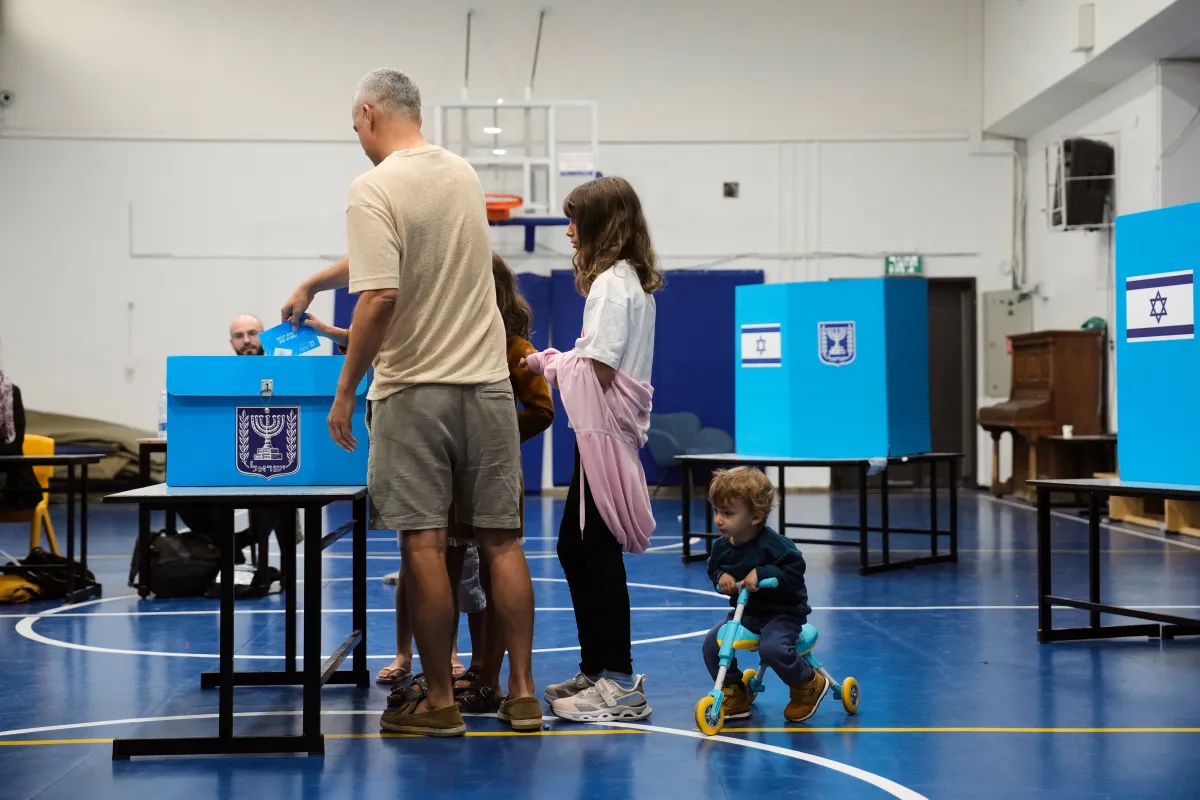
The atmosphere on election day carried an unusual intensity, particularly in Arab communities. Turnout by 4 p.m. reached 55.7 percent, compared to 47.5 percent at the same time in 2022—the highest figure recorded at that hour since comparable records began in 1973. Arab lawmaker Ahmad Tibi, a veteran of countless election battles, described the participation in Arab towns and villages as unprecedented. There was a sense, in the air, that people who had often been treated as afterthoughts by Israeli politics were determined to make themselves impossible to ignore. Long lines, families voting together, old men and young women standing in the same queue—these are the scenes that give democracy its texture. For many Arab citizens, the vote is not only about choosing a leader, but about asserting a place in a system that has often made them feel like strangers in their own homeland. The heavy turnout seems to have unsettled Netanyahu. In his public remarks, he warned supporters about the possible consequences of Arab participation and then went further, alleging that the election was being stolen. “They are trying to steal the election from us,” he said, pointing to arrests of Ra’am activists suspected of voter bribery. But election authorities reported no evidence of systematic ballot tampering. The accusation felt less like a factual claim and more like a sign of anxiety—a recognition that in a country so closely divided, the votes of Arab citizens could be the ones that tip the scale, whether Netanyahu likes it or not.
Now the focus shifts to Eisenkot and the intricate, exhausting mathematics of coalition-building. The question is whether he can secure the support he needs from Arab lawmakers without losing the fragile trust of other potential partners. Both Netanyahu and Eisenkot have publicly ruled out governing with Arab-led parties, a position rooted in longstanding taboos and political calculations. But the numbers on the board do not leave much room for purity. One possible route is a minority government, in which Eisenkot’s coalition would be formed without Arab parties as full partners, but would rely on their outside support from the Knesset to pass confidence votes and budgets. That is a precarious arrangement, and it would leave the government vulnerable to every political gust. Arab leaders themselves would demand a clear price for such support: commitments on housing, crime, education, perhaps a genuine push against systemic inequality. Yet if Eisenkot reaches too far toward them, he risks alienating parties to his right, who may refuse to sit in a government that even tangentially depends on Arab votes. It is a cruel logic, the same logic that has haunted Israeli politics for years. Netanyahu, meanwhile, is not merely a spectator. He can wait, negotiate, sow discord, propose a unity government to Eisenkot, or try to split the Arab parties apart, peeling off Ra’am or another faction. His political instincts have always been sharpest when he is cornered, and the exit polls have left him short but alive.
In the end, this election’s most profound meaning may not be found in the seat count, but in what it says about the Jewish state’s fraught relationship with its own Arab minority. For years, the question of whether Arab parties could be legitimate partners in government was largely theoretical. This time, their votes are at the center of a genuine constitutional drama. The exit polls suggest that Netanyahu may lose power not because his base abandoned him, but because his opponents, despite their own hesitations, may finally be forced to treat Arab citizens as equals in the political arena. That would not guarantee a swift or stable outcome. There will be fierce opposition, deep suspicion, and almost certainly more anger from both sides. But the sight of millions of Arab citizens voting in record numbers, as their elected representatives hold the ultimate prize in their hands, is itself a human story of resilience. It is a reminder that politics is not simply a game of elites and strategists; it is the messy expression of people’s lives, hopes, and fears. The official results have yet to be finalized, and the next stage may take days or weeks. But whatever happens, the old assumption that Arab voters can be ignored without consequence has been shattered. They are not merely a footnote. They are standing in the doorway of Israeli politics, and even if the government that eventually emerges does not invite them inside, everyone will know exactly who helped open the door.