

As Halloween creeps closer, the air turns crisp, the nights grow longer, and there is a familiar thrill in the possibility of being scared. But for a growing number of travelers, the usual haunted houses with actors in rubber masks and fake cobwebs no longer quite satisfy that itch. They want something that feels more authentic, more mysterious, something that might actually connect them to the unknown. This yearning for the paranormal is becoming a major force in travel, so much so that Booking.com has named “Trip to the Beyond” among its top travel trends for 2027. In a survey of more than 28,000 travelers across 32 countries and territories, 65 percent said they were interested in paranormal experiences. Nearly half, 48 percent, admitted they would seek out a paranormal experience in the hope of speaking with someone on the “other side.” And 50 percent were simply curious about experiences that explore questions around the afterlife, death, or spirituality. These numbers reveal something profound: beyond the fun and games, people are searching for meaning, comfort, or a little bit of wonder in a world that often feels too ordinary. Halloween gives us permission to ask big questions, to peek behind the curtain, and to wonder what happens when the lights go out.
Of course, wanting to contact the spirit world is nothing new, but the way we chase that thrill is changing. In the United States, paranormal tourism is already booming in 2026, and some of the most popular destinations are places where death, suffering, and history have left an undeniable mark. Former psychiatric hospitals and funeral homes, once shuttered and forgotten, are now drawing crowds of curious visitors. At a former psychiatric hospital in suburban Detroit and a former funeral home in Toledo, Ohio, guests can take guided paranormal investigations or even strike out on their own, armed with rented equipment like handheld electromagnetic field meters, commonly known as EMF readers. For Halloween enthusiasts, the appeal is the chance to experience something real, not staged. Actors can make you jump, but they can’t make you feel a cold spot pass through the room, or hear a whisper when no one else is there. There is something deeply human about wanting to prove to ourselves that the soul lives on, that tragedy leaves an echo, and that the stories we tell about haunted places might not just be stories after all. The old way of scaring people simply isn’t enough anymore; people don’t want to be tricked, they want to be convinced.
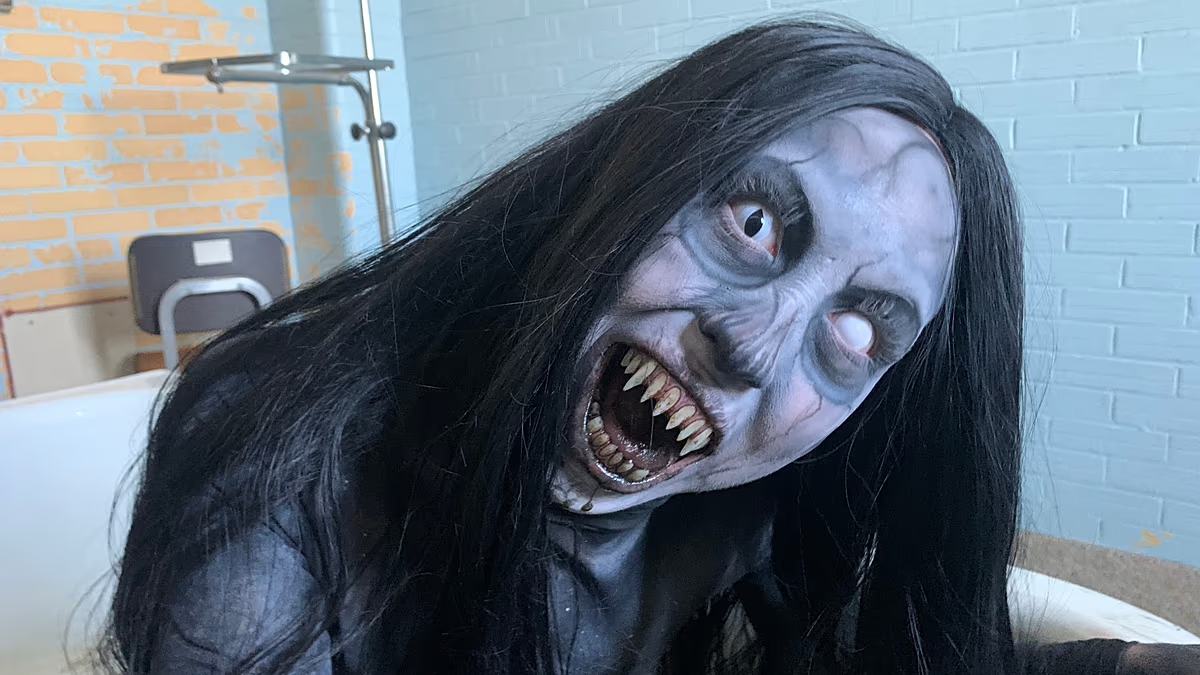
Perhaps nowhere embodies this new wave of paranormal tourism better than the Eloise Asylum, housed in a towering five-story, red-brick building in suburban Detroit. What began as a 19th-century poorhouse grew over the decades into one of the largest public health facilities in the nation, with dozens of buildings and thousands of patients. By the late 1920s, it was a city unto itself, a place where the poor, the mentally ill, and the forgotten were sent, often to live out their final days in sorrow and isolation. Much of the complex was razed in the 1980s, but the Kay Beard Building remains, and it is there that Justin Cox, founder of Michighost Paranormal, leads guests through the upper floors where patients were once treated. According to Cox, this is no ordinary tour. Visitors report being touched, grabbed, whistled at, and finding handprints on their clothing. “Everything that you can imagine has happened here, and we’ve heard it all,” he says. For Cox, the haunting presence is not a mystery but an energy left behind by trauma. “In the paranormal field, we believe that trauma leaves energy, which creates hauntings,” he explains. This place had so much tragedy that he and his team are convinced it is “super haunted.” Visitors can explore rooms frozen in time, including a space with a bathtub once used for hydrotherapy sessions, a treatment that was often more punishment than cure. It’s not uncommon for guests to climb into that tub, as if to feel a fraction of what patients endured. For the brave, overnight stays are offered, a chance to confront the echoes of the past when the building is dark and quiet. Yet, even this thirst for authenticity has a complicated cost. Family members of former patients and others with ties to Eloise have spoken out, troubled by the idea of turning a place of suffering into a profit-making attraction. It is a tension, a reminder that behind every ghost story, there are real people who lived, suffered, and died, and whose memories deserve sensitivity as well as respect.
About eight kilometers south, another former site of death and remembrance has been reborn as a destination for the curious and the fearless. The Urbanski Funeral Home served thousands of families from 1926 until it was sold last year. Now called Mortuary Manor, the massive 5,580-square-meter building has traded its quiet, solemn purpose for a second life as a funeral home museum and paranormal playground. Visitors can explore the embalming room, the autopsy room, and a morgue where the standard photo op is lying on the slab that still juts out from the basement wall. It is a strange, almost playful relationship with death, one that manages to be both chilling and strangely liberating. But Mortuary Manor is not stuck in the past. Operations manager Cory Leibenguth, who lives in a neighboring upstairs apartment, points out that the building has modern amenities like indoor plumbing, heating, air conditioning, and Wi-Fi. “That sets us apart from some of these other abandoned locations that don’t have any of that,” he says, adding that there aren’t many funeral homes where you can actually conduct an investigation. There is also a sense of ownership and pride in the way they care for the space. A visitor can spend the night in a five-room suite for $200, which is about €179, and for those who really want to embrace the atmosphere, there is a horror movie projected onto the wall of the main sitting room, surrounded by caskets. And, in perhaps the ultimate collision of love and death, Mortuary Manor is set to host its first wedding in November, on Friday the 13th, of course. It is a place where the macabre and the everyday intertwine, where guests can smile, laugh, shiver, and maybe even find a strange sense of peace.
Behind all these spooky experiences is a simple, universal need: human connection. In a modern world full of stress, uncertainty, and constant noise, many people feel cut off from each other and from the larger mysteries of existence. Halloween offers a rare opportunity to step outside the ordinary, to embrace the unknown, and to share that experience with friends and family. Cox, who spends his weekends leading people through dark corridors and abandoned wards, sees this clearly. “In today’s world where everybody is so stressed out,” he says, “Halloween is a time that everybody can just relax and just enjoy the time with their friends and their family, maybe get scared along the way.” That may be the real magic of these places. It isn’t just about the thrill of a sudden noise or the sight of a ghostly figure; it’s about the laughter that comes when you grab your friend’s arm after a door slams, the shared silence when an EMF reader spikes, and the warmth of knowing you’re not alone, even in the darkest hallway. The experiences also tap into something deeper. Grief is a universal human experience, and many people carry unresolved questions about loved ones they have lost. The idea that we might hear a message from the other side, that we might feel a presence or receive a sign, is profoundly comforting. These haunted places, with all their creaking floors and strange shadows, offer a kind of spiritual playground, where doubt and belief can exist side by side, and where the dead, at least in our imaginations, are never really gone.
As the sun sets on Halloween night and the jack-o’-lanterns flicker to life, it is easy to see why so many of us are drawn to the darkened edges of the world. We buy tickets to former asylums and funeral homes, we strap on EMF readers, and we sit in silence, listening for a whisper from the other side. We are not just looking for a scare. We are looking for proof that there is more to life than what we can see, and perhaps more to death than simply an ending. Whether or not we ever encounter a spirit, these places allow us to confront our own mortality in a safe and communal way. They remind us that death is not just a fact to be feared, but a mystery to be pondered. The former patients of Eloise, the families who mourned at Urbanski Funeral Home, and the countless unnamed souls who have passed through these buildings are part of a story that continues to unfold. By walking through those doors, we are honoring that story, even as we test our courage. And in that strange, flickering light, between fear and fascination, we manage to find something that feels a little bit like hope. So this Halloween, whether you spend the night in a haunted asylum, lie down on a funeral home slab, or simply watch a scary movie from the safety of your couch, remember that the urge to be frightened is also an urge to feel alive. We crave the goosebumps, the racing heart, the breath catching in our throats, because they remind us that we are here, that we still feel, and that somewhere beyond the veil, maybe someone is listening.