


Paragraph 1
If you think today’s amusement parks are pushing the limits of human endurance, consider the fate of riders who braved the Flip Flap Railway in 1895. Tucked two by two into bench seats and held in place by nothing more than a single lap belt, they were hurled upside down on the first looping roller coaster in the United States. The ride subjected them to forces estimated at 7.5 times the pull of gravity—some witnesses insisted it was closer to 12 g—and the toll on bodies was immediate. Riders stumbled away with strained backs and wrenched necks, and spectators gathered less to admire the thrill than to marvel at the punishment. The park in New York City’s Sea Lion Park closed in 1902, and the Flip Flap Railway passed into history as a cautionary tale. Yet more than a century later, the same fundamental question lingers: how much force can a human body absorb in the name of fun? The question has returned with fresh urgency following a wave of recent lawsuits and ride closures. In September, three lawsuits were filed against Six Flags and ride manufacturer S&S Global alleging that riders suffered “catastrophic” brain injuries on X2, a towering, seat-spinning coaster at California’s Magic Mountain. The cases followed a CNN investigation that documented dozens of X2 injuries leading to hospitalization, disability, and even death. On September 29, Six Flags announced that X2 would be permanently closed, even as the company insisted the ride “consistently passed a multitude of safety tests.” The contrast between the company’s assurances and the accumulating list of injured riders captures a deeper unease about whether the current safety standards for extreme roller coasters are truly protecting people.
Paragraph 2
The X2 cases were not isolated. Weeks after the lawsuits were filed, Six Flags said it would temporarily close nine other coasters across the United States and Canada after a man died at Six Flags Over Georgia. The victim had fallen from his seat on the Goliath roller coaster, a ride that had been operating as designed. On October 24, Six Flags announced it would add seat belts to Goliath and other coasters, and a spokesperson told Science News that the company is “committed to rigorous ride inspection, maintenance and safety procedures.” But these incidents have opened a broader conversation about coaster design and safety, especially when rides are working exactly as intended. It is easy to blame maintenance failures or human error when tragedy strikes, but many of the injuries reported on X2 and other extreme rides did not involve mechanical breakdowns or obvious operator mistakes. Instead, they raise the unsettling possibility that some rides are simply too intense for the human body, and that the industry’s own guidelines fail to account for all the invisible forces that can damage a brain. The current wave of closures and lawsuits has pushed researchers, engineers, and lawmakers to ask whether the standards used to approve coasters are outdated, incomplete, or too forgiving. Riding an extreme coaster has never been entirely risk-free, but as parks have competed for decades to build taller, faster, and more disorienting attractions, the margin between safe excitement and lasting harm may be growing narrower than anyone has been willing to admit.
Paragraph 3
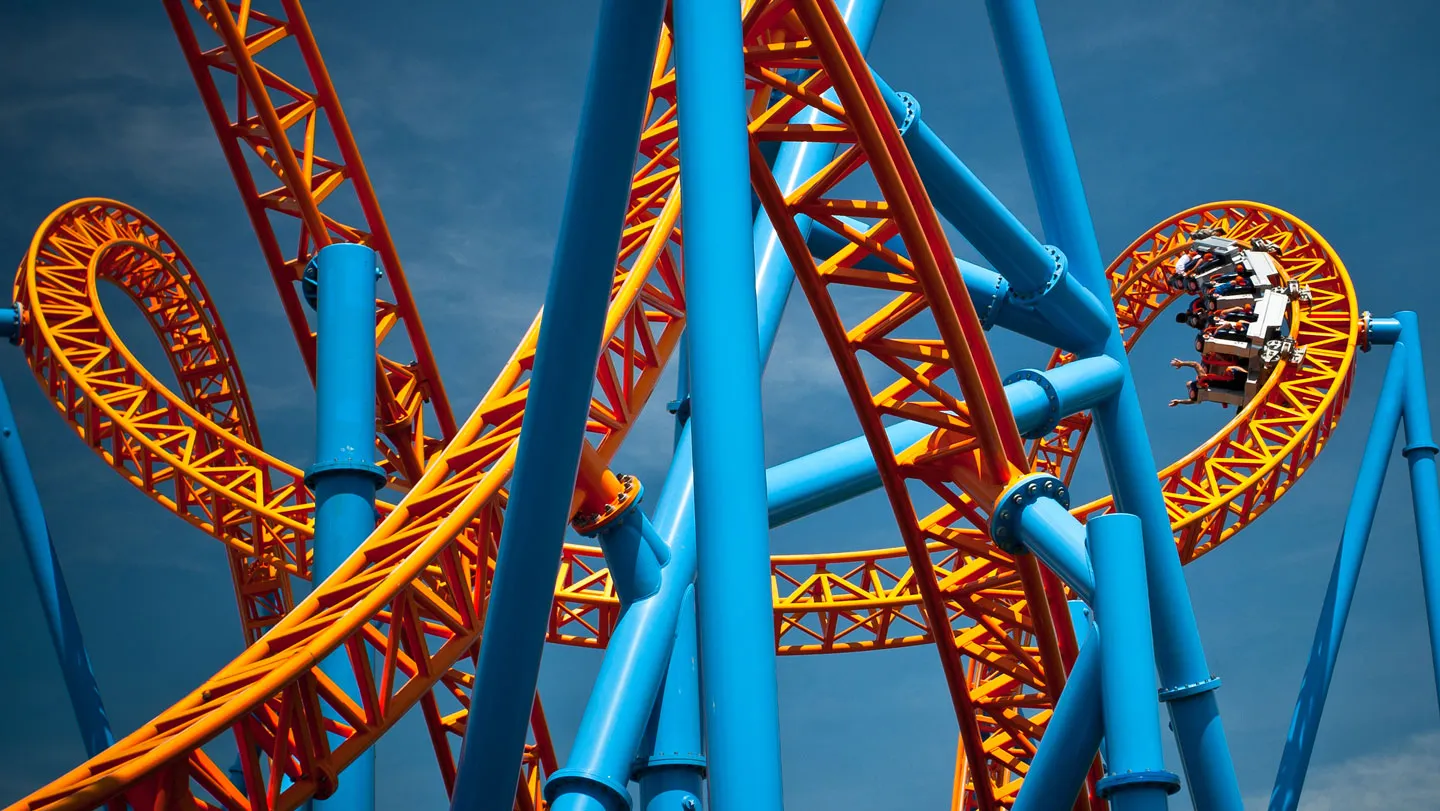
One of the central challenges in ensuring roller coaster safety is that the United States has no federal oversight for fixed-site amusement rides. Each state sets its own approach, and in practice the industry largely polices itself. The closest thing to a national standard comes from ASTM International’s Committee F24 on Amusement Rides and Devices, a technical body of more than 1,000 industry professionals that publishes recommendations widely treated as the gold standard. The first ASTM standards for roller coaster design were released in 1982, just one year after the U.S. Consumer Product Safety Commission was stripped of its authority to regulate amusement rides at permanent parks. That timing was no coincidence, according to Brian Avery, an event and tourism management researcher at the University of Florida who studies ride safety. Freed from federal oversight, the industry entered what Avery calls a “roller coaster arms race,” with parks pushing to “build it taller, faster, longer.” X2, originally simply called X, was a defining product of that era when it opened in 2002. It was the world’s first fourth-dimension coaster, a category in which the car’s seats rotate independently of the main track, adding a disorienting spin to the familiar sensations of speed and drop. X2 launched riders 60 meters into the air, reached speeds of 122 kilometers per hour, and seemed to promise a ride unlike anything else on Earth. In the 24 years since, only about twenty similar coasters have been built, and several have already closed. The rarity of these rides reflects both their engineering complexity and their physical demands, but it also means there is limited real-world data about how such intense motion affects riders over time.
Paragraph 4
Roller coasters, by the numbers, remain comparatively safe. Out of roughly 1.7 billion amusement park rides taken annually across North America, parks that voluntarily shared data reported only 652 coaster injuries in 2024. Studies of brain injuries on coasters are relatively rare, but most suggest that a single ride is unlikely to cause traumatic brain injury. A 2002 study used reported g forces from three coasters in a mathematical model and concluded their acceleration levels were below the threshold predicted to cause head injuries. A 2017 study of three coasters found that average brain effects were low, but at their peak they were “comparable with mild sports impacts,” such as heading a soccer ball. Yet the authors of that same study offered a crucial warning: “The limiting of g forces alone might be an insufficient design criterion for roller coaster rides.” This is where the safety standards begin to show their gaps. The ASTM guidelines set a recommended 6g limit on acceleration, a figure rooted in research from the space race. But they do not account for other types of motion that can rattle the head, neck, and brain—including jerk, the rate at which acceleration changes; snap, the rate at which jerk changes; and vibration. In 2020, biomechanical engineer David Eager and a colleague published a paper drawing attention to these underappreciated forces, noting that riders need time to sense acceleration changes and adjust their muscle tension or risk conditions such as whiplash. The standards also ignore forces that last less than 200 milliseconds, no matter how intense they are in that fraction of a second. That omission may be significant, because even tiny imperfections in track geometry can create sudden jolts. Jurnan Schilder, a mechanical engineer at the University of Twente who teaches roller coaster design, has studied this problem and found that at every track imperfection, “theoretically, you experience infinite jerk.” On a fourth-dimension coaster like X2, the situation is even worse because there are two independent track systems: one moving the train and another controlling the rotating seats. Each imperfection in either track can cause shaking in both, multiplying the number of forceful jolts a rider experiences.
Paragraph 5
The concern extends beyond the amusement park industry. Research on whole-body vibration has long shown that intense, rapidly changing forces can have meaningful effects on the brain. The U.S. Occupational Safety and Health Administration recommends limiting both the duration and intensity of whole-body vibration in the workplace. In April, researchers at the Virginia Tech Helmet Lab published an article suggesting that some concussions in baseball players might be triggered by just milliseconds of vibration, a finding that challenges the assumption that trauma has to involve a direct, violent blow to the head. Perhaps no case illustrates this more poignantly than that of Kayleigh Bonner, a North Carolina high school student who set out to understand her father’s death. Her father was a retired U.S. Coast Guard surfman who had spent 21 years captaining boats through rough waves. He later began experiencing symptoms of a brain injury and ultimately died by suicide. For a senior capstone project, Kayleigh surveyed 77 other elite Coast Guard surfmen and found that 89 percent reported some symptoms of brain injury, likely caused by the intense, rapidly changing forces traveling through their bodies as their boats were thrown by the sea. Her work, written about in the New York Times in July, was soon acknowledged by the Coast Guard. Of course, professional baseball players and Coast Guard surfmen are exposed to these forces much more often and for much longer than the average amusement park visitor. But their experiences demonstrate how much researchers are still learning about the ways repeated vibration and jarring motion can harm the brain. As that knowledge expands, the amusement industry’s standards appear increasingly slow to adapt. Eager says minimizing jerk and snap should be “an important consideration” in roller coaster design, yet it is not a central part of the current guidelines.
Paragraph 6
The recent spate of high-profile injuries and ride shutdowns has intensified calls for stronger oversight. U.S. Representative André Carson, a Democrat from Indiana, has pushed for a bill he first introduced in 2025 that would establish federal oversight of amusement rides. Democratic U.S. Senator Ed Markey of Massachusetts has been introducing similar legislation since 1999, but the bills have consistently stalled in Congress, largely because the amusement industry has long opposed federal regulation. In a 2010 paper coauthored by Avery, the authors argued that “the industry needs to find a collective voice and establish consistent self-regulating policies in order to curb the incident rates and avoid federal regulation.” But Schilder, the Dutch roller coaster design researcher, now asks a more unsettling question: “It makes you wonder: Are the current safety standards sufficient?” For rides built today, he says, the answer is probably yes. Modern manufacturing techniques have made new coasters far smoother than their predecessors, and the ASTM standards are likely adequate for rides that do not vibrate and jerk excessively. The problem is that many parks still operate the ambitious, punishing rides born during the roller coaster arms race. X2 may be gone, but other extreme coasters from that era remain in service, drawing riders who want to experience something close to the edge of human tolerance. There is, as Avery puts it, an element of flirtation with danger in the entire enterprise. Riders understand, at least on some level, that they are stepping onto a machine designed to subject their bodies to extraordinary forces, and they trust that the people who built and run those machines know exactly where the line is between thrilling and dangerous. The real question—now more urgent than ever—is whether the industry, the regulators, and the researchers actually know where that line falls, and whether they can draw it clearly enough to keep riders safe without draining the magic out of the ride.