


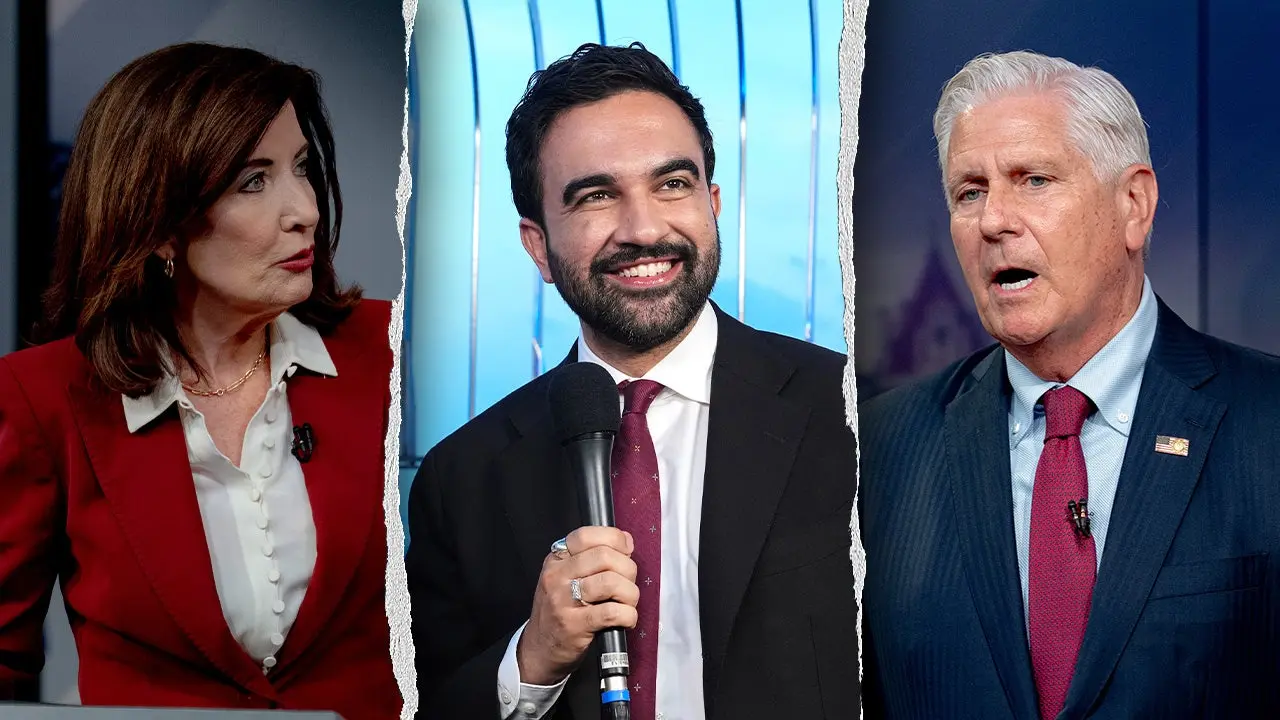
On a crisp Sunday afternoon in Yorktown Heights, New York, the kind of autumn day that makes politics feel both urgent and intimate, Bruce Blakeman stood before a crowd of supporters and let his frustration pour out in a single, sharp accusation. The Republican candidate for governor, who currently serves as Nassau County executive, looked past the familiar issues of taxes and schools and aimed his fire directly at the relationship between his Democratic opponent, Governor Kathy Hochul, and New York City’s newest mayor, Zohran Mamdani. To Blakeman, this was not just a political alliance; it was a surrender. He told the crowd that Hochul had been campaigning with Mamdani, and instead of condemning that fact, he practically encouraged it. “Please take him everywhere you go, Kathy,” he said with a sarcastic grin, “because I want to remind people that this un-American, antisemite, anti-Christian mayor is running the Democratic Party and Kathy Hochul is nothing more than his puppet.” The words landed like a thunderclap, not only because they were harsh, but because they captured a deeper anxiety that has been building in New York politics for years. For the people in that room, many of them suburban parents, small business owners, and longtime residents who feel increasingly disconnected from the direction of their state, the sight of Hochul and Mamdani side by side felt like proof that the governor had abandoned the middle. It was a moment designed not merely to criticize, but to reframe the entire election as a battle for the soul of New York, and Blakeman made clear he intended to stand on the side of tradition, moderation, and public safety, while painting his opponent as a follower of a far-left agenda that he believes threatens the very fabric of the city and state.
The alliance between Hochul and Mamdani is not a secret, nor is it accidental. In recent weeks, the governor and the mayor have appeared together at rallies, including a notable event in Brooklyn, smiling and sharing the stage as if to signal a united front. To their supporters, this partnership represents a hopeful convergence of progressive energy and executive experience, a chance to address the affordability crisis, childcare costs, and the everyday struggles of working families with bold ideas and a new generation of leadership. But to Blakeman and his allies, the relationship tells a different story. It tells the story of a Democratic Party that has shifted so far to the left that its leaders no longer represent the working-class voters who once formed the backbone of their coalition. Mamdani’s victory in last year’s mayoral election was itself a seismic event, a moment that shocked the political establishment and signaled the rising influence of democratic socialism in New York City. And that influence has only grown. In this year’s congressional primaries, candidates aligned with Mamdani and the democratic socialist movement ousted two Democratic incumbents, sending a clear message that the old guard was no longer safe. For many voters, this is exciting and long overdue; for others, it is deeply alarming. Blakeman is betting that the alarm outweighs the excitement, that a majority of New Yorkers will look at the direction of their city and state and decide they want a leader who pushes back, not one who joins the parade. He is also betting that Hochul’s willingness to embrace Mamdani will be her undoing, because it makes her vulnerable to the charge that she is not her own woman, but a vessel for a movement that many moderate and independent voters find extreme.
Public safety has been the sharpest weapon in Blakeman’s arsenal, and he has wielded it with the precision of someone who knows exactly where the wounds are deepest. Earlier this month, during a campaign appearance on the city’s subway system, the Republican candidate described Hochul as the “most pro-criminal governor” in New York history and accused both her and Mamdani of failing to keep commuters safe. It was a powerful image: the would-be governor standing in a subway car, surrounded by everyday New Yorkers who have grown tired of feeling anxious every time they swipe their MetroCard. Blakeman spoke of the fear that many passengers feel, the constant vigilance, the stories of harassment and violence that seem to populate the news with unsettling regularity. He did not offer complicated policy solutions in that moment; instead, he offered something simpler and more visceral: a promise to be tough, to stand with the police, and to stop apologizing for keeping people safe. The subway is a symbol of New York in a way few other places can match, and standing there, Blakeman was trying to claim the mantle of protector. He accused Hochul and Mamdani of being more interested in ideological purity than in the basic safety of the people they serve, and he asked the crowd to imagine what it would feel like to have a governor who actually rode the system and understood their fears. Whether or not his characterization is fair, it resonates with voters who have watched crime statistics with dread and have heard too many stories of people being pushed in front of trains or assaulted in broad daylight. In their minds, the leaders in Albany and City Hall have failed them, and Blakeman is offering himself as the antidote.
Mamdani, for his part, has not remained silent in the face of these attacks. When asked about Blakeman’s criticism, the mayor shrugged it off with a mix of confidence and condescension, saying that the governor had done a good job in their recent debate and that no one could be expected to catch every jab from someone like Blakeman. He went further, accusing the Republican candidate of engaging in “bigotry and racism,” a charge that raises the temperature of an already fiery race. The exchange between the two men has become personal, and the debate stage only amplified the hostility. During one particularly tense moment, Hochul was pressed on her ties to Mamdani, who has been called “anti-Christian” by critics for his positions and statements. The governor deflected, refusing to distance herself, and when the questioning continued, she fired back, telling the moderator or the crowd, “Shame on you.” It was a moment that revealed the discomfort at the heart of her campaign. On one hand, she needs the energy and voter turnout that Mamdani and his movement can bring, especially in a city where Democratic votes are crucial. On the other hand, she cannot afford to be seen as subservient to a controversial figure, particularly in a general election where independent and moderate voters will decide the outcome. Her decision to campaign with him anyway suggests that she believes the progressive base matters more than the criticism, but it is a gamble. Blakeman is clearly hoping that every photograph of the two of them together becomes a reminder to conservative and centrist voters that Hochul is not the moderate she sometimes tries to appear to be. He wants voters to see her as a follower, not a leader, and he is using Mamdani as the proof.
Beyond the insults and accusations, there is a substantive policy conversation happening in this race, and both candidates are trying to appeal to the same group of tired, stressed-out New Yorkers. Hochul and Mamdani have emphasized affordability and child care, arguing that their policies are aimed at lowering the cost of living for working families. They talk about the price of groceries, the difficulty of finding affordable housing, the crushing burden of daycare expenses that can eat up an entire paycheck. These are real concerns, and they are shared by voters across the political spectrum. Blakeman also talks about these issues, but he frames them differently. He argues that the best way to make life more affordable is to create a safer environment, reduce taxes, and push back against regulations that drive up costs. He speaks of a New York where businesses want to stay and grow, where families feel secure enough to put down roots, and where the government is not constantly telling people how to live. Both sides are speaking to the same anxieties, but they offer very different solutions. Hochul and Mamdani see government as a partner, a force that can help ease the burden on families through subsidies, tax credits, and expanded services. Blakeman sees government as the problem, a bloated, inefficient machine that takes too much and gives too little. The choice for voters is not just between two candidates, but between two philosophies of governance, and the stakes feel enormous. In a state as diverse and complicated as New York, these debates touch every community, from the dense neighborhoods of Brooklyn to the quiet suburbs of Westchester and the rural towns of the North Country.
As the campaign heads toward its conclusion, the race between Blakeman and Hochul has become a referendum not just on the governor, but on the direction of the Democratic Party and the future of New York politics. The emergence of Mamdani as a central figure has changed the calculus for everyone involved. For progressives, he represents a long-awaited breakthrough, a leader who is unafraid to call out the establishment and fight for bold change. For moderates, he is a warning sign, a symbol of a movement that is too extreme, too ideological, and too disconnected from the values of most Americans. Blakeman is trying to unite all of that fear and discomfort into a single electoral force, painting himself as the guardian of a more traditional, common-sense vision of governance. Hochul, meanwhile, is walking a tightrope, trying to hold together a coalition that includes both the progressive left and the moderate center without losing either. It is a difficult balancing act, and the presence of someone like Mamdani at her side makes it even harder. But there is also a human dimension to this race that statistics and policy positions often miss. There are real people standing at rallies, clasping hands with strangers, wearing buttons and waving signs, not because they hate the other side, but because they love their communities and worry about what comes next. There are parents who want their children to be safe on the way to school, seniors who want to afford their medications, young people who want to be able to rent an apartment without needing three roommates. In the end, the election will be decided by these everyday hopes and fears, by the stories people tell themselves about the kind of place they want to live in. Bruce Blakeman and Kathy Hochul can spend their days trading insults and accusations, but it is the quiet concerns of ordinary New Yorkers that will truly shape the outcome. And whether they realize it or not, both candidates are ultimately asking the same question: who can be trusted to make life a little better, a little safer, a little more fair? The answer, like the campaign itself, is still being written.