


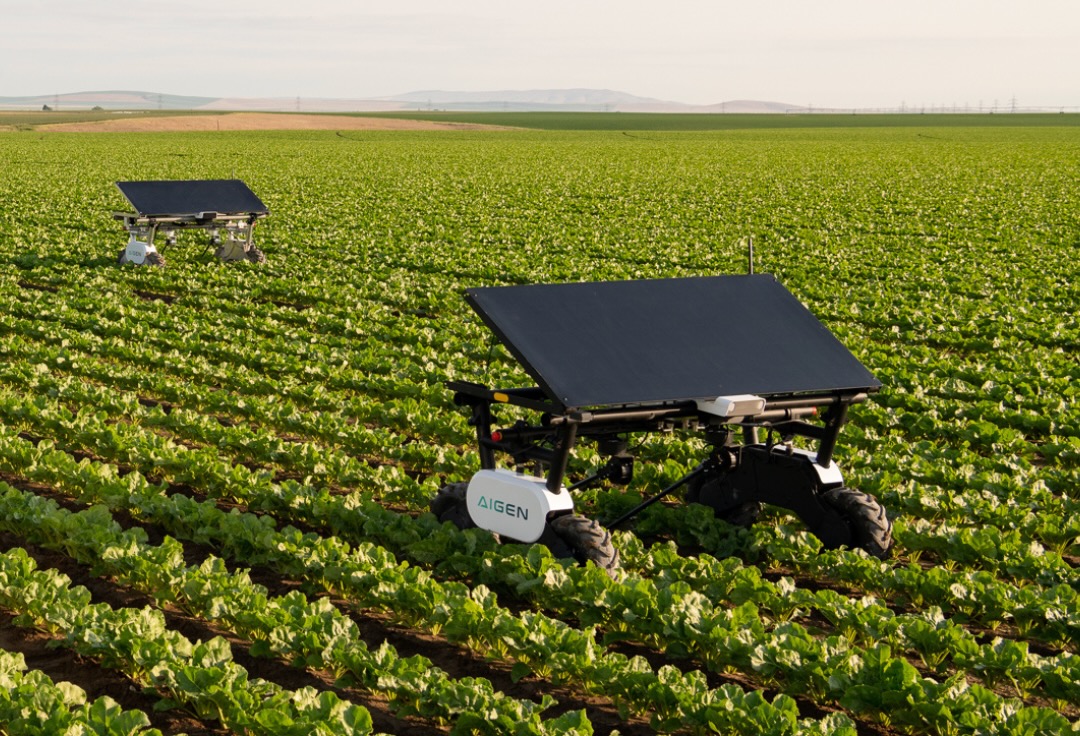
For years, a small company in Redmond, Washington has been quietly obsessed with weeds. Not the kind in your backyard, but the kind that choke crops and force farmers into expensive, unsustainable choices. That company is Aigen, and its answer to the problem is a fleet of solar-powered robots that roam farm fields, identify weeds with AI, and pull them out at the root—no diesel, no pesticides, no human bending over in the hot sun. What makes this more than just another clever farm gadget is the way Aigen is teaching its robots to understand the messy, unpredictable natural world. The company has built a digital greenhouse, so to speak, filled with synthetic plants and weeds created entirely by algorithms. This collection, which Aigen calls Alchemy, is a growing library of artificial imagery that trains the robots far faster than real-world photos ever could. It used to take three to four years of collecting and labeling images of real crops just to get a robot ready for a new type of farm. Now, according to co-founder and CTO Richard Wurden, the company can do it in about a week. That transformation has opened the door to growers of asparagus, hops, flowers, lettuce, and more—crops that were once out of reach for a startup that needed to be selective about where it focused its time and money.
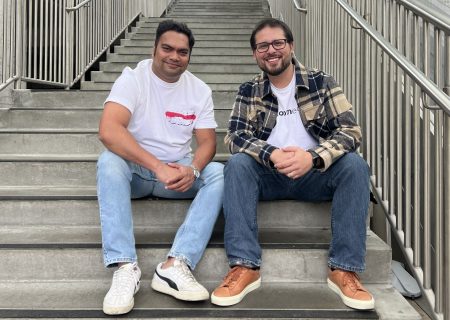
The story of Aigen is also a personal one, rooted in two founders whose lives have been touched by serious illness. Wurden, a mechanical engineer, previously worked on battery systems at Tesla and at Pure Watercraft, an electric boat company in Seattle. CEO Kenny Lee is a cybersecurity veteran who co-founded Weblife.io, later acquired by Proofpoint. The two met in a climate-focused Slack group and discovered they lived just five minutes apart. That coincidence led to long conversations about climate, agriculture, and technology—and eventually to the founding of Aigen in 2020. Their shared mission is deeply personal. Lee is a survivor of non-Hodgkin’s lymphoma, and Wurden lives with type 1 diabetes. Both diseases have been linked in scientific literature to herbicide exposure, a connection that has given the founders a fierce drive to reduce the chemical load on farmland. The startup has raised about $26 million to date, including a $4 million seed round in 2022 and a $12 million round in 2023 led by ReGen Ventures with participation from NEA. Today the company employs about 15 people, a lean team that has managed to build and test more than 100 robots, all assembled in Redmond, and log more than 15,000 hours in real farm fields across California, Minnesota, and North Dakota.
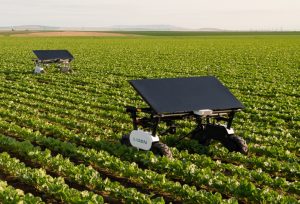
The robot itself, called Element, is a striking piece of engineering. It is about six feet wide and topped with a roughly 400-watt solar panel that powers its cameras, computers, and mechanical arms. As it moves through a field, its cameras capture images of the plants below. Sophisticated AI models distinguish between the crop the farmer wants to grow and the weeds that compete for water and nutrients. When a weed is identified, a mechanical arm reaches down and pulls it out by the root, removing the problem without chemicals or tillage. The robots are not cheap—they cost anywhere from $50,000 to $70,000 each depending on configuration, and Aigen typically sells them in packs of five—but for many farmers, the economics work out when compared to the rising cost of fuel, herbicides, and labor. The customer base already includes organic soybean growers in North Dakota and tomato growers in California, and the company is expanding a pilot program with an unnamed Fortune 500 company. The robots are nearly sold out for the 2027 season, according to the company, which says a lot about the demand for alternatives to chemical weed control. At a recent agricultural robotics expo in Yakima, Washington, Aigen made sales to growers it previously could not serve, a milestone Wurden described as saying “yes to a bunch of crops” after years of being locked into just a few.
Part of what makes Aigen’s expansion possible is the clever use of synthetic data, and that timing could not be better. The price of diesel has spiked dramatically, with U.S. prices up about 70 percent from a year earlier and averaging nearly $6.30 a gallon in recent weeks, according to EIA and AAA data. Many competing weed-control machines are pulled by diesel tractors, which means their operating costs have climbed right along with the fuel market. Aigen’s robots, by contrast, run entirely on solar power with battery backup. That zero-fuel design is a massive advantage in an era of volatile energy prices, and it has become a central part of the company’s pitch. As Wurden put it, “It just so happens running a solar-powered robot without pesticides is the best possible timing right now.” But solar panels alone do not make a robot smart. Training an AI to recognize plants in a real field is notoriously difficult because lighting changes hour to hour, weeds overlap with crops, and soil conditions vary. Hand-labeling thousands of images is slow and expensive, and a startup without the deep pockets of a tech giant cannot easily pay its way out of that bottleneck. That is why Aigen built Alchemy. The system generates unlimited images of synthetic plants, each one perfectly labeled from the moment it is created. The robots learn from these artificial worlds, and when they finally encounter a real weed in a real field, they already know what they are looking at.
Alchemy has evolved into a product of its own, and that opens up an interesting business model for the company. Large agribusinesses are now using Aigen’s synthetic data to train their own systems, Wurden said, because the perfectly labeled images are valuable for any company trying to build agricultural AI. The advantage is precision: when weeds and crops overlap in ways that are nearly impossible to sort out in real photographs, synthetic images can isolate every leaf, stem, and root with clean, unambiguous labels. Aigen’s robots do not use artificial lights to illuminate their work, so the training data has to account for the messy reality of shifting daylight and shadow. The system works so well that Wurden jokes the company’s AI now labels the data for itself, a self-perpetuating cycle that would have been unimaginable in the early days when the team could not afford to pay people to label images by hand. But Aigen is choosy about who gets access to Alchemy. The company is willing to work with precision-spraying companies that use less herbicide than traditional methods, but it draws the line at operations that broadcast-spray entire fields with chemicals. That ethical stance reflects the founders’ belief that technology should reduce harm, not simply make industrial farming more efficient at any cost.
Looking ahead, Aigen is preparing to bring its robots to Washington farms early next year, and the company is also working on an orchard version with arms that can reach out to weed between trees. A next-generation robot is in development, too, and the team is clearly thinking beyond the flat, open fields where its current machines operate. Aigen is not alone in this space. Washington has become something of a hotspot for AI-driven weed control. Issaquah-based TerraClear maps individual weeds so farmers’ existing sprayers can target only those spots, while Seattle-based Carbon Robotics uses lasers to zap weeds and trained its AI on 150 million labeled images of real plants. Aigen is betting that synthetic data will win out, at least for many applications, because it is faster and cheaper to generate than real-world imagery. But the larger point, at least for Wurden, is that all of these companies are trying to solve a genuine problem that affects everyone. For too long, he says, farmers have felt left behind by the technology industry, which often fixates on advertising clicks or yet another useless gadget. Seeing technologists turn their attention to agriculture feels refreshing and necessary. It is also a rare issue that brings people together across political lines, because, as Wurden notes, “everybody needs food.” In a time of polarized debates and soaring costs, a solar-powered robot that pulls weeds without poison is not just a clever machine—it is a small, hopeful sign that innovation can still serve the people who feed us all.