

It’s strange to hear that something you helped build is officially over. When the news broke that the Microsoft Garage was coming to an end after seventeen years, I felt a mix of sadness and pride. Seventeen years is an eternity in software, and I’m deeply proud that this weird little experiment lasted as long as it did. The funny thing is, the Garage never should have existed. Microsoft already had bigger, better-funded grassroots innovation programs when we started. We had no playbook, no experience, no idea what we were doing. We were making it up as we went along. And somehow, against all odds, the Garage outlived those bigger, fancier programs and grew even larger than they ever were. Part of that was luck, pure and simple. But I’d like to think that some of it came down to choices we made along the way. Four choices, specifically, mattered more than anything else. If you ever find yourself with a similar opportunity, I hope they help you the way they helped us. They aren’t complicated. Find the doers, not the talkers. Make it a potluck, not a catered event. Don’t worry about the billions. And don’t be afraid to do epic shit.
The first choice was building the Garage around doers instead of talkers. When we began, the other innovation groups at Microsoft all had a similar structure. They were built around ideas. You submit an idea. Everyone votes on ideas. A few winners get funded and turned into projects. On the surface, that sounds fair and democratic. In practice, it was deeply flawed. It attracted people who liked talking about things more than actually doing them. And voting simply doesn’t work for innovation. When you put ideas to a vote, the obvious ideas win, and if an idea is obvious, someone has probably already built it. The real magic in grassroots innovation comes from special insight, the kind of idiosyncratic understanding that comes from living with a problem every day. Committees are terrible at recognizing special insight. So we deliberately went the opposite direction. The Garage focused on people building small projects. Nobody had to vote. Nobody had to agree. If you wanted to build something, you just built it. That meant someone could create a tool that made one annoying part of their own job easier. Clark Roberts, Victor Boctor, and Mike Cook thought code reviews were too painful, so they built CodeFlow as a Garage project. It spread across Microsoft’s development teams and eventually made its way into Visual Studio. Philip Su coded up Dr. Who, a tool that made it faster to look up anyone inside the company. Truong Do wanted to use one mouse and keyboard across all his computers, so he built Mouse Without Borders, which later became the first Garage project released to the public. None of those projects would have survived a vote. They were too small, too personal, too weird. But every one of them was useful. And that approach attracted a certain kind of person. The best coders are often the best because they genuinely love to code. They code all day at work, then go home and code all night and on weekends. Those were Garage people. The alumni list tells the story. Philip went on to become a tech CEO and site lead for Facebook and OpenAI. Vijaye Raji built Small Basic as a side project long before he founded Statsig and became CTO of Applications at OpenAI. Victor is now a Technical Fellow at Airbnb. Clark leads engineering at TaxBit. Mike leads engineering at Clipboard Health. These were people who fell somewhere between startup founder and safe corporate employee. They wanted the security of a day job, but they also wanted to chase a dream. It’s no surprise so many of them went on to do amazing things. They weren’t interested in sitting around in meetings talking about ideas. They wanted to build things that solved real problems. That same doers-not-talkers spirit is why Ben Gilbert, now of Acquired fame, was the perfect person to take over the Garage after I left. Ben had always been a Garage type of person, building his own iPhone apps on the side. Later, that same impulse led him and David Rosenthal to start hacking on Acquired back before podcasts were even a big thing. When you focus on doers, everything else follows.
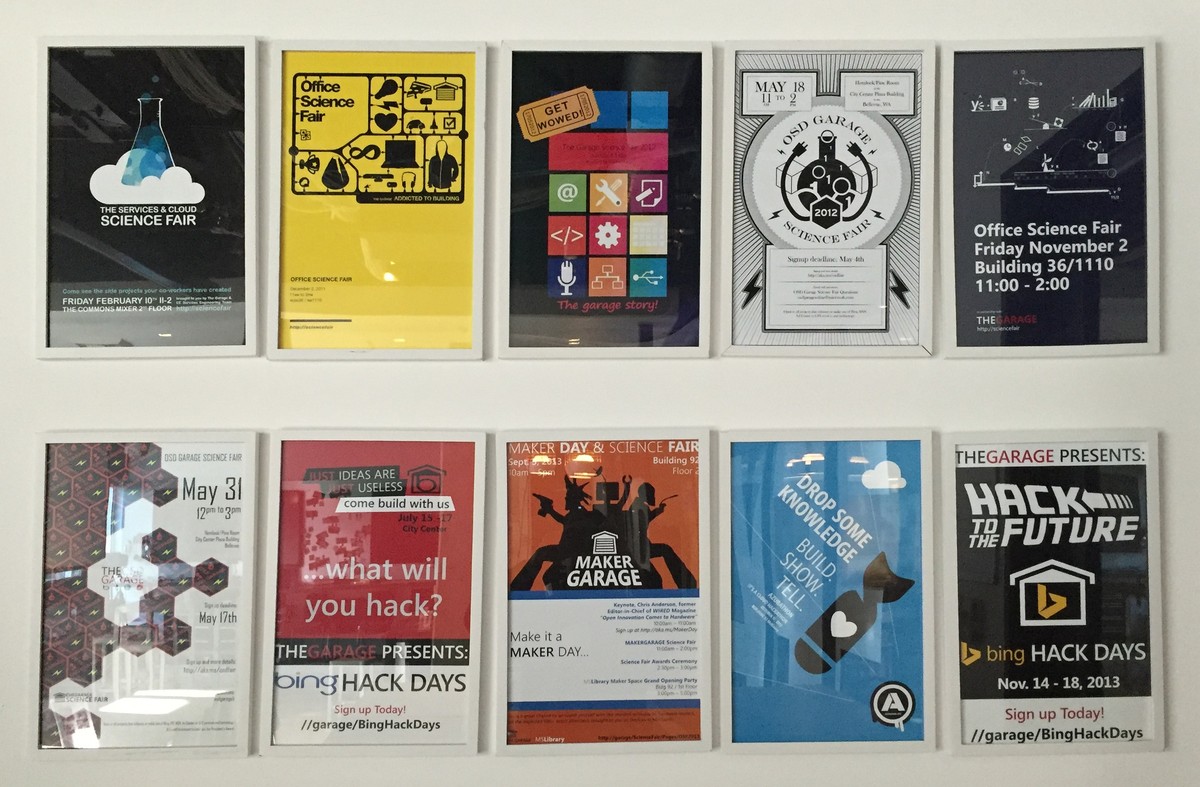
The second choice was making the Garage a potluck instead of a catered event. We had almost no budget. It was just me, one amazing contractor named Liane, and a little bit of money for pizza and poster boards. Meanwhile, one of the other innovation groups at Microsoft had a chocolate fountain at their event. A chocolate fountain. Our tiny budget looked like a weakness, but it turned out to be one of our greatest assets. Because we couldn’t just write a check to solve problems, we had to ask people to step up. When employees at Microsoft’s Hyderabad campus asked us to put on a science fair, we told them: we’d love to support you, but you’ll need to find a way to fund it yourselves. That response felt awkward at the time, but two good things happened because of it. First, it was a great screen. Only the truly motivated people were willing to make it happen. And when people know they’re expected to lead, they step into that role in a way they never would if someone else was doing the heavy lifting. Second, they went to their local leadership and got them to pay for it. And once local leadership paid for it, it became their science fair. It wasn’t some outside group telling them what to do. It was their event, their people, their success. That sense of ownership changed everything. This pattern repeated itself again and again. Bing wanted a science fair, so Bing sponsored it. The Developer Division wanted one, so DevDiv sponsored it. And because they were paying for it, their leaders wanted it to succeed. They showed up. They participated. They celebrated the results. Each event made the next one easier because we could point to a science fair that had worked somewhere else instead of starting from scratch. The Garage became something that lots of people owned. The well-funded groups never got that. They were islands. Their leaders saw them as distractions, and maybe as a little arrogant for thinking they knew how to innovate. We were different. We weren’t the ones being innovative. We were the ones making it possible for others to be innovative. People would bring whatever they had, like a potluck, and the shared meal turned out to be richer than anything a chocolate fountain could offer. It turns out that a potluck beats a catered banquet every time, because when everyone brings something, everyone owns the meal.
The third choice was refusing to worry about the billions. I remember when Steve Ballmer visited Office Labs. Chris Pratley was there, and after the visit, Steve just asked him: “So where’s my next billion-dollar idea?” That one question explains so much about why innovation is so hard inside big companies. If you’re an independent entrepreneur, a business doing ten, twenty, or thirty million dollars a year is a huge success. At a company like Microsoft, it’s a distraction. Big companies are looking for multi-billion-dollar businesses, and they will shut down things that are only going to make tens of millions. So the medium ideas get killed for being too small. And the big ideas require so many resources, and so much alignment, that they rarely make it through the process either. The irony is that billion-dollar businesses rarely look like billion-dollar businesses at the start. Facebook and Twitter didn’t even have a way to make money in their early days. If you demand a path to a billion dollars before you start, you will kill grassroots innovation before it has a chance to breathe. So we sidestepped that entire conversation. The Garage was never about finding billion-dollar ideas. It was about supporting people who were doing grassroots innovation. It was about helping them build skills, ship things, make friends across the company, and make their own teams better. Because of that, nobody could ask us where the billions were. We never promised any. There was no expectation we would justify our existence with a massive return. People always asked Ben, who ran the Garage after I left, “What came out of it?” And his answer was always the same: mostly culture. The output wasn’t a chart of revenue projections. It was a group of people who went back to their day jobs re-energized, connected, and inspired. Look at that list of alumni again. Tech CEOs, startup founders, engineering leaders. All of them spent time tinkering in the Garage, eating pizza, building something that mattered to them. That’s a pretty good return on pizza and poster boards. It’s also a reminder that the value of grassroots innovation isn’t always measurable in dollars. Sometimes the return is human. Sometimes the return is cultural. Sometimes the return is the fact that someone who might have left the company decided to stay because they had a place to dream.
The fourth choice was being willing to do epic shit. One of my favorite Garage stickers said “Do epic shit.” We stole it from J Allard, who had used it on Xbox. It was controversial. People worried that having a swear word in our materials would alienate people. And they were right. It did alienate some people. But that was exactly the point. The sticker had a very different energy from the rest of Microsoft, and we needed that energy. When you’re doing something like the Garage, you need to step outside the corporate culture every once in a while and have a little fun. We never wanted to be arrogant. But we did want to be memorable. We did want to be bold. So we built a giant volcano. It was constructed by two pyromaniacs, and it got bigger and bolder every time we did it. People set things on fire on purpose, and it became one of the most beloved traditions of the Garage. That’s the kind of thing that doesn’t happen in a normal corporate program. We also gave people access to a laser cutter with only minimal training. That was chaos. It was also amazing. The same tension existed with “Doers, not talkers.” Some people worried that it excluded folks who couldn’t code. And honestly, it did. But to have an identity, you have to say both what you are and what you aren’t. You can’t be everything to everyone. When you’re small and scrappy, you have to take risks. You have to be willing to have an identity that isn’t for everyone. Not everyone appreciated the sticker. Not everyone appreciated the volcano. But the people who did appreciate those things were exactly the people we wanted to attract. They were the dreamers, the builders, the ones who weren’t afraid to make something weird and wonderful. The “Do epic shit” sticker wasn’t just about being reckless. It was about refusing to be boring. It was about remembering that innovation is supposed to be joyful, not just efficient. It was about giving people permission to be a little bit unreasonable. Because if you’re doing something that’s ever going to matter, it’s probably going to look a little unreasonable at first.
Now the Garage is ending. But I don’t think it’s really going away. It lives on in the people who built things there and took that habit with them. It lives on in the alumni who became founders and leaders and makers. It definitely lives on in my network, and I suspect it lives on in the memories of everyone who ever hacked on something in the Garage, came to a science fair, ate pizza at Stay Late and Code, or set something on fire on purpose. To all of you, I want to say thank you. Thank you for showing up. Thank you for building things because you couldn’t not build them. Thank you for making the Garage weird, wonderful, and genuinely alive. To the people who were there at the beginning and in the middle of it all, Chris Pratley, Liane Donald, Ben Gilbert, Jen Michelstein, Joe Coplen, and so many others, it was an absolute blast. We didn’t know what we were doing. We had almost no money. We made mistakes. But we also created something that lasted seventeen years, which is practically forever in the world of software. That doesn’t happen by accident. It happens when you find the right people, when you make it a potluck instead of a catered event, when you forget about the billions, and when you’re brave enough to do epic shit. The Garage may be ending, but the spirit behind it doesn’t have to. It’s still alive in anyone who builds something small and useful just because they want to. It’s alive in anyone who hosts a local event and asks other people to bring something to share. It’s alive in anyone who ignores the pressure to justify every project with a giant revenue projection. And it’s alive in anyone who looks at a logo, a sticker, or a volcano and thinks, yeah, I want to be part of that. If you remember nothing else, remember these four things: find the doers, make it a potluck, forget the billions, and never be afraid to do epic shit. That’s what the Garage taught me. That’s what I hope it taught you too.