


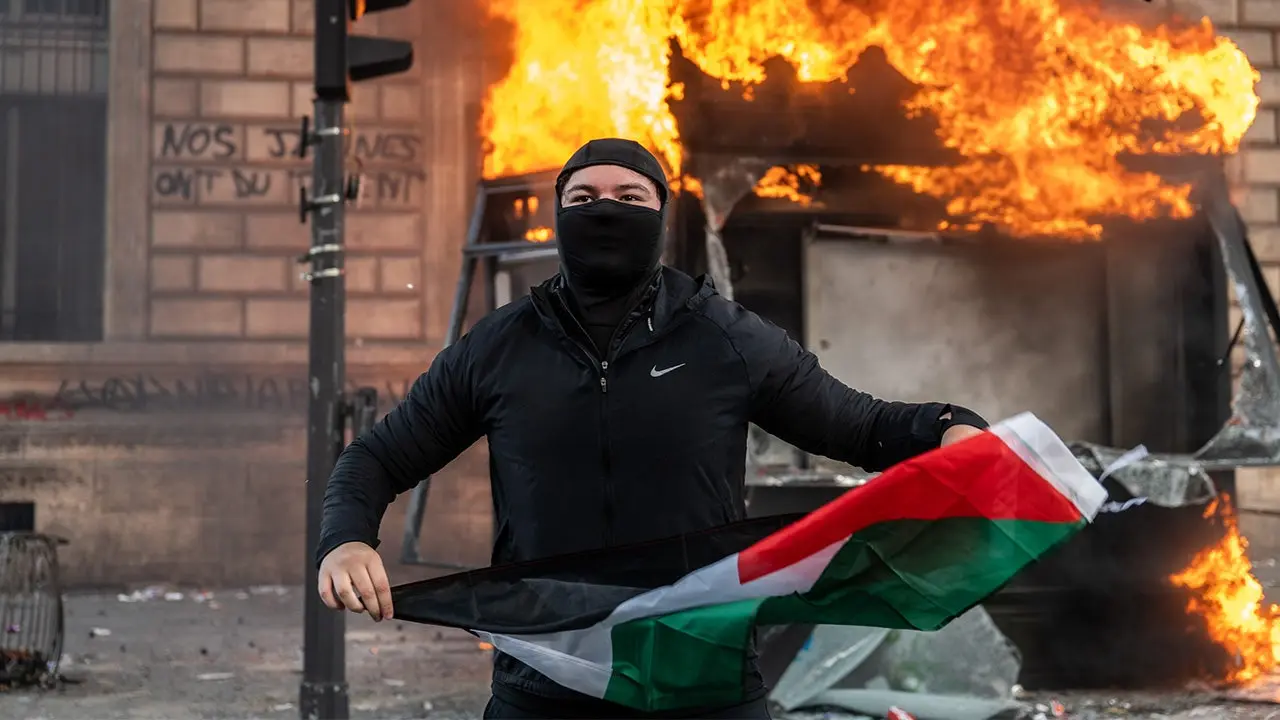
For many French Jews, the weekend’s violence did not begin with shattered storefronts or clouds of tear gas. It began with an email. In the hours before Saturday’s protests swept across France, synagogue leaders quietly urged their congregations to stay home, to skip the afternoon Mincha prayers, to avoid wearing anything that might mark them as Jewish in public. Samuel Arrouas, a French Jewish community member who splits his time between Paris and Israel, said he had never seen anything like it. At 40 years old, he told Fox News Digital, this was the first time he had received such a warning. The message was simple and chilling: Don’t go out. It’s dangerous. Arrouas, who had already returned to Israel before the unrest, described the atmosphere as one of palpable dread. Observant men were told to leave their kippahs and tzitzit at home or hidden under clothing. Worshipers were advised not to linger outside synagogues after services, to pray and then immediately disappear into the streets. The fear was not abstract. Before leaving France, Arrouas encountered masked demonstrators carrying Palestinian flags near Paris Dauphine University. When you are Jewish and you pass in front of such a scene, he said, the only thing you want to do is get away. That single image—a man walking quickly past masked strangers, eyes down, heart racing—captured a deeper anxiety rippling through a community that has learned to read the signs.
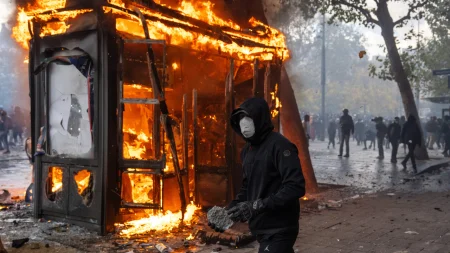
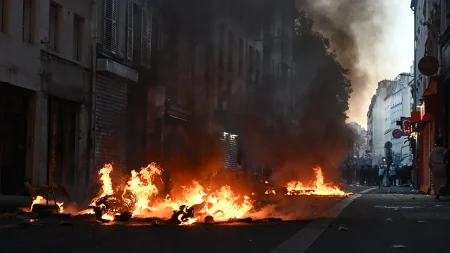
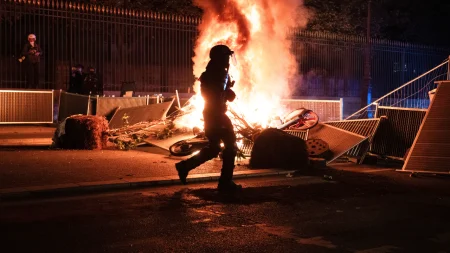
The unrest itself was massive, loud, and chaotic, but its stated causes were not religious. Around 550,000 people took to the streets across France on October 17, angry about rising fuel prices, the soaring cost of living, and crumbling public services like schools and hospitals. What began as a demonstration over economic pain quickly curdled into something darker. In Paris, Marseille, and other cities, masked rioters clashed with police, looted businesses, set fire to vehicles and buildings, and turned working-class neighborhoods into war zones. France’s Interior Ministry reported roughly 2,400 arrests. President Emmanuel Macron addressed the nation, calling for calm and order while acknowledging the anger beneath the surface. “We all feel anger and shame,” he said, carefully separating the protesters’ legitimate demands from those who destroyed, smashed, and looted. He insisted that nothing justified the violence and promised accountability. Interior Minister Laurent Nuñez offered his resignation; Macron refused it. But for French Jews watching from their windows, the political explanations felt incomplete. The violence was not just about fuel or inflation. It carried an edge, a menacing undertone, and it was aimed at more than the state. The warnings to skip prayer services and hide religious symbols were not about traffic jams or tear gas. They were about identity. And that, perhaps, is what made the weekend so terrifying: the sense that being visibly Jewish in France had once again become a liability, a risk, a target.
Shannon Seban, the France-based executive director of European affairs at the Combat Antisemitism Movement, saw the connection clearly. She pointed to the Palestinian flags appearing at demonstrations that were ostensibly about education, wages, and public services. What does Gaza have to do with any of this, she asked. The answer, she argued, is that the unrest had been infiltrated by a broader ideology, one that seeks to globalize the intifada and spread antisemitic conspiracy theories through social media. Seban’s organization documented 1,384 antisemitic posts in just two days, including claims that Jews and Israel were secretly behind the riots. These posts did not emerge from nowhere. They were part of a coordinated narrative, amplified by far-left leaders and online agitators, that transformed economic anger into something older and uglier. Seban was careful to defend the right to protest, calling it fundamental in a democracy. But, she added, the right to protest is not the right to destroy. Her words were direct: France and Europe must wake up before it is too late. For many readers, the urgency of that warning is hard to dismiss. When a peaceful demonstration over cost-of-living becomes a stage for Palestinian flags and calls for intifada, when Jewish conspiracy theories trend alongside riot footage, the message to French Jews is unmistakable. You are not part of this struggle. You are the problem. And when the state is overwhelmed by looting and arson, it cannot protect you. That is a terrifying thought to live with.
In Marseille, the damage was visceral. Bruno Benjamin, president of the Marseille-Provence branch of CRIF, the Representative Council of French Jewish Institutions, described the aftermath as unbearable. Several hundred shops were ransacked, vandalized, and looted. Storeowners who had spent years building their businesses watched their work destroyed in a matter of hours. Some were now facing layoffs or temporary unemployment for their employees. Benjamin spoke not just about property damage but about dignity. This is not just an attack on businesses, he said. It is an attack on people’s livelihood, their dignity, and the very fabric of our society. Yet he also acknowledged a painful nuance. The SPCJ, France’s Jewish community security organization, cautioned against assuming that Jewish-owned property was targeted specifically because of religion. A break-in and vandalism at a synagogue in Paris’s 19th arrondissement initially appeared to be a burglary, though the motive remained uncertain. Jewish-owned businesses were among those damaged in Marseille, but there was no clear evidence they had been singled out for being Jewish. This ambiguity is part of the trauma. Are these attacks random expressions of social rage, or are they aimed at Jews? The community cannot know for sure, and that uncertainty is itself a form of fear. For every shopkeeper sweeping up broken glass, the question lingers: Was this just chaos, or was this about us? Benjamin’s words reflect the exhaustion of a community that has lived through waves of antisemitism before and knows how quickly the lines can blur. The rational explanations matter, but so does the emotional weight of walking through a looted city and wondering if your faith made you a target.
The broader context only deepens the unease. The U.S. State Department’s Level 2 travel advisory already urges Americans to exercise increased caution in France because of terrorism and unrest. Fox News Digital reached out to the French Embassy in Washington, D.C., for comment on the violence and the safety of the Jewish community, but the silence itself speaks to the difficulty of the moment. Benjamin said that rising insecurity and antisemitism have left some French Jews contemplating leaving the country entirely, while others remain determined to stay, refusing to be driven out of the nation they love. This is the painful paradox of French Jewish life today: the desire to belong, to be French, to participate in the Republic’s public life, collides with the instinct for survival, the ancient reflex to pack up and flee when the mob gathers. Benjamin articulated this tension with striking clarity. We must relentlessly combat antisemitism, defend the right to live in safety and dignity, and ensure that no Jew in France should ever have to choose between their personal security and their love for their country, he said. Because being Jewish in France should never mean having to live in fear. That sentence, simple and devastating, captures the stakes. A community should not have to weigh its faith against its homeland. Parents should not have to decide whether their children can wear a kippah to school. Congregants should not have to cancel Shabbat prayers because the streets are unsafe. And yet, in France in October, that is exactly what happened.
Ultimately, the blame, in Seban’s view, is not diffuse. She is unequivocal: La France Insoumise and the far left bear a political responsibility for fueling this climate of violence and confrontation. Their rhetoric, she argues, does not merely criticize government policy; it delegitimizes the Republic itself and encourages a politics of destruction. By framing the protests as a righteous uprising against an oppressive system, by allowing Palestinian flags and intifada slogans to mingle with calls for higher wages, they have created a brew that is toxic for Jews. This is not to say every protester is antisemitic, or that economic grievances are not real. But in the ecosystem of extremism, the language of revolution often finds its easiest target in the Jewish community. The 1,384 antisemitic posts documented in two days are not a coincidence. The synagogue cancellations are not an overreaction. The fear in Arrouas’s voice, the devastation in Benjamin’s description, the urgency in Seban’s warning—all of it points to a moment of reckoning. France has faced this before, and its Jewish community has survived, often by adapting, by reading the room, by knowing when to stay and when to go. But survival should not require invisibility. The human cost of these riots cannot be measured only in burned cars and broken windows. It is measured in emails telling families to hide their faith, in children asking why they cannot wear their symbols, in elderly worshipers praying alone at home instead of together in the synagogue. It is measured in the quiet, chilling realization that in the land of liberty, equality, and fraternity, being Jewish once again means being afraid. And that, as Benjamin said, is simply too much to bear.