



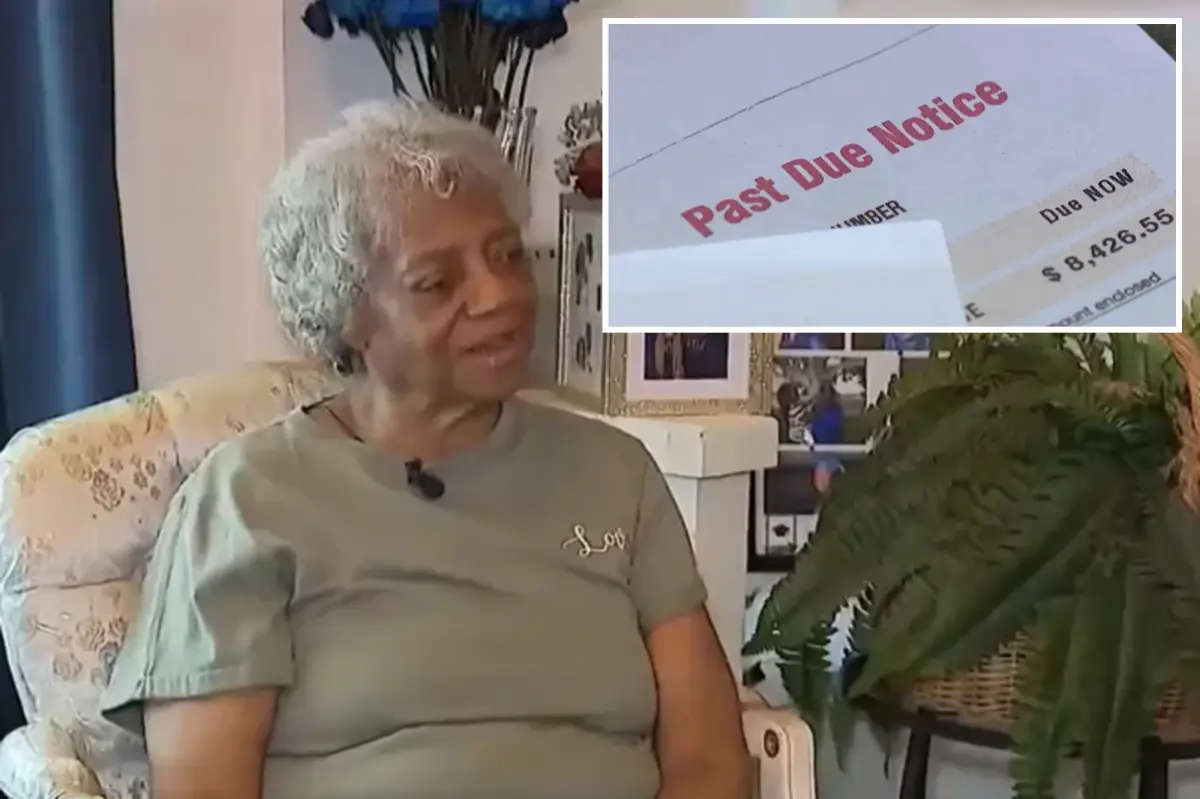
For more than half a century, Joyce Howell and her husband have called the same house in Los Angeles home. Now in their eighties, they have lived quietly there since the 1960s, raising ten children within those walls and building a life around family, work, and community. Joyce, now 82, spent her career as a nurse, caring for others long after her own children were grown. Her husband served his country in the Vietnam War, and together they represent a generation that believed in hard work, sacrifice, and paying one’s way. That is why the sudden arrival of a monstrous water bill felt like more than just a financial shock—it felt like a betrayal of everything they had done right. Earlier this year, the Los Angeles Department of Water and Power presented them with a bill for more than $9,200. The charge supposedly covered water used between February 2023 and March 2026, a period during which the couple had no idea they were accumulating debt by the month. For a retired couple living on a fixed income, a bill of that size was not merely inconvenient; it was devastating. The Howells never expected to spend their twilight years drowning in an impossible utility bill, especially for water they did not know they were using. Their home, a 3,100-square-foot place that had sheltered a large family, had always been modest in its consumption. But the numbers on the bill seemed to suggest otherwise, and Joyce was left to wonder what had gone so wrong.
Initially, the couple thought they might have a leak. It seemed plausible—an old house, aging pipes, perhaps something hidden behind the walls. Joyce asked her daughter, Stephanie, to contact LADWP and find out what was happening. Stephanie made the call, expecting perhaps to learn that there was a fixable problem or at least an explanation. Instead, she was told something far more unsettling. An LADWP representative revealed that the meter at her parents’ home had been broken for three years. During that entire time, the utility had not been charging them for their water. But now, having noticed the problem, they were doing what they called “catching up.” The representative was matter-of-fact: the family owed for all the water that had been used over those three years, and they would have to pay. It did not matter that the meter had been faulty—the water had indeed flowed, and in the utility’s eyes, the charge was legitimate. Stephanie was stunned. It seemed impossible that a massive municipal agency, responsible for hundreds of thousands of meters across the city, had allowed a broken meter to go unnoticed for so long. Yet instead of accepting responsibility for the oversight, the utility was handing the entire burden to her elderly parents. The family had not been warned, had not been given a chance to fix anything, and certainly had not been told to budget for a ten-thousand-dollar debt.
The human reality of the situation is what makes it so difficult to swallow. Joyce Howell dedicated her working years to nursing, a profession built on empathy and compassion. Her husband served his country in a controversial and painful war, returning home to raise a family and contribute to his community in Los Angeles. They did not seek fame or fortune; they simply lived good, decent lives. Now, at the end of those lives, they are being asked to pay a bill that they cannot possibly afford. Stephanie put it plainly when she spoke to the local news, describing the outrage of coming at her parents, who had given so much, with a bill like this at the end of their lives. She pointed out that elderly people do not have additional income. They cannot go back to work. They cannot magically find several thousand dollars tucked into their budget. This is it for them. It was not as though they had been living extravagantly or ignoring notices. They had no idea anything was wrong. The utility, by its own admission, had failed to read or service the meter for years. And now the consequences of that failure were being visited upon two of the most vulnerable people a city has—an aging nurse and a veteran, living on a fixed income, with no room for surprises. It is hard to imagine a more lopsided contest.
Stephanie also voiced a question that many people will hear and recognize: why was the issue not caught sooner? LADWP has around 700,000 water meters and 1.7 million electric meters in its vast service area. The utility employs technicians whose job it is to read meters, check for damage, and ensure that everything is functioning properly. Yet no one apparently noticed that this particular meter was stuck, and no one came to investigate. If the meter had been read even once on a regular schedule, an alert should have been raised. The family believes that the utility should be responsible for its own failure, not the customer. That is a fair point. When a business fails to send a bill for months or years, or when a device it owns breaks down and affects the amount a customer owes, the burden of that mistake usually falls on the business, not the customer. In this case, it felt like the exact opposite. The Howells had no way of knowing what was happening. They were not receiving bills, not being told about any problems, and not accumulating costs they could track. Then, out of nowhere, a three-year bill landed on their doorstep. LADWP’s official response was that stuck meters are rare, but the utility has a responsibility to charge customers if water is used, and that they would work with the family under terms they could afford. But for the Howells, the question was not whether they had used the water—it was why no one had done anything about the meter sooner.
There is a cold bureaucratic logic to the utility’s position. They are not charging for water that was never delivered. The Howells presumably did use water in their home during those three years. A family home with that many people over the years would naturally use a certain amount, and the monthly bill of just over $300 suggests a normal, consistent pattern of use. But that only makes the situation more absurd. If the meter was broken, why not fix it? And if it could not be fixed immediately, why not estimate the charges based on prior usage, notify the customer, and avoid this dramatic and painful reckoning? Instead, the Howells were left in the dark for three full years. The utility, for its part, argues that it is constrained by its own regulations to bill only for the past three years, meaning the broken meter period they are charging for is actually the maximum allowed by policy. But that regulation was designed to protect consumers from unlimited retroactive charges, not to give the utility a free pass on its own negligence. When asked about the couple’s situation, LADWP officials expressed a willingness to set up a long-term payment plan. They reduced the bimonthly payment from $360 to $100 after the story received public attention. That is something, but it is also an indication that the initial offer was not designed with genuine compassion. It took news coverage for the city to bend, and even then, the couple was still left with a bill that would stretch out for many years.
Joyce Howell, despite everything, remains remarkably composed. She told reporters that she has no problem paying the bill—if she owes it, she wants to do the right thing. But she could not hide her disappointment that a broken meter went unnoticed for so long. Her words carry the weight of a woman who has spent a lifetime doing the right thing, only to be treated like a deadbeat by the very institution that should have protected her. She said that if it was not working, somebody should have done something long before things got so out of hand. That simple sentence is the heart of this story. It is not about greed or entitlement. It is about accountability. When a large utility fails to maintain its own equipment, the customer should not be the one paying the price. And when the customer is an elderly retired nurse and a war veteran who have given decades to their family and community, the least the city can do is act with grace and humility. The Howells’ story is a reminder that behind every meter, every bill, and every bureaucratic decision, there are real people—people whose lives can be upended by a single piece of paper. For Joyce and her husband, the fight is not over. But their dignity remains intact, and in their quiet insistence that someone should have done something, they speak for countless other families who have found themselves at the mercy of an indifferent system.