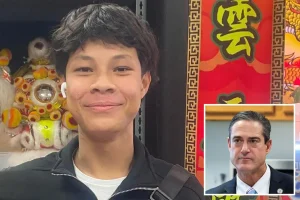


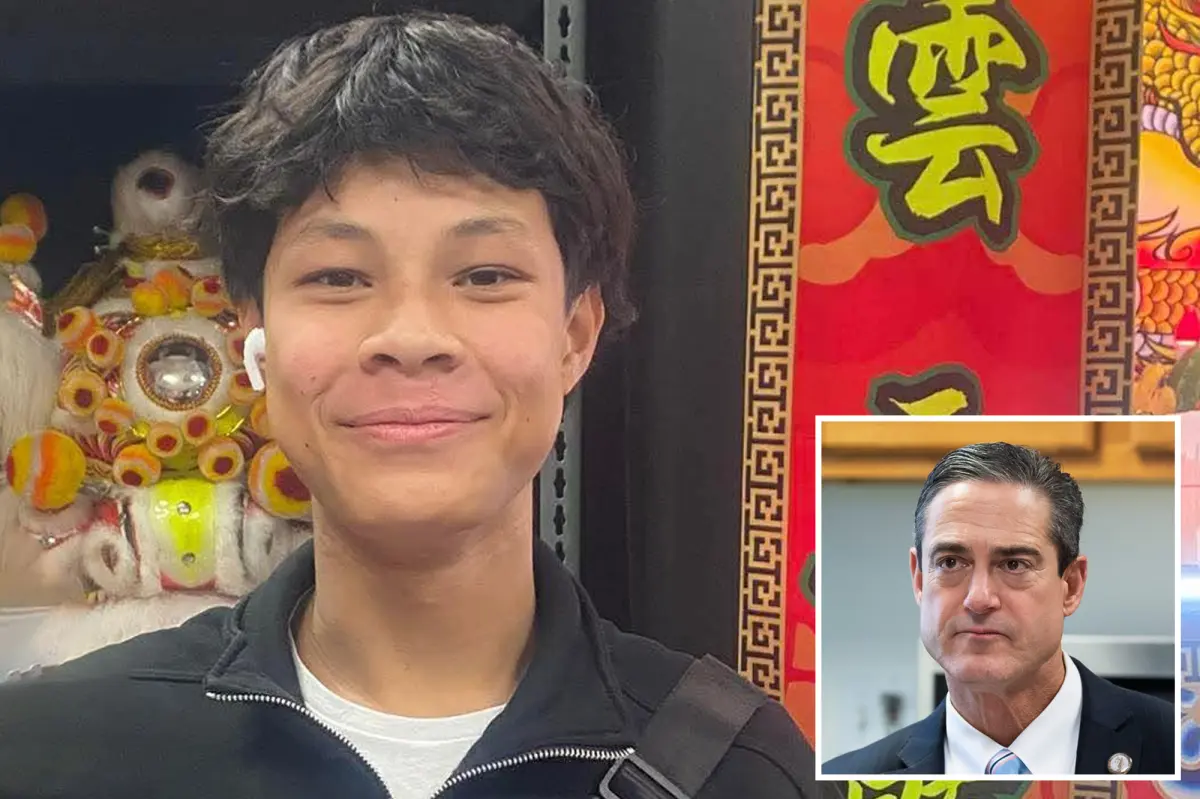
Benson Nguyen was just 13 years old, an age when childhood still lingers but the pull of speed and freedom is already impossible to ignore. On May 7, in Garden Grove, California, that pull ended in a horrifying instant. Benson was riding his E-Moto, a powerful electric machine that looked like a dirt bike and moved like one too. According to authorities, he was traveling at 43 miles per hour when he slammed into a concrete light pole. He was rushed to UCI Medical Center, but the injuries were too severe. He did not survive. What followed has become not only a story of a community grieving a lost child, but a deeply uncomfortable story about blame, parenting, and the limits of legal responsibility. Because now, in addition to burying their son, Benson’s parents are facing criminal charges. His father, Vu Thanh Nguyen, 56, and his mother, Hong Cuc Thi Nguyen, 49, both of Santa Ana, have been accused of allowing their son to ride the powerful bike illegally. For a family already shattered by loss, the legal threat is almost too much to bear. There is no version of this tragedy in which anyone walks away without wounds.
The circumstances leading up to Benson’s final ride are difficult to hear. Prosecutors say that in the moments before the crash, the teenager was running red lights, speeding, and popping wheelies on the high-powered E-Ride Pro SS 2.0. That kind of behavior is terrifying to imagine, and it is also, in an uncomfortable way, familiar to anyone who has raised a thrill-seeking teenager. Adolescents are wired to push boundaries, to test limits, and sometimes to ignore danger entirely. But the machine Benson was riding was not a toy. It was a motorcycle in every practical sense, classified as such under California law, which means it requires a driver’s license and proper registration with the Department of Motor Vehicles. Benson was 13. He had no business being on it. What makes the case even more heartbreaking is that this was not his first serious accident. Just six months earlier, Benson had broken his leg in a separate crash. Any parent would have been shaken. Any parent might have hidden the keys. Instead, according to authorities, his father bought him an even faster, more powerful bike. That decision has become central to the criminal case. It is the kind of detail that makes people gasp, and also the kind of detail that raises uncomfortable questions about what ordinary people do when they cannot control their child, or when they convince themselves that one more chance will be enough.
Now the legal system is stepping in where, prosecutors argue, parental discipline failed. Orange County District Attorney Todd Spitzer did not mince words in a public statement. “When parents refuse to hold their children accountable and that refusal to parent results in unspeakable tragedy, then I have no choice but to hold parents accountable,” he wrote. Those words are sharp, and they carry the weight of a public official who has seen too many young people die on these machines. But they also open a painful door. How exactly should a parent be punished when their child dies? Is the purpose of this prosecution justice, deterrence, or simply the need to place blame somewhere, anywhere, after a preventable catastrophe? Under the charges filed by the district attorney, the boy’s father now faces up to six years in California prison. His mother faces a maximum of one year in county jail. That is a staggering consequence for a family whose child is already gone. The two parents, who likely spent their son’s last moments on earth begging for his survival, are now preparing to defend themselves in a courtroom. It is impossible not to feel the cruelty of that reality, even while understanding why prosecutors are angry and why the public is demanding answers. No one wants to see a child die. But no one should be naïve enough to think that charging grieving parents will undo the damage, or that it will bring Benson back.
This case is not happening in a vacuum. Across Southern California, authorities are sounding alarms about a wave of deadly crashes involving electric bikes and motorcycle-style e-Motos. The numbers are startling. More than 125 deaths have been attributed to e-bikes and e-motos across the United States. In Orange County, e-bike and e-moto injuries are now the number one reason children end up in the emergency room. The increase is staggering: injuries have skyrocketed by more than 430 percent in Southern California in just the last four years. Behind those statistics are real children, real families, and real hospital rooms. Some of those children recovered. Some of them, like Benson Nguyen, did not. Communities are struggling to adapt to a new reality in which a teenager can essentially acquire a motorcycle without a license, without a registration, without a single driving lesson, and wander into traffic on a machine that can outrun a car in certain situations. Parents cannot be present at every moment. Children cannot always be trusted to make wise choices. And the laws that govern these vehicles were written for an era before the explosion of electric bikes that blur the line between bicycle and motorcycle. That is not an excuse for negligence, but it is a context that makes the Nguyen family’s story more complicated than a simple headline.
In the midst of this legal storm, something tender has emerged. A GoFundMe campaign was created in Benson’s memory, and it has already raised more than $7,100, nearly reaching its $7,500 goal. The money will not bring him back, but it shows that people in the community and beyond recognize that this is not just a case to be prosecuted. It is a family to be mourned. There is a strange and painful duality here: the same community that may understand the district attorney’s frustration is also reaching out to help Benson’s parents. That is because grief and accountability are not opposites. A parent can be devastated by their child’s death and still be responsible for the choices that contributed to it. A community can demand justice while also remembering that the people facing charges are not strangers. They are a mother and father who woke up one morning with a teenage son and went to sleep that night with an empty room and a broken heart. The fundraiser is a reminder that every sentence of this case, every legal document, every courtroom debate, is attached to a real human being whose life was cut far too short. Benson Nguyen was not just a statistic. He was a 13-year-old boy who may have made reckless choices, who may have been allowed to do things he should not have been allowed to do, and who died because of it. He was also someone’s child.
In the end, this entire tragedy forces us to look at a much larger picture. Who is responsible when a child dies on a vehicle that is legally sold but illegally ridden? What should a parent do when a teenager refuses to obey the rules, lies about where they are going, or sneaks out for one more ride? How can communities keep children safe without simply criminalizing families that have already been punished by fate? These are not easy questions. There are no clean answers. But one thing is certain: Benson Nguyen’s death is a heartbreaking reminder that love sometimes means making unpopular choices. It means saying no, even when it leads to screaming and tears. It means refusing to buy the bigger bike, hiding the keys, and taking the long way home to avoid tempting roads. It means understanding that a moment of anger is far better than a lifetime of regret. The Nguyen family is living every parent’s nightmare. Their son is gone, and now they face the possibility of prison. Whatever the courts decide, there is no verdict that can bring Benson back. No prison sentence can restore what was lost. The only meaningful way forward, for all of us, is to turn this grief into action: better education for children, better training for parents, better laws for these powerful machines, and honest conversations in every kitchen, before another thirteen-year-old takes to the road at 43 miles per hour and never comes home.