


Here is a newly written, humanized account in six paragraphs, designed to bring the news story to life while staying close to the reported facts.
—
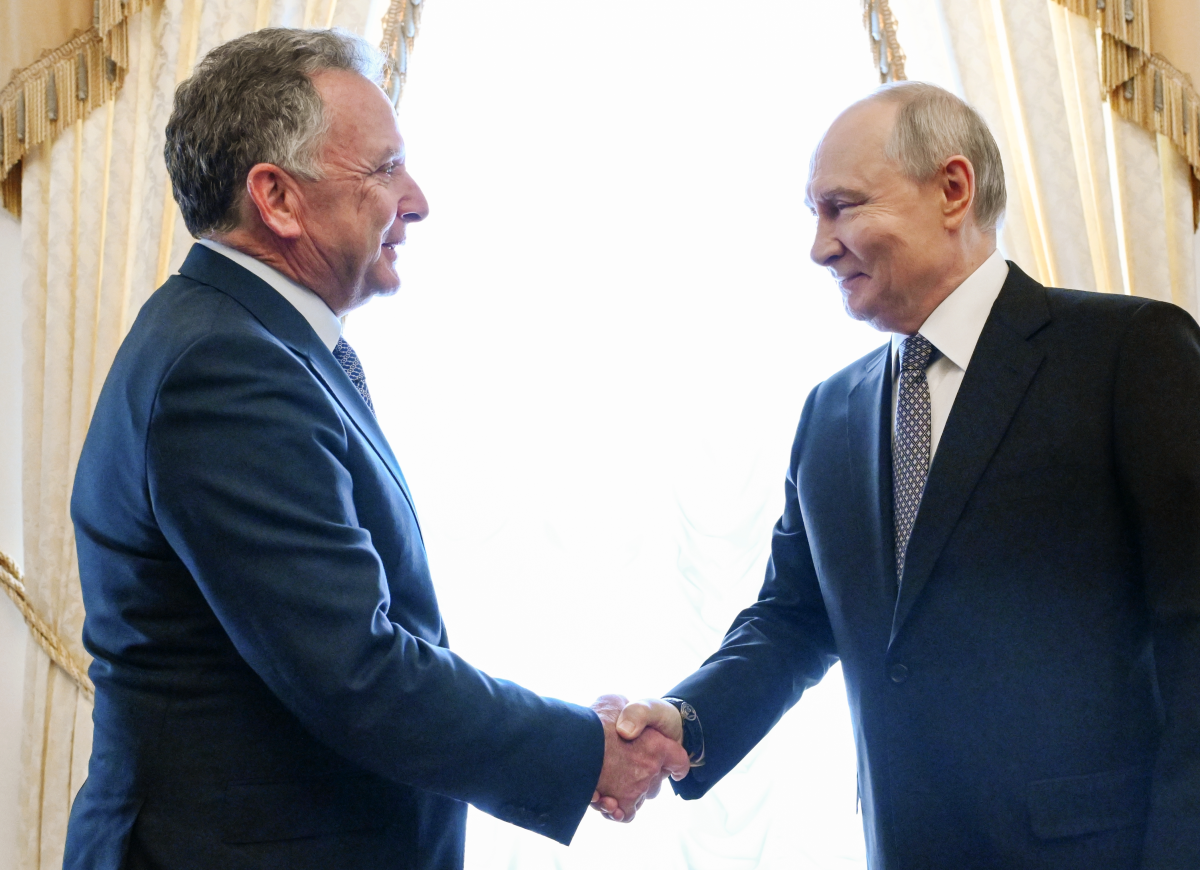
The cold, gray light of a St. Petersburg afternoon fell over a meeting that carried the hopes of millions. When U.S. Special Envoy Steve Witkoff sat down with Russian President Vladimir Putin, the world held its breath, and when he emerged, his words were measured but meaningful. Witkoff, a man whose own life story is rooted in real estate, deal-making, and personal relationships, has been thrown into one of the most difficult diplomatic puzzles of our time: finding a way out of the war in Ukraine. Yet on this Wednesday, he said something that felt like the first crack of daylight in a very long night. There is, he explained, a “foundation” now in place, a groundwork of possibility, something solid enough to build upon. He had come to Russia after a “constructive” meeting with Ukrainian President Volodymyr Zelensky in Norway the day before. The shuttle diplomacy had been relentless, full of long flights, short sleeps, and carefully chosen words, but now, for the first time in a long time, there was a sense that the pieces might be coming together. Humanly speaking, it was the difference between staring at a pile of bricks and imagining a home—not yet built, but no longer impossible.
To understand why those words mattered, you have to know the weight they carried. The war in Ukraine has been a slow-burning disaster, measured in shattered towns, blacked-out cities, and the quiet grief of families separated by front lines and closed borders. For nearly three years, the conflict has consumed young lives, drained economies, and hardened hearts on all sides. Every day of fighting means another mother somewhere learns her child will not come home. Every missile strike is not a map coordinate or a news ticker but a screaming, terrifying moment in a person’s life. So when a diplomat speaks of a “foundation,” he is not speaking in abstract policy terms. He is speaking about the possibility of a mother seeing her son walk through the door again. He is speaking about the chance for a child to grow up without the sound of air raid sirens. The Kremlin’s spokesman, Dmitry Peskov, said that all of Witkoff’s proposals would be studied by Putin, which may sound like diplomatic routine, but in the strange, high-stakes world of international relations, it was a signal: Russia was not shutting the door. The fact that such a statement was made through the state news agency Tass only added to its weight. It was a formal, deliberate acknowledgment that something had changed in the tone between Washington and Moscow.
There was another detail, small but profoundly human, that illustrated the strange intimacy of diplomacy during wartime. Putin, according to the reports, asked Witkoff to express his “sincere gratitude” to U.S. President Donald Trump and First Lady Melania Trump for their efforts regarding Ukraine. It is easy to forget, in the cold language of official statements, that these negotiations are carried out by human beings, with egos, emotions, and personal histories. Putin and Trump have had a complicated relationship over the years, one that has swung unpredictably between mutual admiration and sharp criticism. And yet here, in the middle of a brutal war, there was a moment of personal courtesy, a request that a message be carried across the ocean, like a note passed in a classroom between two wary students. Melania Trump’s name being included is also a reminder that there are always people behind the scenes, unseen but present. It is not unusual for leaders to acknowledge the families of their counterparts, but it takes on a special resonance when war is the backdrop. The gesture, while small, softens the image of Putin as an unrelenting adversary. It reminds us that even in the most painful conflicts, there is room for courtesy, or at least the performance of it. In a world starved for good news, even a fine, diplomatic formality can feel like oxygen.
The human dimension of these developments became even more striking with the news that Russia had agreed to release Stephen Hubbard, a 74-year-old American citizen. Hubbard, a former teacher from Michigan, had been sentenced in 2024 to six years and ten months in a Russian prison on charges of allegedly fighting for Ukraine. His case was not a global headline every day, but behind the legal language were the very real details of an old man, far from home, spending his later years in a Russian prison, surrounded by a language and a system he may not have fully understood. For his family, the news of his release was not just a diplomatic bullet point; it was a lifeline. Imagine the sleepless nights, the phone calls to lawyers, the desperate searching for any scrap of information. Imagine the birthday and holiday dinners with an empty chair. Then, on that Wednesday, Putin himself said that Hubbard had been taken to St. Petersburg’s Pulkovo Airport. That simple sentence—so quiet, so matter-of-fact—would have sounded like thunder to the people who love this man. The image of a 74-year-old walking through an airport terminal, perhaps blinking in the unfamiliar brightness of freedom, is one that breaks the heart in the most beautiful way. It is impossible to know exactly what his life had been like inside, or what he endured, but his release is a reminder that prisoners are not just legal categories; they are fathers, brothers, teachers, and friends.
The combination of these two events—the conversation about a ceasefire and the release of an American prisoner—signals that something important is happening behind the scenes. In the theater of international conflict, gestures are never purely altruistic. Prisoner releases and humanitarian gestures are often used as confidence-building measures, ways to test the waters before larger, more difficult negotiations. Russia’s decision to free Hubbard may be a goodwill gesture, a calculated exchange, or simply a recognition that holding a 74-year-old teacher was more trouble than it was worth. But regardless of the calculation, the effect is real: it creates a small, precious reservoir of trust. The word “foundation” was chosen carefully by Witkoff, a man who understands construction metaphors. Before you can build a permanent structure, you need a solid base, and a ceasefire is nothing if not a structure that must support the weight of everything that comes after it—negotiations, reconstruction, reconciliation. The fact that Witkoff met with Zelensky first, and then with Putin, suggests a deliberate strategy of maintaining balance, of showing both sides that the United States was listening to each of them seriously. It is a delicate dance, one that has been tried before and often failed, but this time there seemed to be a little more rhythm in the steps.
As the evening news began to spread these fragments of possibility, ordinary people were left to wonder what would come next. The world has been burned too many times, by ceasefires that collapsed into renewed violence, by grand announcements that faded into silence. And yet, there is something stubbornly human about hope. We need it the way we need air. We look at a man like Witkoff, who could have stayed in the comfort of his ordinary life, but instead chose to fly across the world, sit in rooms with powerful and dangerous men, and ask them to choose peace. We look at a man like Zelensky, who has become the face of resistance, weary but determined. We look at Putin, sitting in his office, studying proposals, sending private messages of thanks. And we look at a 74-year-old Michigan teacher, finally on a plane out of Russia, heading home. The stories of nations are made of these individual human stories. The ceasefire is still not a fact; it is only a foundation, a first stone. There is a long road ahead, with many traps. But for a brief moment, on a Wednesday afternoon, the world was allowed to believe that peace might be possible. It is a modest hope, but after so many dark days, a modest hope is enough to light the way. This is a developing story, and more will follow, but the direction, for now, seems to be toward the light.