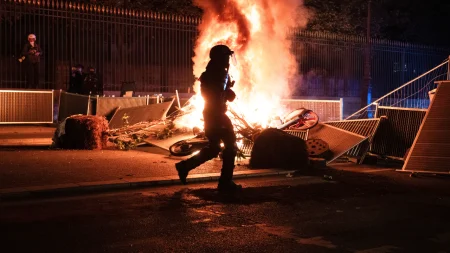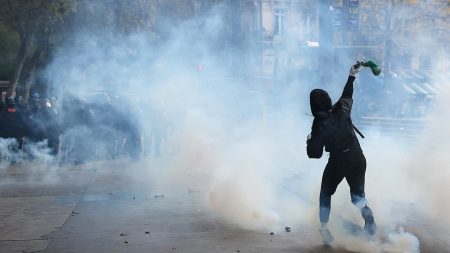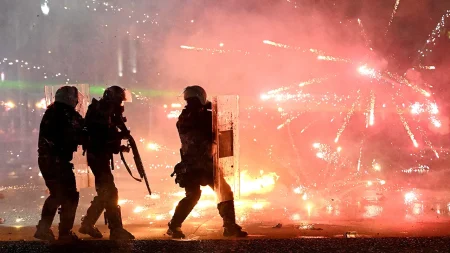



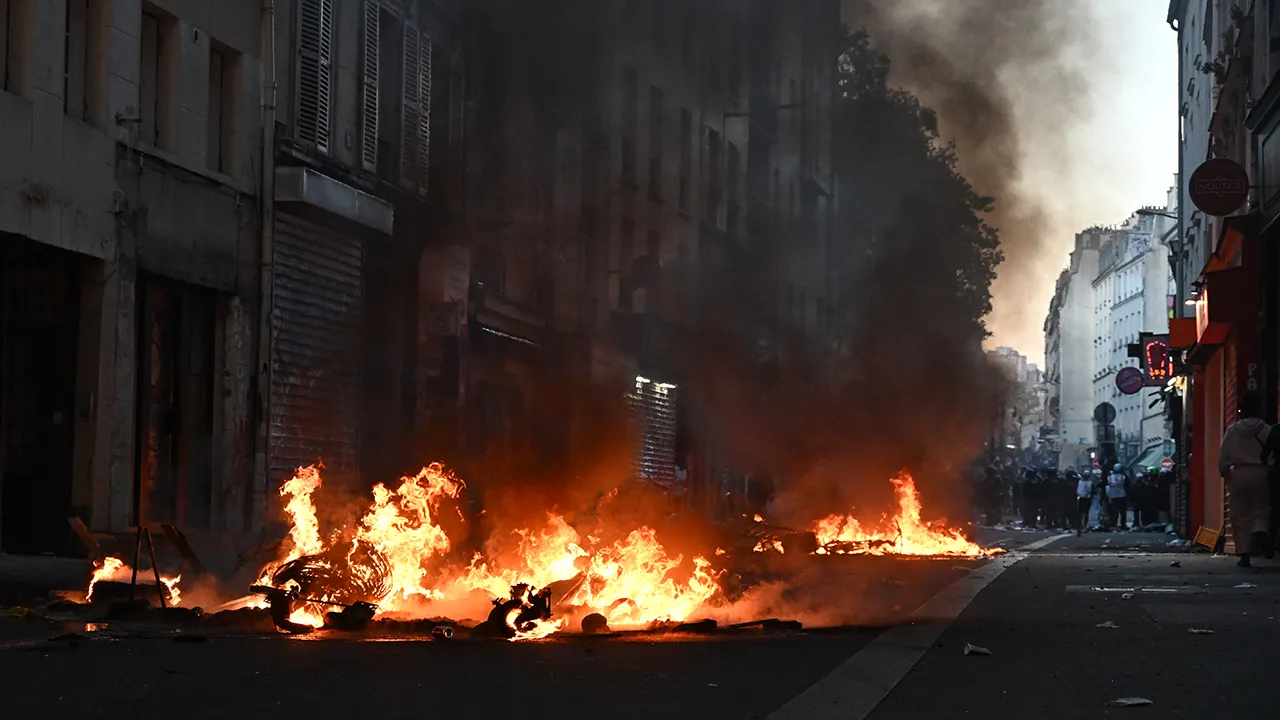
I have spent decades covering protests in France, and for nine of those years I lived in Paris, so I know something about the French way of anger. The French are remarkably skilled at taking politics to the street; they have turned barricades, banners, and burning cars into a kind of national art form. Over the years, I have watched students march, farmers blockade highways, and workers shut down refineries, always with a sense that beneath the chaos there was some recognizable logic, some deeply French sense of grievance. But this time, as I walk through the neighborhoods I once knew, I feel something different. The city is scarred. Storefronts are boarded, cars are overturned, and the air is heavy with the smell of smoke and tear gas. When I stopped at a brasserie near the Place de la République, the waiter looked at me and asked if I was an American journalist. When I said yes, he nodded and said, “So you’ve come to cover the civil war.” I laughed at first, but he wasn’t laughing. And neither were the people around him. Officials and analysts keep saying that this wave of unrest is different from the ones before, and I believe them. The anger is deeper, the violence is more brutal, and the feeling of a country losing its grip on itself is hard to escape.
The numbers tell a story that is impossible to ignore. During the last weekend of clashes alone, roughly 2,500 people were arrested. Around a thousand police officers were injured, some seriously, and many activists were hurt as well. More than three thousand businesses were attacked, looted, or trashed, and the estimated damage has already passed one billion dollars. But what struck me most were the targets. This was not just about shop windows and burning cars. The rioters went after the symbols of the French state itself. They attacked a historic city hall in Limoges, a police headquarters in Marseille, and a major tourist office in Lyon. These buildings are not random; they are the faces of the republic, the places where citizens go to be served, to be protected, to feel that the government is present. Watching them go up in flames, or seeing their windows smashed and their doors broken, felt like watching a country devour itself. Behind every number is a person, and I cannot forget that. The shopkeeper who spent his life savings building a little bookstore and watched it burn in minutes. The police officer who goes to work every morning knowing he may be attacked simply for wearing a uniform. The mother who wonders if her teenage son will come home tonight or end up in a jail cell. These are not abstract statistics. They are the raw materials of a national tragedy, and they are still unfolding.
What makes this moment so unsettling is how difficult it is to define. The protests began with legitimate concerns from students and with the economic fears of working-class and middle-class families who feel left behind by a changing world. Those concerns are real, and they deserve to be heard. But somewhere along the way, the movement was hijacked by people who do not want reform; they want chaos. There are anarchists, there are troublemakers, and there are opportunistic young criminals who see a broken window as an invitation to steal. Yes, there are immigrants and foreigners in the crowds, and there are people with ties to the so-called ultra-left, but this remains a very French uprising, and in a way that makes it even more disturbing. The French have always known how to protest with passion and conviction, but this feels different, more nihilistic, more detached from any concrete demand. It is as if the anger itself has become the only message. The movement has no single leader, no clear list of demands, and no obvious endpoint. It is a fire that feeds on itself, and nobody seems to know how to put it out. I have covered yellow vests and student strikes and pension battles, and in each of those movements I could see the outlines of a dialogue, however violent, between the people and the state. Here, the dialogue has collapsed into static, and the only thing that remains is the sound of breaking glass.
Nearly ten years of Emmanuel Macron’s presidency have left this country more divided than I have ever seen it. Macron came to power as a promise of renewal, a young leader who would modernize France and heal its wounds. Instead, many people feel that he has only deepened the cracks. The working class feels abandoned. The middle class feels squeezed. The young feel that their futures have been stolen from them. Promises have been made and broken, and the anger that was always simmering beneath the surface has finally boiled over. What is particularly troubling is that the authorities have admitted that there were moments when parts of Paris and other cities were simply out of control. The police were overwhelmed. Shop owners were left to defend themselves with broomsticks and chairs. In some neighborhoods, the state simply disappeared for hours, and people had to make a choice: hide, run, or fight. That kind of experience leaves wounds that do not heal quickly. It also leaves a dangerous question in people’s minds: If the government cannot protect us, who can? The confidence that holds a democracy together, the quiet trust that the system will eventually respond to the ballot box, is hard to rebuild once it is shattered. And in France right now, that trust is lying in the rubble.
I have covered enough French politics to know that every crisis is also an opportunity, and the politicians are already circling. On the left, there is sympathy for the protesters, or at least a strategic embrace of their grievances. On the right, there are demands for order, for the army, for a crackdown that will restore the republic. Both sides are using the chaos to attack those in power, and with presidential elections only six months away, timing is everything. The current government, aware that the treasury is bare and that there is no money to buy peace with promises, is betting on security. The prime minister, Lecornu, has announced a massive police operation for the next planned protest, backed by the military. He has warned activists that they will have to choose between violence and the French republic. It is strong language, the kind of do-or-die talk that plays well with voters who are afraid to leave their homes. But it does not address the underlying problems. It does not explain why so many young people feel that they have no stake in society. It does not fix the broken schools, the struggling neighborhoods, the sense of injustice that drives people into the streets. You can deploy a thousand officers and still not solve the problem of a generation that feels invisible. You can fill the prisons and still not empty the hearts of those who believe the system is rigged against them.
And so France finds itself at a crossroads, not just for its own sake but for the sake of the world. Everyone is watching Paris because France has always been a mirror for the tensions of the modern age. The inequality, the dwindling resources, the distrust of institutions, the rise of social media rage, the feeling that the old rules no longer apply; these are not exclusively French problems. They are global problems, and France is simply the place where they have chosen to explode. What happens here in the coming weeks and months will offer real-time lessons about how to handle a brave new world of discontent. It will show us whether a democracy can respond to chaos with both strength and compassion, or whether it will simply choose repression and hope for the best. It will also test the resilience of the French people, who have been through so much before and somehow always found a way to come back. I have seen the worst of Paris in these last days, but I have also seen small acts of kindness: neighbors helping each other board up windows, strangers offering water to exhausted firefighters, a café owner serving coffee to police and protesters alike. That is the other France, the one that refuses to be defined by its worst moments. So yes, I will be at the barricades, metaphorically at least, watching and trying to understand. And I will be hoping that from the ashes of this strange and frightening uprising, France can find a way to speak to itself again, not with fire and fury, but with the voice of a republic that still believes in its own future.