


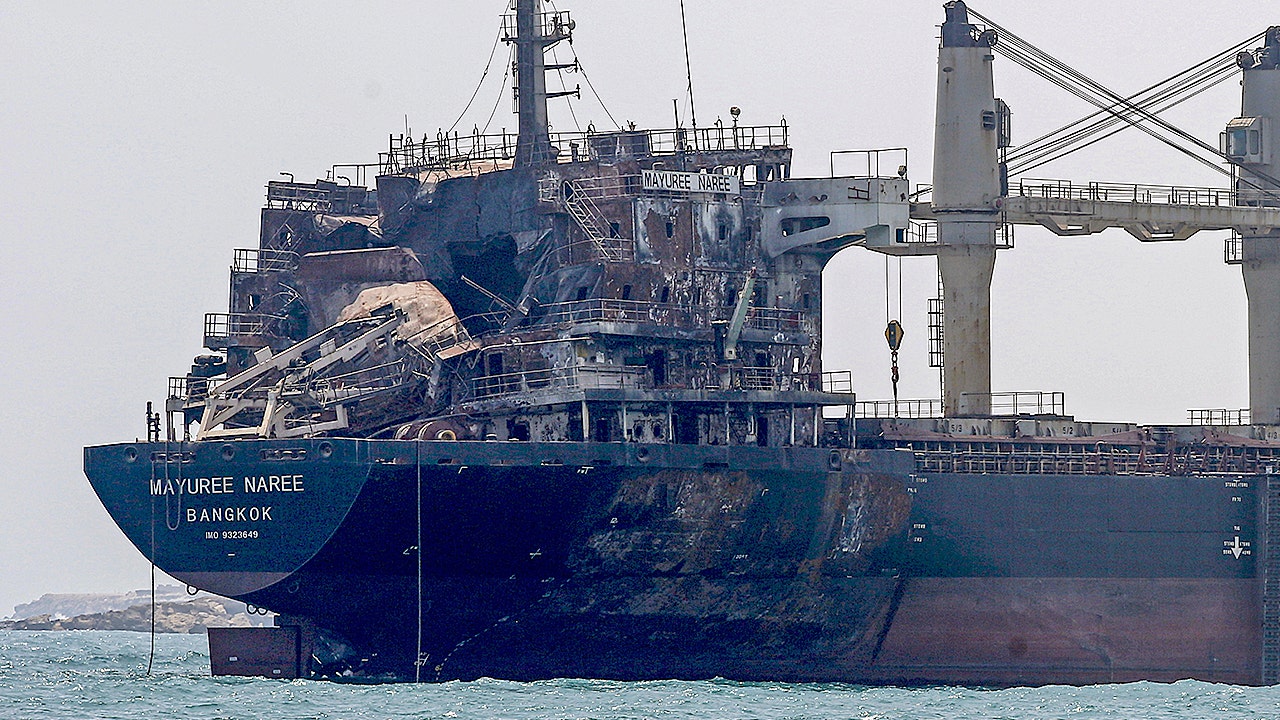
The Strait of Hormuz, a narrow ribbon of water separating Iran from the Arabian Peninsula, has long been understood as one of the most strategically important and volatile maritime passages on Earth. Roughly one-fifth of the world’s total petroleum consumption moves through this chokepoint, making its safety a matter of global economic stability rather than merely regional concern. That delicate balance was shaken again on October 17, when Iran reported that two oil tankers caught fire after striking naval mines while transiting the strait. The incident, carried by Iran’s official Islamic Republic News Agency, immediately triggered fresh alarms about the security of the waterway and the safety of the mariners who navigate it. The two vessels were reportedly carrying a combined total of around two million barrels of crude oil, a staggering cargo that underscores how much is at stake in these waters. The reports also indicated that the tankers had turned off their positioning and radar systems and were attempting to use a route through the strait that Iran had not authorized. One of the vessels was left immobilized after the strike, drifting in dangerous waters while the world watched and waited for clearer information. The episode was not an isolated incident but rather the latest symptom of a broader and increasingly dangerous confrontation unfolding in and around the strait, one that has drawn in the International Maritime Organization, the United States, and Iran’s Islamic Revolutionary Guard Corps.
As the situation developed, the International Maritime Organization stepped forward with a stark and sobering warning. The IMO’s Secretary-General, Arsenio Dominguez, told Fox News Digital that sea mines continue to pose a serious threat to vessels navigating the strategic waterway, and that despite ongoing conflicts, the organization cannot guarantee safe passage. “The traffic separation scheme, the information that we have is that they still have mines. And of course, whilst the conflict is ongoing, it’s very difficult for us to use third parties to verify that it is clear of these hazards,” Dominguez explained. “So in the meantime, we cannot guarantee that a vessel that intends to transit that route will not be hit by a mine.” His words carried an unusual weight, because for decades the safety of shipping through the Strait of Hormuz has rested on a traffic separation scheme adopted by the IMO in 1968. That scheme established a single, internationally recognized route that appears on navigational charts and is used by commercial vessels moving through the strait. It was designed to prevent collisions and provide predictable, orderly passage in one of the world’s most congested and dangerous waterways. But now, with mines reportedly scattered through the area and no independent means of verifying their removal, that route can no longer be considered safe. Dominguez was blunt about the situation, emphasizing that there is only one route that should be used for transit, but that it is currently not clear of mines, and therefore not safe.
Amid this uncertainty, Iran has continued to maintain its own separate shipping corridor inside its territorial waters, a pathway that imposes tolls and safety fees administered by the Islamic Revolutionary Guard Corps. This parallel route, according to Tehran, is a temporary measure created because of the ongoing conflict and the dangers posed by the main shipping lane. But Washington and the IMO have rejected it as inconsistent with international maritime law, and the organization has not given it any official recognition. Dominguez explained that any new route must go through the established mechanisms of the IMO, with member states reviewing and approving it. “We have received communication from Iran to use that route because of the conflict,” he said. “That’s the way that it’s been presented. But anything for us to approve needs to go through the mechanisms at the international maritime organizations and the member states need to review it.” In practical terms, this means that commercial shipping operators are left in a deeply uncertain position. They can choose to follow the old, IMO-approved route, risking the possibility of mines, or they can follow Iran’s unofficial corridor, accepting tolls and potentially violating international norms. Neither option offers the kind of clear, lawful, and safe passage that shipping companies have relied on for decades. The human dimension of this crisis is significant: thousands of sailors, engineers, and officers find themselves caught between geopolitical tensions, unsure whether their next voyage through the strait will be their last.
The October 17 incident itself was a grim reminder of how quickly that uncertainty can turn into catastrophe. According to Iran’s state media, the two oil tankers were attempting to cross the Strait of Hormuz when they struck naval mines and caught fire. The vessels were reportedly carrying roughly two million barrels of crude oil, a massive amount of flammable cargo that made the danger of fire and environmental disaster even more acute. Iranian officials said the tankers had disabled their positioning and radar systems and tried to use a route through the strategic waterway that had not been authorized by Tehran. The second tanker, according to reports, was left immobilized after the strike, unable to move and vulnerable to further attacks. The incident followed a broader pattern of escalating violence in the region. Over the past two weeks, attacks on commercial vessels around the Strait of Hormuz have surged, with senior Iranian officials telling Reuters that Tehran has shifted its strategy for how it targets ships. The exact nature of that strategy remains murky, but the effect is clear: shipping companies are becoming increasingly wary of sending their vessels through the strait, and insurers are likely raising premiums accordingly. The economic consequences are already rippling outward, threatening to raise energy prices and disrupt supply chains in a world that is still recovering from years of turbulence.
The diplomatic front, meanwhile, remains stalled and deeply fragile. Negotiations between Washington and Tehran over ending the conflict and restoring normal maritime traffic have made little visible progress. Mohsen Rezaei, secretary of Iran’s Supreme National Security Council and a former commander of the Revolutionary Guard, said Tehran considered Washington’s latest response to negotiations “insufficient.” He indicated that the United States had accepted some of Iran’s seven conditions but that other issues remained unresolved. Rezaei added that Tehran was no longer responding to Washington and that the United States needed to clarify the outstanding matters if any further progress was to be made. Iranian Foreign Minister Abbas Araghchi, speaking in Baghdad, offered a slightly more detailed picture. He said that Tehran had submitted a proposal to Washington through Qatar, which is mediating the negotiations, outlining conditions under which the Strait of Hormuz could reopen and normal maritime traffic resume within seven days. “Our situation is clear and based on the seven-day proposal presented to the US. They shared comments which we are reviewing, but our proposal is still on the table and if there is any honesty on the US part, which there isn’t, the way to reopening the Strait of Hormuz is obvious,” Araghchi said. His remark, laced with skepticism toward American intentions, reflected the deep mistrust that continues to poison any attempt at diplomacy. The seven-day proposal, if genuine, would represent a potential off-ramp from the current crisis, but the unresolved conditions and the lack of direct communication make it difficult to see how it might be implemented.
In the absence of a diplomatic breakthrough, the immediate future of the Strait of Hormuz remains bleak. Dominguez, speaking for the IMO, made clear that the waterway is not open for business in the way it was before the conflict began. “Our role right now is to prepare for when we have the opportunity to go back, resume the operations, follow all the procedures at IMO, but not until the root causes are addressed and those are beyond IMO,” he said. That statement captures the painful reality of the situation: the international organization responsible for the safety and regulation of global shipping can prepare the groundwork, but it cannot resolve the underlying political and military tensions that have made the strait so dangerous. The root causes lie in Tehran, Washington, and the broader strategic rivalry that has turned the region into a powder keg. Fox News Digital reached out to U.S. Central Command for comment, but no response was provided at the time of publication. For the sailors on the ships, the executives in the shipping companies, and the consumers around the world who rely on the energy that flows through this narrow waterway, the crisis is far from abstract. Every day that the mines remain, every unauthorized corridor that Iran imposes, and every negotiation that stalls brings the world closer to a catastrophic maritime disaster. The Strait of Hormuz has always been a place where global pressures converge, but right now it is also a place where the ordinary business of moving oil from one part of the world to another has become a dangerous gamble with lives and livelihoods on the line.