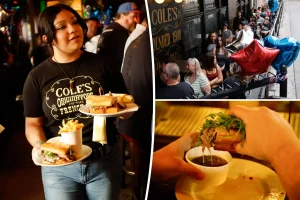


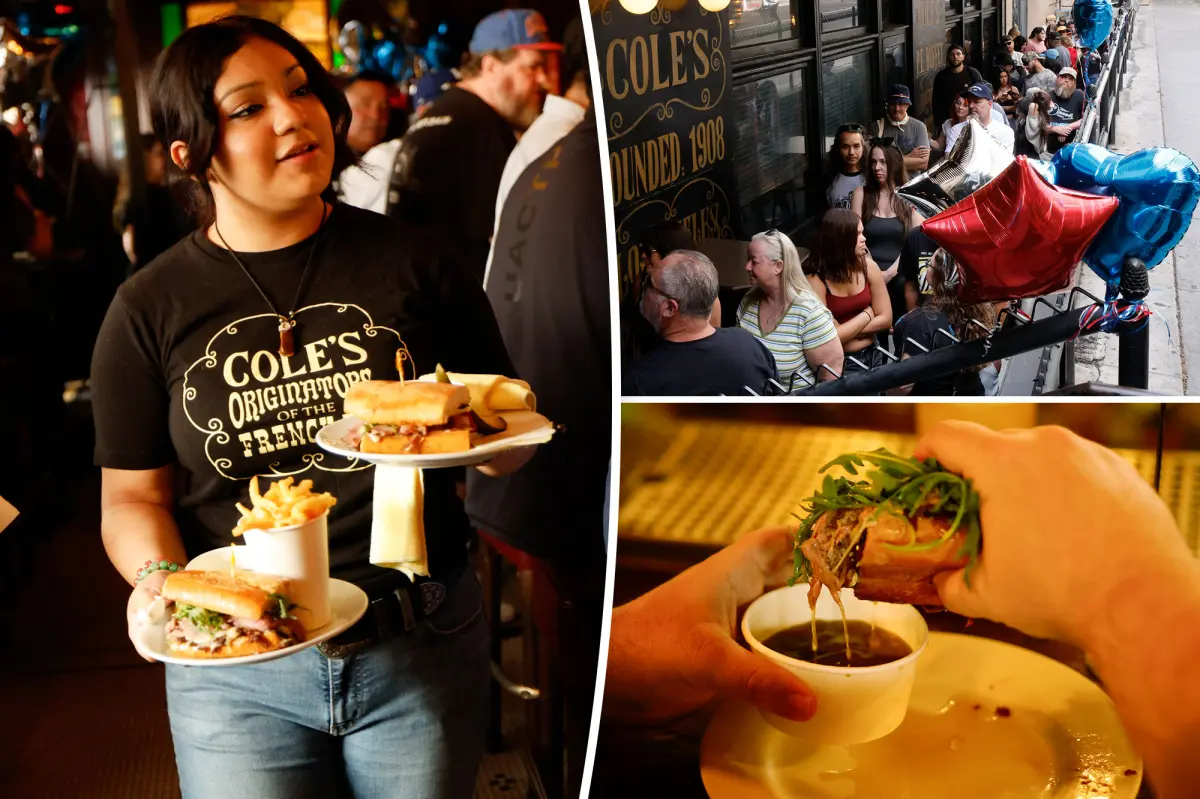
Los Angeles has never been a city that lingers. It demolishes, rebuilds, reinvents, and moves on faster than almost anyplace else in America. That is why the survival of Cole’s French Dip for 118 years felt like a small miracle, a stubborn, grimy anchor in the shifting tides of downtown. For over a century, this legendary spot served its famous French dip sandwiches to everyone from power brokers to drifters, from gangsters to poets, and it claimed, with fierce local pride, to have invented the sandwich itself. So when Cole’s served its last meal in March, after the weight of rising costs and a changing city finally became too heavy, it seemed as though another piece of old Los Angeles had vanished forever. The announcement hit the city like the end of an era, and loyal customers packed the block, waiting in lines that curved around the corner, desperate for one final taste of au jus, one last look at the worn wooden booths and the ceiling that had witnessed so much history. It felt like goodbye. And then, just as suddenly as the doors closed, word came that Cole’s was coming back. Not as a museum piece, not as a relic preserved under glass, but as a reborn, reinvigorated version of itself, with new owners, a new vision, and a surprising amount of ambition. The old downtown landmark is scheduled to rise again as soon as November, and while the details are still unfolding, the news has already ignited a strange and hopeful mixture of excitement and anxiety. Can a place so steeped in grit and nostalgia reinvent itself without losing its soul? That is the question hanging over the French dip as Los Angeles waits to see what happens next.
The people behind the resurrection are hospitality entrepreneur Jeremy Fall and former Mozza Restaurant Group executive Sean Maloney, and they are not approaching this as a simple restoration project. They are aiming for something far more ambitious: a transformation that keeps the beating heart of the old Cole’s while giving it the polish and glamour needed to survive downtown’s brutal restaurant landscape. Their inspiration is a curious mashup of influences, part New York’s impossibly exclusive 4 Charles Prime Rib, part the buzzy French bistro Pastis, and part Hollywood’s eternal Musso & Frank Grill. The goal seems to be a place that feels both timeless and trendy, a spot where you could imagine a modern celebrity sitting next to a ghost of the past, where the cocktails are impeccable and the history is thick enough to taste. They are promising to preserve the gritty, old-school charm that made Cole’s beloved, but they are also bringing in white tablecloths, elegant French fare, and a level of polish that the old dive-bar iteration never had. It is a bold bet, especially in a city where restaurants close with alarming regularity, and where downtown LA has become something of a bloodbath for the hospitality industry. But Fall and Maloney seem to believe that a little luxury, combined with a heavy dose of nostalgia, can succeed where the old business model eventually failed. They are betting that people will come not just for the sandwich, but for the experience, the story, the sense of stepping into a living piece of history that has somehow been made beautiful again.
The menu itself reflects this careful balancing act between old and new, humble and extravagant. The French dip sandwich, the eternal star of the show, will remain, but it is getting an upgrade that would have seemed unimaginable in the old Cole’s. The beef will be dry-brined prime rib, the au jus will be simmered for twenty-four hours until it is deep, rich, and almost intoxicating, and the bread will come from trendy Los Angeles bakery Clark Street Bread, a custom-made roll designed to hold up to the dipping without falling apart. This is not the quick, sloppy sandwich of memory; it is a refined, carefully considered version of itself, respectful of the past but dressed for a night out. Around it, the new menu will reportedly include fresh ravioli, prime rib frites, and salmon crowned with trout roe, dishes that sound more like a French bistro than a downtown dive. There is even talk of an au jus-infused martini, a cocktail that seems designed to make traditionalists raise an eyebrow and adventurous food lovers salivate. It is a strange, compelling vision: the old Cole’s as a place where you can still get your hands messy with a French dip, but also where you might celebrate an anniversary, impress a date, or feel as though you have stumbled into a party that has been going on for over a century. The danger, of course, is that in polishing the roughness, something essential might be lost. But the new owners are clearly hoping that the sandwich, the history, and the atmosphere will be enough to keep the spirit alive, even under the white tablecloths.
For all the changes, there are signs that the new owners understand exactly what made Cole’s special in the first place. They are not trying to sanitize the past; they are trying to honor it. The famous plaque above one of the urinals in the men’s room, the one that proudly declares “Charles Bukowski pissed here,” will remain, a defiant little monument to the restaurant’s irreverent, literary, hard-drinking history. That single plaque says more about the old Cole’s than any marketing campaign ever could. It is a reminder that this was not just a restaurant; it was a refuge for misfits, a place where the rules of polite society did not quite apply, where a poet could sit alone at the bar and a gangster could conduct business in the corner without anyone asking too many questions. The new owners have made it clear that they want to preserve that colorful past, even as they drag the place into a more polished future. Some things will change, of course. The pool tables have been removed to make way for additional dining space, a decision that will surely break the hearts of longtime regulars. But vintage-style ceiling tiles are being added, along with a piano, touches designed to give the space an old-world elegance that feels both familiar and fresh. The hope seems to be that Cole’s can become the kind of place where the ghosts of the past feel welcome, but where a new generation of diners will also feel at home. It is a delicate dance, and it remains to be seen whether the magic of the old space can survive the renovation.
The fact that Cole’s is getting this second chance at all is remarkable, especially considering the circumstances that led to its closure. The restaurant’s previous owner, Pouring With Heart, announced last summer that the place was on its last legs, hammered by rising labor and insurance costs, the lingering fallout of the pandemic, and the devastating effects of the Hollywood strikes that emptied downtown Los Angeles of its usual crowds. For a restaurant that had survived 118 years, through wars, depressions, changing tastes, and endless urban transformations, it was a surprisingly unglamorous way to go: not a dramatic fire, not a scandal, just the slow, grinding pressure of economics and a city that no longer needed it the way it once had. When the news of the impending closure spread, it triggered a sudden frenzy. People who had not thought about Cole’s in years suddenly realized they could not bear to let it go. They lined up down the block, waiting for hours in the California sun, desperate to taste the French dip one last time, to drink one last cocktail in the dim, historic bar, to stand in the presence of something old and real in a city that is constantly erasing its own history. Those final weeks were equal parts celebration and funeral, a strange, emotional farewell from a city that often does not know what it has until it is gone. And yet, even as the doors closed, there was a sense that the story was not truly over. The love that poured out during those final days must have been impossible to ignore, and it surely played a role in convincing the new owners that Cole’s was worth saving.
Now, as November approaches, the next chapter of this extraordinary story is about to begin. The new Cole’s will be different, no question about it. The white tablecloths, the fancy French dishes, the au jus martini, the refined prime rib, the beautiful custom bread from Clark Street Bakery; all of these represent a significant departure from the rough, worn, dive-bar charm that defined the place for so many years. There are real risks. Some longtime patrons may feel that the soul of Cole’s has been smoothed over, that the grit has been scrubbed away in favor of something more marketable. Others will argue that this is the only way to save a historic institution, that a little reinvention is better than extinction, and that a Cole’s that evolves is infinitely preferable to a Cole’s that disappears entirely. The truth is probably somewhere in between. What cannot be erased is the simple fact that the restaurant will still be there, standing in the heart of downtown Los Angeles, serving French dips and pouring drinks, with the Bukowski plaque still hanging in the men’s room and 118 years of memory soaked into the walls. In a city that is always looking forward, always tearing down and rebuilding, there is something almost defiant about a place that refuses to die. Cole’s has outlasted gangsters and poets, economic crashes and pandemics, Hollywood strikes and changing neighborhoods. It has earned the right to try something new. And when those doors finally reopen, when the smell of au jus fills the air once more, Los Angeles may just find that its old friend has come back to life, older, wiser, a little more elegant, but still ready to feed the city’s hungry, lonely, and hopeful souls, one French dip at a time.