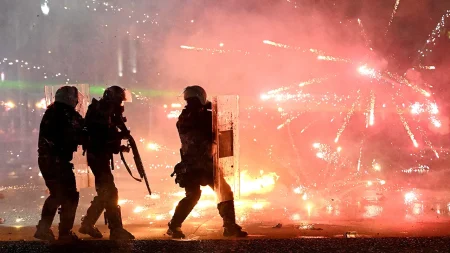



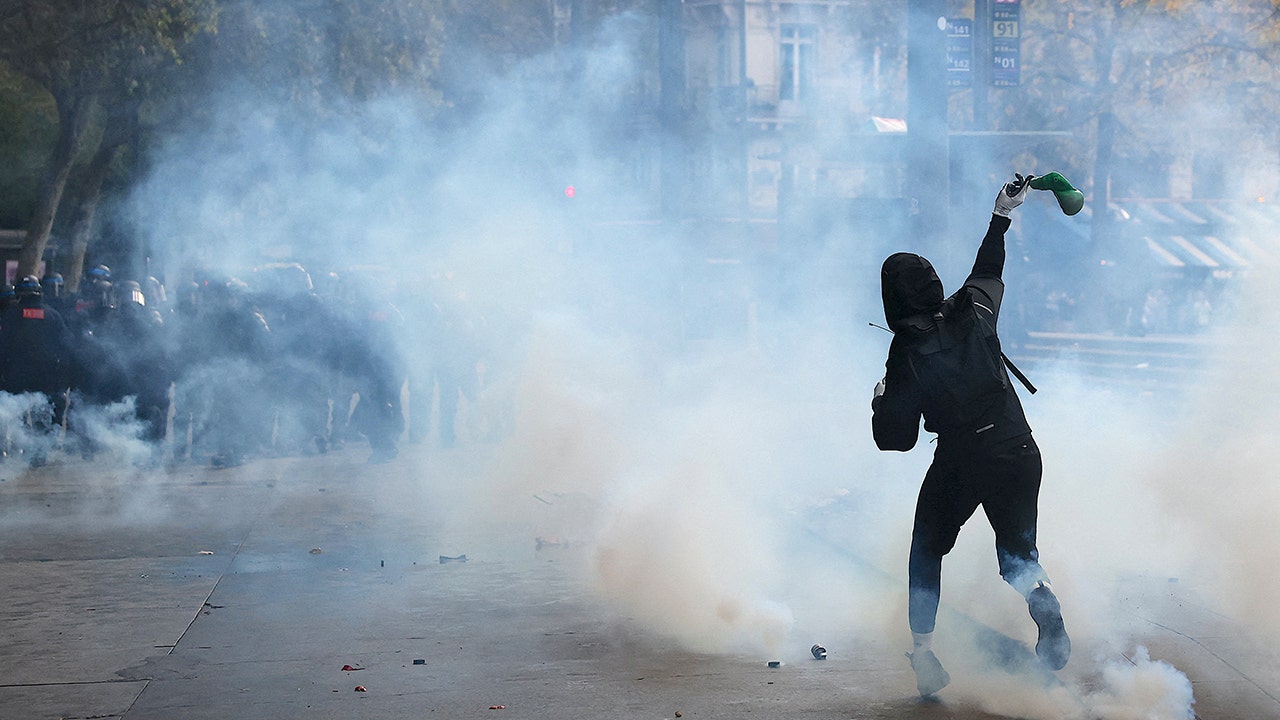
Across Europe this week, the images have been impossible to ignore: cars reduced to smoking metal, plumes of smoke rising over elegant boulevards, and the facades of centuries-old buildings glowing orange in the night. From Paris to Rome, the violence has triggered alarm, condemnation, and the familiar ritual of political finger-pointing. But in Budapest and Warsaw, something more calculated is happening. Leaders there are not simply wringing their hands or offering sympathy; they are taking notes and sharpening their arguments. Hungary’s Péter Magyar and Poland’s Prime Minister Donald Tusk have both seized on the unrest not to address the rioting itself, but to redefine Europe’s migration debate on their own terms. As Italian Prime Minister Giorgia Meloni condemned “gangs of thugs” after protests turned violent in her own country, Magyar posted on X that “Europe can count on Hungary,” adding that the destruction should make clear “why Hungary advocates the strictest possible approach to migration, and why we will not weaken our border protection or immigration policy under any pressure.” Tusk was just as blunt, writing: “Poland will not repeat the mistakes of other European countries, nor will it pay for them.” The message from Central Europe is unmistakable: the chaos on Western European streets is not a random outbreak of violence—it is a warning, and they intend to prove they have learned the lesson. The subtext is not lost on anyone watching. For years, Western European leaders lectured Central Europeans about human rights and solidarity, telling them to open their hearts and borders. Now, as smoke rises from Paris and Rome, those lectures feel like distant memories. In Budapest and Warsaw, the reaction is less “there but for the grace of God” and more “we tried to warn you.”
Underneath the rhetoric is a hard set of numbers that Central European leaders are using as ammunition. Eurostat, the European Union’s official statistical office, shows that France is home to nearly 10 million foreign-born residents, while Italy has about 7 million. Poland, by contrast, has roughly 1 million foreign-born residents, about half of them from neighboring Ukraine, and Hungary reports fewer than 700,000, most born in other EU countries. For those who see mass migration as a threat, these figures tell a simple story: countries that opened their doors widely are now reaping chaos. The crime statistics, at least on paper, seem to reinforce the point. In 2024, France reported 304,900 police-recorded offenses, among the highest totals in the EU; Italy reported 142,600. Poland recorded 57,300, and Hungary just 28,600. Eurostat’s 2023 “perception metric,” which measures how many people report crime or vandalism in their neighborhoods, tells a similar story: France was among the highest at about 20 percent, Italy ranged from 14 to 17 percent, while Poland and Hungary sat near the bottom at 6 to 8 percent. None of this proves causation, and correlation is not destiny. But in the emotional arithmetic of politics, perception often outweighs nuance. For leaders like Magyar and Tusk, the lesson is not complicated: strict borders, fewer migrants, safer streets. And both countries have been willing to pay a price for that position, having been fined and sanctioned by EU courts for refusing to open their gates to unchecked immigration; Poland faced sanctions in 2025, and Hungary has long been at odds with Brussels over the same issue. In their telling, the fines are not a punishment; they are a badge of honor. They can point to the numbers and say: the countries that lectured us are the ones with burning cars, while the countries they punished are the ones where people still feel safe.
Political scientists watching this moment say the strategy is as old as politics itself: use the other fellow’s burning house to light your own fire. Daniel Schatz, a Sweden-based political scientist, told Fox News Digital that “burning buildings and looted shops in France and other countries are becoming political ammunition across Europe.” Leaders pushing tougher immigration policies, he said, have a blunt message for voters at home: “This is what we intend to prevent.” Images of chaos, he noted, “can carry more political weight than a hundred policy speeches.” Boštjan Udovič, chair of international relations at the University of Ljubljana’s Faculty of Social Sciences in Slovenia, put the dynamic in historical context. In Central and Eastern European countries, he said, the riots in France are linked to immigration and to the issue of “non-adaptation and non-integration of immigrants.” These countries, he argued, have long understood their national identity as rooted in a single nation, and it would be “unrealistic to expect that countries that fought for their independence based on their national movement would adopt a concept of a multiethnic society.” Schatz summed up the political calculation neatly: “Magyar and Tusk are delivering a blunt message to Brussels. Being pro-European does not mean signing up for liberal immigration policies.” In other words, you can love Europe and still slam the door. This is a crucial shift. For years, the debate in Europe was framed as open versus closed, tolerant versus backward. Now, leaders in Central Europe are trying to flip that framing: they are the ones who want to preserve Europe, its culture, and its safety, while Western capitals are recklessly gambling with all three. The fact that this argument is being made by both an opposition figure like Magyar and a sitting prime minister like Tusk shows how much the political center of gravity has moved.
Neither leader is hiding that message. Magyar, fresh from the European Council summit, said the meeting made clear that “the overwhelming majority of European countries have woken up and want to break with the permissive policies of the past. We hope it is not too late.” He framed the crisis in almost existential terms, declaring that “the Europe we all love is in serious trouble today. It is our responsibility, too, to help preserve our continent as the most wonderful place in the world for our children and grandchildren.” He also expressed solidarity with the French people while drawing a careful line between peaceful protest and criminal violence: “Let there be no doubt: peaceful and lawful protest is one thing; vandalism and violence are quite another. The former is a fundamental right; the latter is a serious crime.” Tusk, for his part, laid out a policy platform that sounded like a campaign speech: “We are firmly defending the border against illegal migration, we have our own asylum policy (we do not accept applications), we deport those who break Polish law. On security issues, we will be relentless.” With Poland’s next parliamentary election due in 2027, Tusk is already entering what Udovič calls “a sort of pre-election campaign where migration will also be an issue.” His potential rival, former Prime Minister Mateusz Morawiecki, is echoing the same themes, posting that “France is burning, and we must be wise before the harm is done,” and promoting his new coalition, Rozwoj Plus, which he says “has a package of comprehensive solutions that will allow Poland to be not only prosperous, but also the safest country in the world!” The fact that both sides in Poland are competing to sound tougher on migration shows just how much the political center of gravity has shifted. Even those who once might have defended a more humanitarian approach now feel they have to at least nod to the fear of open borders. The language of “not paying for other countries’ mistakes” is especially potent in a part of Europe that has historically been treated as a junior partner by Western capitals.
In Hungary, the political calculation is even more delicate. Strict immigration policies enjoy broad support across the country, says Á. Félix Debrenti, a former government official under Viktor Orbán and a current board member of the Hungarian Atlantic Council. He argues that Magyar understands perfectly well that “abandoning Orbán’s tough approach to immigration and border protection could cost him significant political support, particularly at a time when his party is already facing growing pressures.” There is also a strategic advantage in making immigration the focus: “Taking a strong position on immigration allows Magyar to shift public attention away from the government’s domestic challenges and onto an issue where there is a broad national consensus.” The timing is not accidental either. All this comes just days before October 23, when Hungarians commemorate the 1956 Revolution and their fight for freedom against Soviet oppression. In that context, the message of defending Hungary’s borders and sovereignty resonates with deep historical memory. For a country that has spent centuries fighting for its independence—against Ottoman invaders, Habsburg emperors, and Soviet tanks—the idea of surrendering control over who enters the nation feels like a betrayal of the past. The riots in France, in this reading, are not just a warning about crime; they are a warning about what happens when a nation loses its identity, its sense of belonging, and its confidence in its own culture. Magyar’s language, with its invocation of “the Europe we all love,” is carefully chosen: it lets him sound like a loyal European while simultaneously rejecting the liberal, open-border vision that many EU institutions have championed. It also lets him position himself as the true defender of Hungarian interests, not just against migrants but against Brussels, and against any domestic critics who might accuse him of being soft. In a political environment where national sovereignty is sacred, that is a powerful place to stand.
At the end of the day, this is not really about France or Italy. As Schatz put it, “This is all politics is local playing out across borders. The streets are French or Italian; the voters being addressed are Hungarian or Polish.” The rioters in Paris and Rome are not thinking about Magyar or Tusk, but their images are being used to shape elections in Budapest and Warsaw. The historical resonance is powerful: leaders in Central Europe do not even need to invoke King Jan Sobieski, whose allied cavalry broke the Ottoman siege of Vienna in 1683 in a victory long celebrated as the defense of Christian Europe, to cast themselves as protectors of the continent. Burning buildings provide a vivid contemporary backdrop for that message. Whether the numbers justify the narrative is almost beside the point. In the rough-and-tumble of European politics, a single image of a car in flames can outweigh a thousand spreadsheets. And so the migration debate in Europe is being redefined not in Brussels boardrooms but on the streets of Paris and Rome, with every shattered window becoming a political argument, every looted store a warning, and every riot a reason for Central Europe to hold its line. The irony is that the images of burning cars may actually reinforce the very policies that Western European leaders have long resisted. If the riots lead to a political backlash across the continent, the Central European approach may become the model, not the exception. That would be a historic reversal—and one that few could have predicted a decade ago. The question now is whether the rest of Europe is listening—and whether the leaders who have spent years demanding open borders can answer the charge. For the moment, at least, the loudest voices are not in Paris or Rome. They are in Budapest and Warsaw, pointing at the flames and saying: we told you so.