



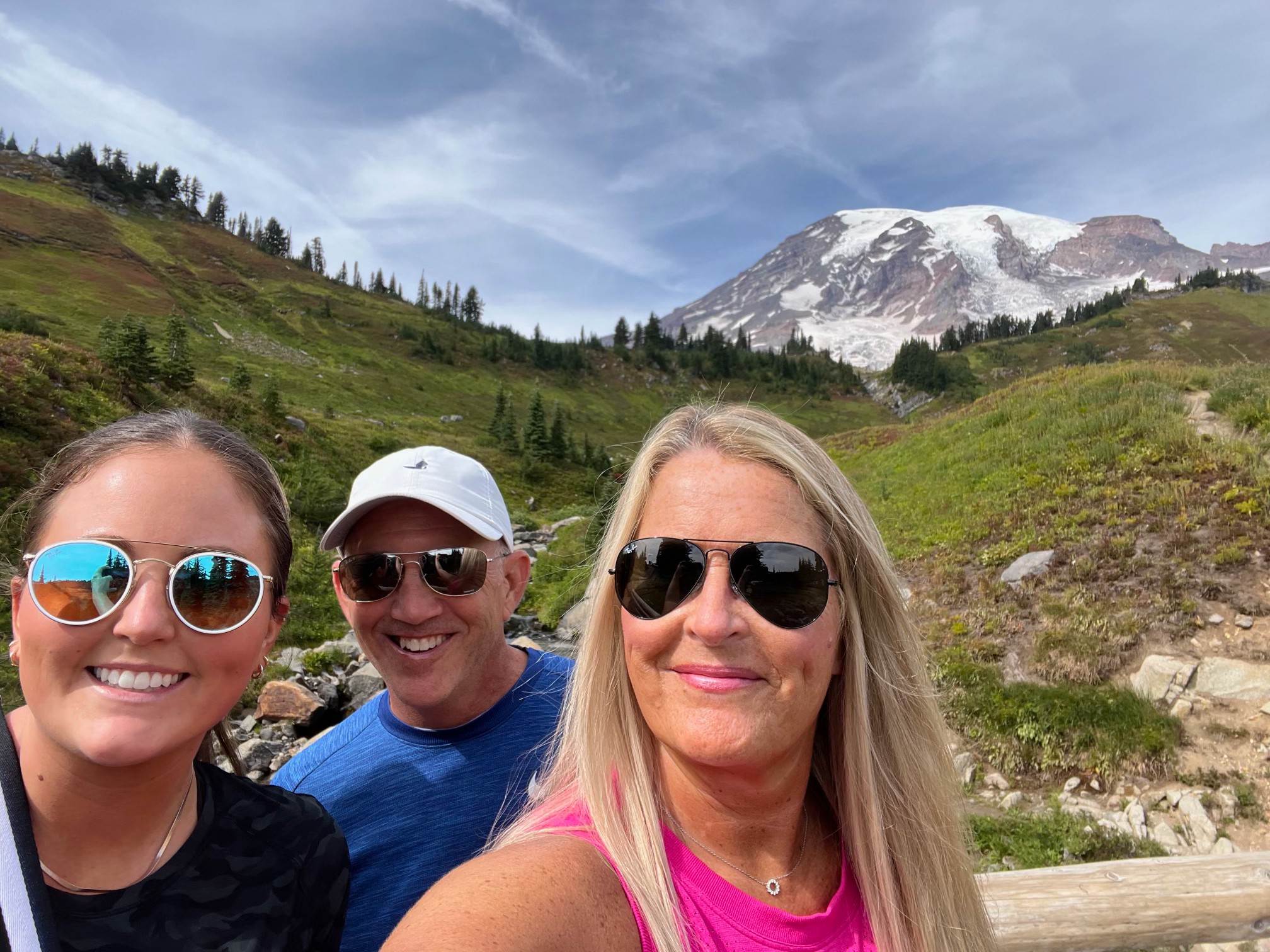
For Deeanne King, the Pacific Northwest is not just where she works—it’s where she found a deeper sense of purpose. When she relocated from Kansas to the Seattle area in 2020, after the merger between Sprint and Bellevue-based T-Mobile brought her to the region, she was struck by the lush forests, the expanse of water, and the sense of possibility that seemed to come with the landscape. As T-Mobile’s executive vice president and chief people officer, King’s official responsibilities center on the company’s workforce, culture, and leadership. But in recent years, she has also become a key voice in the telecom giant’s sustainability efforts, helping to guide a company that has been recognized as one of the greenest in the United States and the world. For King, this work is deeply personal. She has described the outdoors as her “happy place,” and she finds that the region’s lakes, inland sea, and trails are not just beautiful backdrops, but constant reminders of what she and her colleagues are working to protect. At a time when many corporations are quietly scaling back their climate commitments or abandoning their carbon targets altogether, T-Mobile has continued to push forward—and King’s own journey from Kansas transplant to sustainability leader is a reminder that sometimes the most meaningful change begins with a simple appreciation for the world around us.
What gives King the most hope for the planet? Her answer is immediate and heartfelt: people. She says that working alongside some of the smartest, most curious, and most committed people she has ever met has taught her an important lesson: when you put a hard problem in front of people who truly care, they find a way. They challenge the status quo, try new things, learn from their mistakes, and keep going. In her years at T-Mobile, she has never seen her teams walk away from a problem just because it was difficult. That stubborn optimism is at the heart of her sustainability philosophy. She is also encouraged by the growing recognition that sustainability and good business do not have to be at odds. Building more efficiently, using resources more thoughtfully, and reducing waste can make a company more resilient while also being better for the planet. These goals, she believes, can reinforce one another rather than compete. And she sees this mindset in T-Mobile employees every day. People want their work to matter, she explains. They want to contribute to something larger than themselves. When you combine that sense of purpose with ingenuity and a willingness to work together, King says, there is tremendous reason for hope. It’s a perspective that refuses to be paralyzed by the scale of the climate crisis, and instead focuses on the human capacity for creativity and collaboration—a belief that progress is possible when people are given the chance to make a difference.
On a personal level, King’s own environmental journey has been shaped by small, intentional choices. She has become much more deliberate about cutting down on single-use items, and her reusable water bottle is perhaps the simplest example. It goes everywhere with her now. She admits that it sounds small, but that is exactly the point. Once you make one change part of your routine, you begin to notice other opportunities: what you throw away, what you reuse, what you buy, and what you probably didn’t need in the first place. Those small choices, she says, add up. But King is also thinking much bigger than her own habits. When asked which sustainability leader she would choose to have coffee with, past or present, she names Kara Hurst, the chief sustainability officer at Amazon. T-Mobile has joined Amazon and hundreds of other companies in signing the Climate Pledge, a commitment to reach net-zero carbon emissions by 2040. And there is something Hurst has said about that work that resonates deeply with King: “We cannot go at this alone.” King wholeheartedly agrees. The biggest challenges facing the planet are not going to be solved by one company, one industry, or one brilliant person. They require finding common ground, sharing lessons learned, and working together toward something bigger than any single organization. King would love to sit down with Hurst and compare notes on what’s working, where they are getting stuck, and how companies like theirs can move faster together. And, knowing herself, she adds with a laugh, they would probably end up talking about people and leadership too—because ambitious goals only become real when there are people willing to question how things have always been done and figure out how to get there.
One of the most underrated solutions in the climate fight, King says, is making sustainability practical. People tend to gravitate toward the giant, breakthrough idea—and those ideas are absolutely necessary. But there is also enormous opportunity in doing the basics really, really well, and using data to understand where small changes can add up to a very big impact. Take buildings, for example. They are not necessarily the first thing that comes to mind when people think about climate innovation. Yet at T-Mobile, managing HVAC systems more intelligently produced nearly five million dollars in estimated energy savings in 2025 alone. The company has also built a portfolio of 132 community solar projects, providing an estimated lifetime total savings of sixty million dollars in energy costs. For King, these numbers are not just about the bottom line—they prove that you can reduce energy use, lower costs, and do something positive for the planet all at the same time. It’s a quiet kind of innovation, the kind that doesn’t always make headlines, but it is exactly the kind of practical progress that gives her confidence in the path forward. She believes that by paying attention to the details, measuring what matters, and making sustainability a part of everyday business decisions, companies can make meaningful strides even without waiting for the next breakthrough technology. This approach is about being smart with what you have, recognizing that small, consistent improvements can compound into something significant over time.
When it comes to measuring progress, King is careful not to claim obsession, but she absolutely believes in tracking whether the work is actually making a difference. One number she is particularly proud of: in 2025, T-Mobile’s total emissions were 50 percent lower than the company’s 2020 baseline. That is meaningful progress, especially because T-Mobile’s business has not been standing still. The company has continued to grow, expand its network, and serve more customers, all while cutting emissions in half. That kind of decoupling of growth from environmental impact is exactly what a more sustainable future looks like. But King also acknowledges that the scope of the climate challenge can feel daunting. How does she approach work that is so enormous? Her answer is grounded in practicality. You cannot let the size of the problem become the reason you don’t start. That is true of climate change, but honestly, she says, it’s true of almost every really hard problem she has encountered in her career. When something feels overwhelming, she focuses first on what she and her team can control. What is the next decision? What is the next action? What can we make better today? Then, she says, you keep going. King is a big believer in learning along the way. Take smart risks, look at the data, listen to people, adjust, and keep moving. It’s a philosophy that avoids both despair and complacency, and instead embraces the messy, iterative, and deeply human work of making progress one step at a time.
Looking ahead twenty years, King thinks about the world her generation is handing to the next one. As a mother, she wants her children—and someday, their children—to inherit a healthy planet. But even more than that, she wants them to inherit a belief: that when something matters, you don’t wait for somebody else to fix it. You figure out what you can do, you bring people together, and you get to work. That is the legacy she hopes her sustainability work at T-Mobile will leave. Not just cleaner operations or lower emissions, but a culture that treats the future as something we actively build, rather than something that simply happens to us. King’s journey from Kansas to the Pacific Northwest, from human resources leader to sustainability advocate, is a story about finding purpose in place and translating that into action. The lakes and trails she loves are not just scenic escapes; they are living reminders of why this work matters. And in her role at T-Mobile, she has helped prove that a large company can take meaningful climate action while also building a strong business—and that the two goals are not in conflict, but in harmony. Her message is one of quiet, steady optimism: the planet’s problems are enormous, but so is the capacity of people to solve them when they care, collaborate, and keep showing up. For King, that is not just a hope—it’s a commitment.