


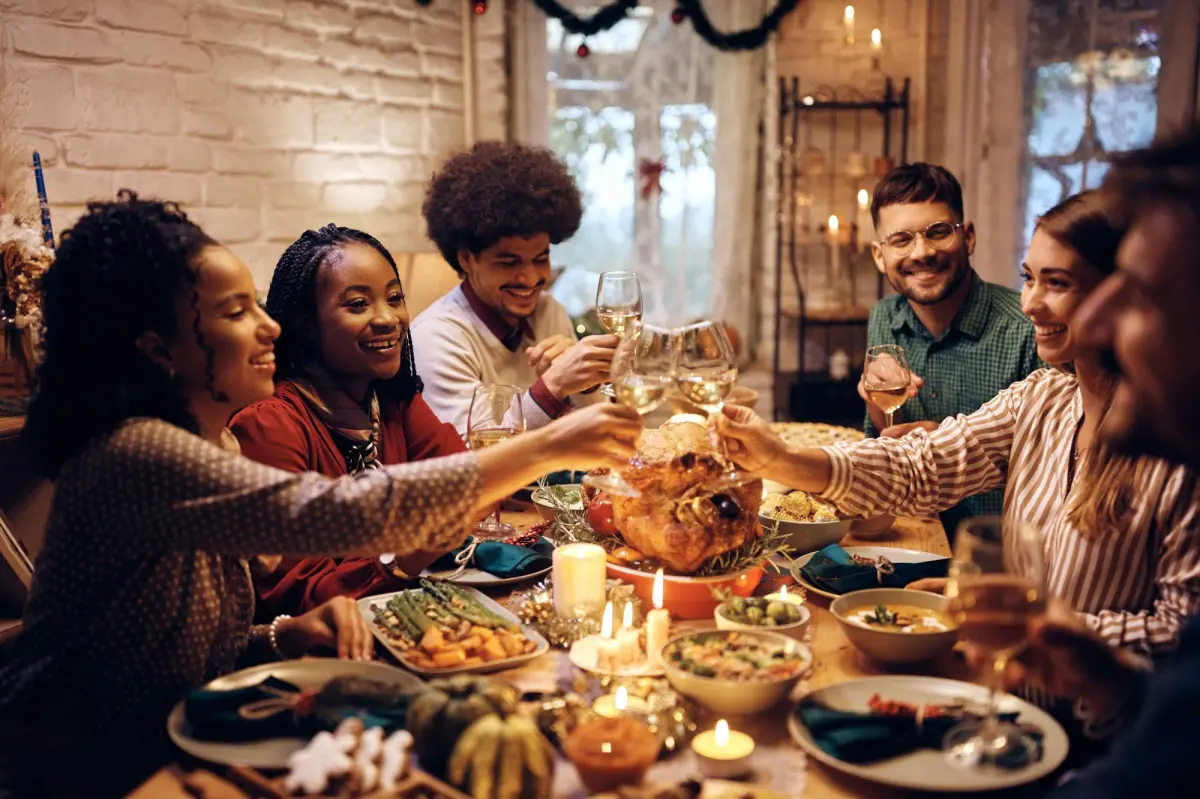
There was a time, not so long ago, when the dinner party felt like a quiet cornerstone of American social life—the invitation, the extra chairs pulled around the table, the clinking of glasses and overlapping conversations that stretched late into the evening. Opening your home to friends and family was a normal, expected way to stay close to the people you cared about. But that era seems to be fading. A new analysis from Data for Progress has found that only 67 percent of Americans said they entertained people in their homes at least once over the past year, a sharp drop from the 88 percent who said the same in 1995. Even more striking, The Atlantic reported, the share of Americans who host friends or family at home at least once a month has plummeted from 42 percent in 1975 to just 12 percent in 2026. The think tank compared its own recent survey with the older one and cautioned that the two used different methods, so the numbers are more a signal of a powerful trend than a precise scientific measurement. Still, the direction is unmistakable: fewer of us are opening our doors, pulling out the good dishes, and making room for one another. It is not a sudden collapse—it is a slow, creeping disappearance, driven by the very texture of modern life.
One of the biggest reasons for the decline is simple exhaustion. After a long day of work, commuting, childcare, and the endless small emergencies of daily life, the idea of hosting can feel less like a pleasure and more like another obligation. There is a reason the dining room table sits unused and the good napkins stay folded in the drawer: by evening, many people simply have nothing left to give. Florida-based psychotherapist John Puls told Fox News Digital that people working multiple jobs to make ends meet often feel burned out, and they do not have the same level of “social battery” they once did. Shebna N. Osanmoh I, a board-certified psychiatric nurse practitioner in California, put it in even more human terms: when you’ve spent the whole day working and taking care of your kids, hosting people can seem like just another task to complete, even though you’d genuinely love to see them. The emotional weight of that contradiction is real. You remember how good it feels to have friends around, but the thought of cleaning, cooking, and coordinating schedules can drain the joy right out of it. The Atlantic also noted that with more women working, the social schedules they traditionally maintained—from birthday parties to neighborhood potlucks—have frayed. For generations, women were often the ones who held the thread of community together, sending invitations, remembering dietary restrictions, and making sure the house felt welcoming. Now that thread has snapped, not because women stopped caring, but because there are only so many hours in a day, and the unpaid labor of connection often ends up at the bottom of the list.
Even when people do find the energy, many are paralyzed by expectations. We live in an era where every moment can be photographed, filtered, and shared with a wider audience than the actual guests. So the pressure to make a gathering picture-perfect is enormous. Wildaliz Caro, a licensed clinical psychologist in Puerto Rico, explained that high expectations clash with what people can realistically manage, making hosting feel stressful rather than enjoyable. Trying to plan the perfect gathering can fuel a need to impress others—the perfectly styled table, the flower arrangement, the meal that accommodates every allergy and preference while still looking effortless. The Atlantic noted that accommodating all those preferences and dietary needs only adds to the pressure. And of course, none of this comes cheap. With grocery prices still climbing, feeding a group of people can make even a casual get-together feel like a luxury. Daniel Schatz, a political scientist and former visiting scholar at Harvard, Stanford, and Georgetown, told Fox News Digital that rising housing costs and smaller living spaces make hosting feel financially and practically harder. Many people live in apartments or homes without a large dining area, and the simple act of inviting eight or nine people over can feel like a logistical puzzle. When you combine the emotional pressure, the physical effort, and the real financial cost of putting food on the table for a crowd, it becomes easy to understand why so many choose to simply not host at all.
The decline of the dinner party is also tied to something deeper and more painful: many of us simply have fewer friends to invite. Data for Progress found that the share of Americans with five or more close friends dropped from 63 percent in 1990 to just 38 percent in 2021. That is a staggering loss of social connection in the span of a generation. Americans spend more time alone, report fewer close friendships, and participate less in the kinds of local institutions—churches, clubs, community organizations—that once created regular, natural social contact. Schatz warned that younger adults, people living alone, lower-income households, and those without strong social networks are most affected. And the stakes of this isolation are serious. In 2023, the U.S. surgeon general issued a formal advisory describing loneliness and social isolation as an epidemic, with consequences for both mental and physical health. Puls added that declining friendships can contribute to depression, anxiety, and social isolation. He says he sees this trend most often among younger generations, while Gen Xers and baby boomers still commonly gather in person. There is something heartbreaking about that divide: older generations still remember what it feels like to sit around someone’s kitchen table, while younger adults are navigating a world where the table is empty, the chairs are folded, and the phone is always within reach. The dinner party was never just about food; it was a way of saying “you matter to me” in a physical, unmissable way. And when that ritual disappears, so does some of the glue that holds communities together.
The fifth reason is perhaps the most universal: screens have made staying in almost too easy. Puls said that adults are more inclined to stay home and stream movies and television shows instead of hosting friends and family or going out. There is a comfort in the couch, the blanket, and the endless queue of recommendations. There is no need to vacuum, no need to worry about whether anyone will like the food, no need to do anything but watch and scroll. Schatz captured the contrast perfectly: a dinner party requires planning, cleaning, coordination, and a degree of social energy, while streaming or scrolling requires none of those things. It is effortless, and effortlessness is deeply seductive, especially at the end of a long week. But there is a cost. The same technology that connects us to entertainment also makes it easier to avoid the messy, imperfect, unpredictable pleasures of being with other people in person. A text message replaces a phone call; a “like” replaces a hug; a group chat replaces a conversation that happens in real time. We tell ourselves we are staying connected, but we are often simply watching other people’s lives from a safe distance. The screen asks nothing of us and gives us the illusion of company. Meanwhile, the real friendships that require patience, vulnerability, and presence quietly fade. The dinner party was one of the most human ways we had to push back against that drift, to be physically together, to share a meal and look one another in the eye. It is hard to overstate what we lose when that becomes rare.
But there is hope, and it lies in lowering the bar. Experts say the remedy need not be elaborate, and that is perhaps the most comforting part of the message. Schatz put it simply: the most realistic response is to lower the threshold for gathering. A simple coffee, a takeaway meal shared in the kitchen, a neighborhood walk, a recurring “come as you are” evening. It does not have to be a five-course dinner with hand-lettered place cards and a perfectly roasted bird. It can be a pot of soup, a bag of groceries, a stack of paper plates. The point, Schatz said, is not to revive the perfect dinner party; it is to rebuild the ordinary habits of seeing one another. That means letting go of the idea that hosting has to be a production, and remembering that the real gift is presence, not perfection. It means accepting that the house might be messy, the food might be simple, and the conversation might meander. It means inviting someone over for no occasion at all, just because the week has been hard and you are tired of being alone. We do not have to return to the dinner party days of 1975 to be connected. We just have to start saying, “Come over,” without waiting until everything is perfect. The first step can be as small as asking a neighbor for coffee, texting an old friend for a walk, or starting a standing weekly gathering where everyone brings whatever they can. It will not happen overnight, and it may feel awkward at first. But the human need to sit beside one another, to share food and laughter and even silence, has not gone away. It is still there, waiting just behind the front door. All we have to do is open it.