


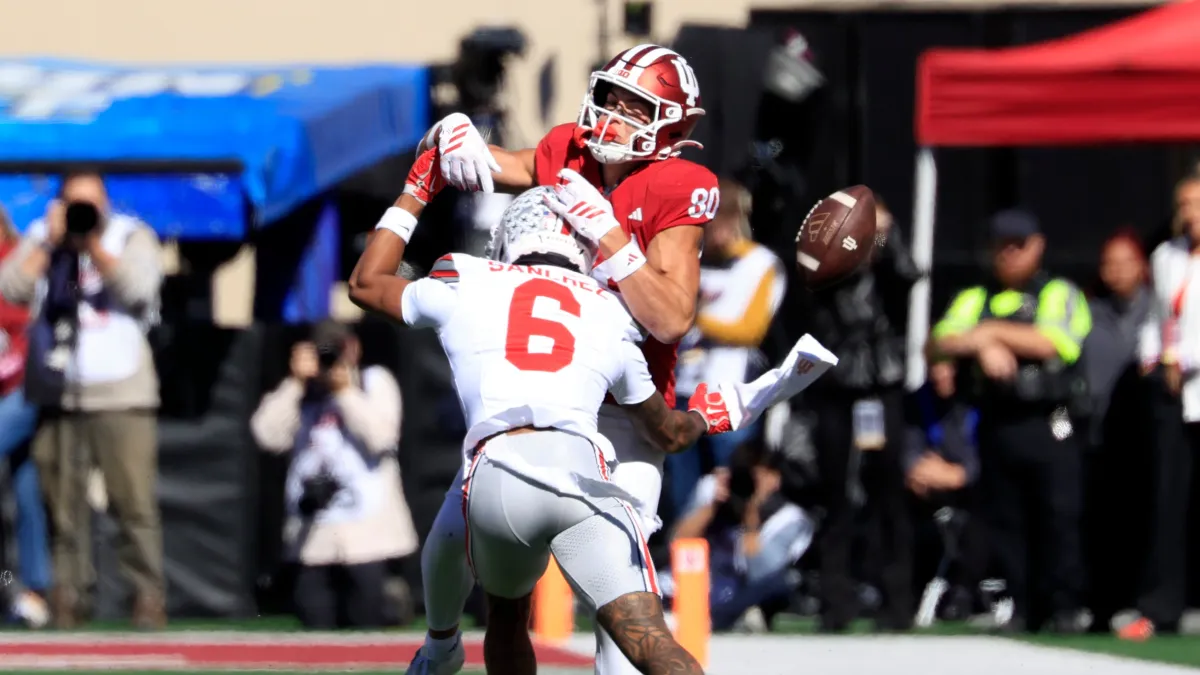
Saturday was supposed to be another chapter in a dream season, but it ended in a way Indiana had almost forgotten. The Hoosiers lost for the first time in 666 days, a stretch of nearly twenty-two months in which every Saturday had ended in celebration. For that long, the streak had become more than a statistic. It was a badge of identity. It told fans that this program had turned a corner, that those old days of frustration were gone, that losing was a thing their team no longer did. When the final whistle sounded, the reality settled over the field like a heavy rain. Players stood for a moment, as if waiting for an official to reverse the result, then began drifting toward the tunnel. There was no panic, no shouting, just the strange silence of a team unaccustomed to failure. Some kept their helmets on, hiding their faces from the cameras. Others pulled them off and stared at the grass, unsure where to put their eyes. The majority wanted to be alone. They wanted to feel the emotion in their own chests before anyone else could see it. In college football, losses are public, but grief is private. The celebration on the other side made the moment even harder; Ohio State players were hugging and laughing, and the contrast cut deep. So, one by one, the Indiana players disappeared, leaving the noise behind them. Charlie Becker, however, did not follow. He had a different kind of weight pressing on him, one that had nothing to do with the game’s result. He turned away from the Indiana sideline and moved directly toward the Ohio State coaching staff. The move was quiet, almost unnoticed amid the chaos. But it would become one of the most telling moments of the afternoon—a small, unplanned act that had nothing to do with touchdowns or tackles and everything to do with who Charlie Becker really was.
To understand what was happening in Becker’s head, you have to rewind to last season’s Big Ten Championship Game. That night was everything Indiana had worked toward, a mountaintop moment that came after years of climbing. The trophy ceremony was loud, chaotic, joyful. Players and fans were celebrating together, and Becker, a wide receiver with a big smile and an even bigger pulse, got swept up in the emotion. From a stage, he started an “O-H-F-U” chant. It was childish. It was crude. It was exactly the kind of thing that looks like a harmless joke in the heat of celebration but feels different in the cold light of the next day. To Ohio State fans, the chant was a direct attack on their school, their program, and their identity. They did not find it funny. They stored it away in the mental bin where rivalries keep their sharpest edges. Some of the players on that Ohio State team heard it too. They may have brushed it off at first, but as this week’s game approached, it resurfaced. A few of those players mentioned it. They reminded Becker, maybe in interviews, maybe in practice chatter, maybe simply by the way they looked at him during warmups, that they had not forgotten. To them, it was bulletin-board material, a small piece of disrespect to carry onto the field. To Becker, it was a gut punch. He realized that what he had intended as a bit of celebration had been received as an insult by people he respected. The realization did not make him defensive; it made him ashamed. And he decided that the only way to fix it was to face the person at the top of the Ohio State program: head coach Ryan Day. Not a statement. Not a post. Not a carefully scripted apology released through a sports information department. A face-to-face apology, made without a microphone, on the same field where his team had just been beaten.
After a game like that, most players avoid the opposing sideline unless they know someone. Losing skips the formalities. The winning coach is surrounded by happy players, security, and staff; the losing coach is already trying to keep his team together. It is the last place anyone wants to go. Becker went there anyway. He made a beeline for Ryan Day and, when he got there, he did not mince words. According to video of the exchange, he said, “That’s not who I am and I’m sorry for doing that.” The sentence is remarkable in its simplicity. There is no “but.” There is no “you know, emotions were high.” There is no “I hope you understand.” There is only an admission of fault and a request for understanding. Becker was not apologizing for winning; he was apologizing for, in a moment of celebration, turning a rival into a target. He was apologizing for the chant, for the profanity, for the disrespect, for making a championship trophy feel less like a celebration and more like an insult. He was saying that the version of himself on that stage was not the version he wanted to be. It takes a certain kind of courage to apologize to a coach who just spent three hours trying to beat you. It takes even more courage to do it on a day when your own heart is still heavy. Ryan Day could have turned away. He could have dismissed Becker as someone just trying to smooth things over. But the fact that Becker made the journey at all is a sign that he understood something deeper: an apology is not about whether the other person forgives you; it is about whether you are willing to own the mistake. Becker was willing. And in doing so, he did something many players never manage to do—he left the field with his conscience clear.
Some fans might see this and think it is no big deal. They might say that a silly chant is inconsequential compared to the real rivalries in sports. But the context mattered. Ohio State fandom, as the report noted, took more offense than the team did. That is not unusual. Fan bases collect grievances the way players collect stats. They remember. They bring up the chant in replies and radio call-ins. They use it to paint an entire program as arrogant. For a player, that can be exhausting. But Becker did not need to appease fans. He needed to address the people who stood across from him on the field. A few players from last year’s Buckeye squad had mentioned the chant in the lead-up to this game. They had, in effect, told Becker that his actions had staying power. It would have been understandable to laugh it off, to say “that’s just rivalry stuff.” It would have been understandable to blame the culture of college football, to say every player has said something they regret. But Becker took it seriously. He understood that the insult did not exist in a vacuum; it was directed at a team that had done nothing to him except compete. He also understood that an apology after a loss is worth more than an apology after a victory. Nobody can accuse him of being self-serving. He did not humble himself to celebrate something; he humbled himself in the middle of disappointment. That is the definition of accountability. It is also a reminder that sports are played by human beings, not just jerseys. The people on the other sideline have feelings. Coaches have mothers. Players have memories. A small moment of disrespect can linger long after the trophy is put away. Becker learned that the hard way, and instead of carrying the lesson privately, he responded with decency. He did not wait for someone to force his hand. He did not wait for a formal fine or a public scolding. He did it on his own, at the worst possible moment, which may be exactly why it meant so much.
Let’s pause for a moment and think about what it means to be a college athlete. You are conditioned to be fierce. You are taught that mental weakness is a loss, that regret is a trap, that you must move on quickly to the next play. In that culture, saying “I’m sorry” can feel like surrender. That is why Becker’s gesture is so striking. He did not let the pressure of the moment imprison him. He did not worry that apologizing to Ryan Day would be seen as a sign of weakness. He cared more about making things right than about preserving his pride. In a way, his detour across the field was the strongest thing he could have done. It showed that his character was larger than his ego. It also showed that he was thinking about someone else’s feelings at a time when almost everyone on the field was focused on their own disappointment. The majority of his teammates went off by themselves to grapple with an unfamiliar loss. Becker went off by himself too, but not to hide. He went to do the one thing that would make the memory of last season less ugly. There is a reason the video of the conversation was quickly shared and praised as “classy.” It is because we are not used to seeing genuine humility in big-time college football. We are used to excuses, to deflections, to athletes who would rather be right than be a better person. We are used to rivalries that make people deaf to accountability. But here was a young man who understood that respect matters more than revenge, that a rivalry does not have to be cruel, and that the people you compete against are not your enemies. They are simply opponents. And to opponents, the right response, even after a loss, is honor. That kind of thinking is not taught in many locker rooms. It comes from somewhere deeper, from the kind of character that shows up when the cameras are not watching and the game is already over.
At the end of the day, the Indiana Hoosiers’ streak is over. There will be debates about what went wrong, what could have been different, whether the 666-day run meant anything in the larger scope of the program’s rise. All of that matters, because football is a game of results. But on a human level, Saturday belonged to Charlie Becker just as much as it belonged to the team that won. His two sentences to Ryan Day will not show up in the box score. They will not be replayed on the recruiting trail. They may not even be remembered by most people by the time next season rolls around. But they should be. Sports are full of moments that reveal character, and this was one of them. In a game where winning is the only thing, a young man walked over to the losing end of a rivalry, swallowed his pride, and said, “That’s not who I am.” And by saying it, he made it true. The Hoosiers lost, but they did not lose their dignity. The chant was not the last word; the apology was. That is a lesson worth keeping long after the score is forgotten. It is a reminder that an athlete can be a competitor and a decent human being at the same time. It is proof that accountability, not rage, is what ultimately defines a person. Charlie Becker made one mistake. Then he made things right. There are worse ways to be remembered, and there are few better ways to be forgiven.